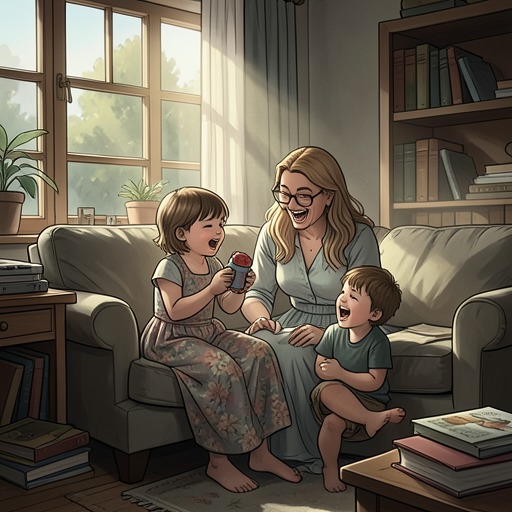
Hannah Keeley–Kyler Keeley mother-son relationship
Crazy Mama: 9 Steps to a Not-So-Normal LifeThe mother-son relationship between Hannah Keeley and Kyler Keeley is presented through comic domestic scenes in which care and authority continually meet ordinary resistance. Hannah tries to teach, protect, and direct her son, but the anecdotes also let Kyler answer back and expose the limits of her authority. Their exchanges make the relationship feel affectionate without making it frictionless: the mother gives advice, the son challenges it, and both become part of the joke.
A Driving Lesson Reversed
On a summer trip to the store for groceries, Hannah drove along a rural country road with Kyler, who had received his learner’s permit only a month earlier. She used the ride to give him driving advice, including checking the side mirror, rear-view mirror, and the space over his shoulder before changing lanes. Kyler’s reply that he already knew this set a lightly resistant tone: the lesson was welcome only up to a point.
Hannah then turned to the danger of looking away from the road. She pointed out a deep ditch beside them and told Kyler to keep his eyes on where he was going rather than on either side. As she looked toward the ditch to illustrate the risk, the car veered off the road and ran into it. The demonstration became an accidental enactment of the very mistake she had just described. Kyler dropped his phone, grabbed the dashboard with both hands, and shouted to his mother; the car tilted into the ditch, leaving them both silent with fear.
When the silence broke, Kyler challenged the lesson’s method: “Seriously?” he shouted. “You couldn’t just tell me? You had to give me a demo?” Hannah was still clutching the steering wheel, her heart in her throat. The exchange turns a parent’s instructional confidence into a shared mishap: Kyler is not merely the novice being taught but the witness who can point out that his mother has failed to follow her own advice. Hannah says she considered herself an excellent driver and never swore, yet the emergency nearly brought out an expletive that she remembers as “shitooo.” Her self-mockery keeps the episode from ending as a stern lecture; the mother’s embarrassment becomes part of their exchange.
The Morning Routine and the Words Kyler Wants
Hannah’s account of waking her children sketches the household rhythm around her relationship with Kyler. On Saturday, she might rise around 7:30 in the morning while her teenagers slept until about one in the afternoon. On school days, she describes a three-stage campaign: a song and lights, then a threat to sing again, and finally louder emergency tactics, including a drum set or a vuvuzela. The exaggerated routine establishes a mother who keeps escalating her efforts to get her children moving, even when her usual tactics fail.
On one such day, repeated attempts did not get Kyler out of bed. He eventually stumbled into the kitchen while Hannah was making what she could not decide was breakfast or lunch. His hair stuck out in every direction, his eyes were half shut, and his face looked pale and greenish. Speaking in a raspy voice, he told her, “Mama,” and then, “I feel terrible.” The details make his entrance look less like a teenager simply refusing to rise and more like someone who feels genuinely unwell, though the account does not resolve that distinction.
Hannah’s response came from her stated belief in the power of words: she regarded speech as a confession of faith that could work for or against a person. Rather than contradicting Kyler, she agreed with his confession. Kyler then explained that he had been addressing the imagined mother in his head—the one who would give the response he wanted and say, “Oh, baby, I’m so sorry.” His retort identifies a familiar gap between Hannah’s chosen response and the sympathy he hoped to receive. The scene makes their humor reciprocal: Hannah turns his statement into a lesson about words, and Kyler turns her answer into a joke about the motherly comfort she did not provide.
Kyler Among His Siblings
Kyler is the oldest of Hannah’s three sons, positioned between two older sisters and two younger sisters who, in Hannah’s joking account, all love to boss the boys around. She presents the sons as superheroes who could withstand that pressure, recalling their childhood play in the woods: climbing trees, running at super speed, and pretending to lift cars. The recollection places Kyler within a lively sibling group rather than isolating him as the subject of a single mother-son episode.
As the boys settled into distinct play identities, Kyler became Mighty Man, whose defining ability was super strength. His middle brother became Rubber Boy, able to stretch to incredible lengths, while the youngest son still had to choose a character. Hannah’s description of Kyler’s role links her to his imaginative life: she remembers not only the title he adopted but the talent attached to it. The superhero play is part of a broader family portrait in which the boys’ powers are inventions of childhood, while Hannah’s narration treats those inventions with amused affection.
A Relationship Told Through Everyday Scenes
Across these episodes, Hannah’s maternal role takes different forms. On the road, she gives practical safety instruction and then becomes the driver who makes the mistake. At home, she manages the repeated work of getting children out of bed, but Kyler’s imagined alternative response shows that he has his own clear sense of what he wants from her. In the woods, she observes and recounts the boys’ play, preserving Kyler’s place in the family’s shared world.
The relation is therefore defined less by a single turning point than by recurring exchanges: instruction met with a retort, danger followed by a joke, and a claim of distress answered in a way that prompts further teasing. Hannah’s stories let her appear as both caregiver and comic participant, while Kyler is allowed to challenge her, startle her, and make his preferences known. The book offers these moments as snapshots rather than a complete account of their lives, but together they show a mother-son bond made visible in the practical, awkward, and playful details of family life.