Meeting of Baran and the Donkey
Crazy Mama: 9 Steps to a Not-So-Normal LifeBalaam and the donkey is a biblical episode retold as a warning about compromise: while Balaam is fixed on the rewards offered by Balak, his donkey recognizes the danger ahead and tries to turn them away. The reversal is the story’s decisive force. The prophet who claims to heed God cannot see the Angel of the Lord standing in his path, while the animal he beats can; when God finally gives the donkey a voice, her obedience is shown to have protected the very master who punished her.
Background and the Choice to Go
Balaam is introduced as a prophet with a genuine regard for God, but also as someone vulnerable to worldly desire. The narrator describes him as a powerful figure whose blessings and curses carry weight. Balak, king of Moab, fears the Israelites, who have arrived near his territory after conquering kingdoms, claiming land, and growing in number. Believing Balaam’s curse could remove the threat, Balak sends messengers to ask him to curse them.
The first delegation arrives bearing gifts and inducements. Balaam does not give an immediate answer; he lets the visitors stay overnight so that he can consult God. God’s instruction is unambiguous: Balaam must not go with them or curse the Israelites, because they are blessed. In the morning, Balaam sends the delegation back. At this point, his response appears to match the command he has received.
Balak tries again, this time sending more numerous and more honorable princes. Their offer includes great honor and whatever reward Balaam might request. Balaam answers that even a house full of silver and gold would not allow him to go beyond God’s word. Yet he makes room for the temptation to continue: rather than dismissing the visitors, he asks them to stay another night while he consults God again. In the narrator’s reading, the danger lies not in a lack of clarity but in Balaam’s willingness to remain close to the offer after receiving a clear refusal.
The Journey and the Three Obstructions
That night, God tells Balaam that he may go if the princes come to summon him, but that he must do nothing beyond God’s instruction. They do not call on him that night. Balaam nevertheless rises, saddles his donkey, and sets out with the men of Moab without permission. The account presents this departure as the point at which he acts against the direction already given, drawn onward by the promise of wealth and influence.
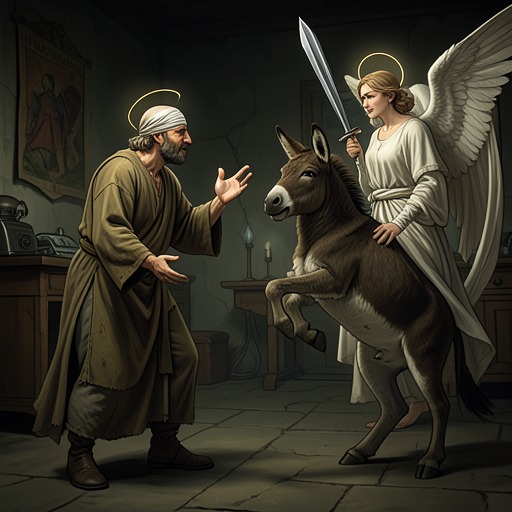
God’s anger is kindled, and the Angel of the Lord stands in the road as an adversary. The donkey sees the angel with a drawn sword and veers off the road into a field. Balaam, unable to see what has frightened her, strikes her to force her back onto the way. The first obstruction therefore reverses the apparent roles: the donkey’s deviation is an act of perception, while Balaam’s attempt to correct it reveals his blindness to the danger.
The angel appears again along a narrow path through vineyards, with a wall on each side. The donkey presses against one wall, crushing Balaam’s foot, and he strikes her again. Farther on, the angel stands in an even narrower place, where there is no room to turn either right or left. The donkey falls beneath Balaam, and he beats her with his staff. The repeated encounters intensify the pressure: first the animal leaves the road, then she traps Balaam’s foot against a wall, and finally she can go no farther and collapses. Each time Balaam responds with more force, although the donkey is responding to a threat he cannot see.
The Donkey Speaks and Balaam Is Exposed
After the third beating, God opens the donkey’s mouth. She asks Balaam what she has done to deserve being struck three times. The narrator punctures the gravity of the scene with a comic association: having watched Shrek, she cannot read the passage without imagining the voice of Eddie Murphy. The humor makes the extraordinary event vivid without changing its function. The donkey’s speech interrupts Balaam’s violence and forces him to answer the creature whose warnings he has mistaken for stubbornness.
The Angel of the Lord then speaks directly to Balaam and asks why he has struck the donkey three times. The angel explains that he came to oppose Balaam because his behavior was willfully obstinate and contrary to God. The donkey had seen the angel and turned aside on all three occasions. Without her actions, the angel says, Balaam would have been killed while the donkey was spared. The disclosure changes the meaning of the journey’s delays: what Balaam treated as obstruction was protection, and the animal he punished had been the one standing between him and death.
Meaning and Narrative Emphasis
The episode becomes, in the book’s exposition, a lesson about obedience under the pressure of reward. Balaam knows God’s instruction but allows the princes, their promises, and the possibility of riches to remain within reach. The narrator compares compromise to a gradual spiral: a person may imagine that he is only going to investigate an opportunity, yet small departures from conviction can lead farther from the path one means to follow. Balaam’s failure is not portrayed as ignorance of the command but as a willingness to proceed without it.
The donkey’s repeated turns also give physical shape to the teaching about a narrow way. The vineyard walls and the final passage with no room to move make the road constricted in literal terms; the narrator reads that pressure as an image of the difficulty involved in following God’s direction. In this interpretation, hardship may halt or redirect someone before a destructive choice can run its course. Balaam sees the animal’s resistance as the problem because his attention is fixed on the promised gains; the donkey’s sight, by contrast, makes her resistance an act of integrity.
The ending places divine protection on the side of the repeatedly beaten animal. God not only enables her to speak but also explains that her actions have preserved Balaam’s life. The narrator draws from this reversal the claim that God can use those who obey even when their actions are misunderstood, and that integrity may protect others who depend on them. The encounter closes not with Balaam’s reward or the completion of his journey, but with his conduct exposed and the donkey vindicated: the apparent fool has seen clearly, and the celebrated prophet has been unable to recognize the danger in his own path.