Moab
Crazy Mama: 9 Steps to a Not-So-Normal LifeMoab is introduced as the kingdom ruled by Balak, whose fear of the advancing Israelites turns the territory into the center of a campaign against them. The Israelites have overtaken kingdoms, claimed territory, and grown in strength before settling on Moab’s outskirts, effectively at Balak’s doorstep. Moab therefore functions as a threatened political space: Balak sees the Israelites not as neighbors but as an overwhelming force that may destroy his security and authority.
Setting and Political Threat
Moab’s narrative importance comes from its position on the edge of Israelite expansion. The Israelites have moved through surrounding kingdoms with striking success, and their arrival near Moab causes Balak to fear that his own land will be next. His response is not military confrontation alone. Instead, he seeks a spiritual weapon by appealing to Balaam, a prophet whose blessing and curse are believed to carry extraordinary power.
Balak’s anxiety is expressed through the request that Balaam curse the Israelites so that Moab might defeat or drive them from the land. The episode thus presents Moab as a place where political power, fear, wealth, and religious authority converge. Balak attempts to solve a territorial crisis by purchasing the services of a prophet, treating divine blessing as though it could be redirected through royal influence.
Balak’s Appeal to Balaam
Balak sends messengers from Moab to Balaam’s house carrying gifts and promised advantages. Their mission is designed to entice Balaam to come and curse the Israelites. Balaam initially responds cautiously, asking the visitors to remain overnight while he consults God rather than giving an immediate answer. This pause establishes the central conflict associated with Moab: the pressure exerted by visible rewards against the clarity of divine instruction.
God tells Balaam that he must not go with Balak’s representatives or curse the Israelites, because they are blessed. Moab’s intended curse is therefore placed in direct opposition to a blessing that does not originate with Balak, Balaam, or any human authority. The land’s danger is real within the story, but the Israelites’ status is presented as protected by God’s word.
Escalation and the Test of Compromise
Balak refuses to accept the first refusal. He sends a second delegation, larger and more honorable than the first, including noble princes and a promise that Balaam will receive very great honor and whatever he requests. The increased status of the messengers and the scale of the proposed reward reveal how Moab’s pressure intensifies: when ordinary influence fails, royal prestige and material wealth are brought to bear.
Balaam declares that even a house filled with silver and gold could not authorize him to go beyond the word of the Lord. Yet he makes a consequential mistake by allowing the delegation to remain and by seeking another consultation after God’s prohibition has already been made clear. The continued presence of Moab’s representatives gives wealth and promotion time to compete with obedience. The narrative treats compromise not as a single dramatic surrender but as a gradual weakening produced by prolonged exposure to attractive rewards.
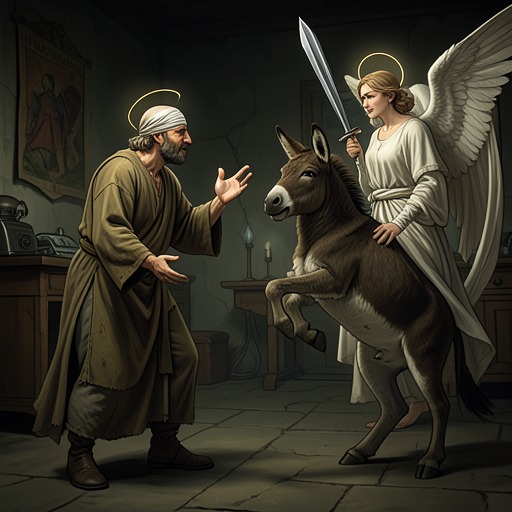
That night, Balaam receives permission to go only on the condition that he do nothing without God’s direction. The representatives do not call for him, but Balaam nevertheless rises, saddles his donkey, and travels with the men from Moab without God’s permission. Moab consequently becomes the setting for a decisive distinction between hearing a command and submitting to it. The journey begins not because the divine instruction changed, but because Balaam allowed the promised rewards to reshape his response.
Narrative Significance
As a location, Moab embodies the wide and tempting path that competes with the narrow path of obedience. Its king offers honor, wealth, and influence, while God’s command requires Balaam to refuse a profitable assignment. The territory is therefore associated with pressure from the outside world, but the deeper conflict takes place within Balaam, whose desire for the rewards connected to Moab makes a clear command appear negotiable.
Moab also sharpens the book’s larger claim that blessing cannot be overturned by hostile circumstances or purchased by political power. Balak seeks to use Balaam against the Israelites, but the stated divine verdict remains that the Israelites are blessed. In this sense, Moab represents an environment of threat without possessing final authority over the people it fears. Its king can summon messengers, display wealth, and promise promotion, but he cannot rewrite God’s word.
The episode ultimately uses Moab to connect location with moral choice. The kingdom is not developed as a landscape through detailed description; it is defined through Balak’s fear, his repeated attempts to recruit Balaam, and the material inducements attached to the mission. Moab’s lasting function is thus symbolic and dramatic: it is the place from which opposition is organized and the place where Balaam’s resolve is tested by the glitter of compromise.