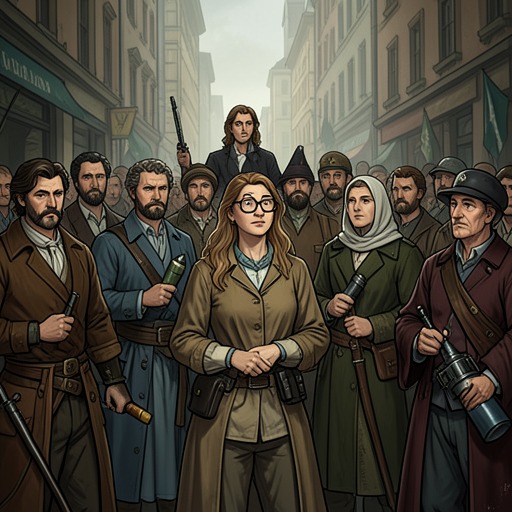
Nonconformity
Crazy Mama: 9 Steps to a Not-So-Normal LifeNonconformity is the book’s refusal of two different molds: the crowd’s compromised standards and the private fantasy of becoming someone else. It asks readers to live distinctively, pursue righteousness, and trust the abilities and character they have been given. Its central claim is that imitation diminishes both the person doing the imitating and the people who might have benefited from that person’s genuine gifts.
Identity and Purpose
The argument begins with difference as a source of value, not a problem to correct. Children can look at the same unusual pair of pants and imagine entirely different costumes; the anecdote makes individuality concrete before extending it to adults. The book presents each person as an original whose particular gifts matter to the wider world. Conformity, in this account, is more than adopting familiar habits: it can conceal a person’s capacities and deprive others of what that person alone can contribute.
This account of authenticity is explicitly religious. The Creator is understood to have made people distinct for a reason, and the life intended for them exceeds the limited possibilities offered by ordinary expectations. Accordingly, becoming oneself is not framed as mere self-expression or permission to follow every impulse. It is a response to divine purpose: a person becomes more fully useful by living in keeping with the design and abilities already present, rather than treating another person’s identity as a template.
Standards, Grace, and Abundance
The book describes conformity as attractive because it feels safe. A person who blends in is less likely to be treated as strange, while resistance can invite labels such as fanatic or lunatic. But the comfort of fitting in can come at a cost: social standards may settle at what the author calls the lowest common denominator, far below what people might become. In contrast, divine purpose is associated with abundance, so accepting the crowd’s limits can mean settling for less than one’s potential.
That challenge does not mean rejecting moral boundaries. The discussion invokes Romans 12:2 to distinguish being shaped by the age from being transformed through a renewed mind. It also cautions against turning resistance into self-righteous condemnation. Everyone is described as sinful, and freedom and forgiveness are attributed to grace; the appropriate response is therefore to pursue righteousness with humility. The book holds together acceptance of people and refusal to approve of conduct it regards as sinful. Its Philippians-based “Phlip Test” offers a practical standard for what a family allows into its eyes, ears, and minds: truth, honor, justice, purity, loveliness, kindness, virtue, and excellence.
Righteousness, however, is not presented as a checklist that exhausts the meaning of a nonconforming life. The book names ordinary practices such as refusing gossip, attending church, praying before meals, giving to charity, and sponsoring a child in Uganda, but warns against becoming content with goodness alone. Its further demand is movement: growth, boldness, and an expanding trust in what a person might do. Boundaries are described not as restrictions intended to make life dull, but as conditions that open the way to blessing. The desired alternative to conformity is therefore neither rule-breaking for its own sake nor complacency within familiar religious routines, but a life that joins moral seriousness to abundance.
Biblical Examples and the Cost of Standing Apart
David supplies a vivid example of nonconformity expressed through action. In the story, he is selected as a future king despite appearing small and inexperienced; the decisive measure is the heart, not outward stature. Later, while the country celebrates victory, he removes his robes and dances in the street wearing an ephod. His wife condemns the spectacle as embarrassing and unbecoming a king. David’s response, as the book presents it, is that he is dancing before the divine, not performing for public approval. The scene makes the argument physical: his worship breaks the expectations attached to rank, appearance, and respectable behavior. The author treats his willingness to risk embarrassment as part of his devotion, not as a general instruction to imitate the scene literally.
The account of the scouts sent to the Promised Land shows the same principle operating as a matter of perspective. Ten see the inhabitants as too powerful to overcome and describe themselves as grasshoppers beside them. Caleb argues that the people should go up and take the land; Joshua shares the minority position. The book emphasizes that, among the twelve scouts, only Joshua and Caleb enter the Promised Land. Their contrast with the ten illustrates how conformity to a fearful majority can close off a promised future, while a different outlook can support action toward it.
The Struggle to Accept an Original Self
Personal recollections give the principle a less triumphant and more costly dimension. The author remembers being placed in special-needs classes and imagining that school officials had discovered she was unintelligent. In fact, her father had asked for testing to determine whether she qualified for those classes. The results moved her into advanced studies; her grades rose from Ds and Fs to As and Bs, and she later became one of the top-performing students at her high school, graduating fourth in a class of twenty-seven. The change did not end the food fights: teachers liked her, while the lunch ladies feared her. The anecdote links an overlooked capacity with the importance of seeing past a premature judgment, then turns that experience into a claim that people may carry unrecognized gifts beneath habits of conformity.
The author also recalls praying to be changed because she did not feel refined or polished. The answer she describes was that her rough edges were not a mistake and that trying to become someone else would deprive both her and the world of what she had been created to be. A scene from Shrek provides a comic parallel: Donkey rejoices when a potion makes him a stallion, then droops when its effects wear off; Shrek still sees him as a noble steed. The contrast exposes the instability of acceptance based on appearance. The book argues that the hunger to look or act like someone else can outweigh the desire to fulfill one’s own calling, leaving people frustrated and anxious as they force themselves into a mold that does not fit.
Practice, Opposition, and Fulfillment
Nonconformity also requires choosing work and direction without relying on the crowd’s approval. The book acknowledges that even a churchgoing person may encounter raised eyebrows when religious commitment becomes serious. Pleasing everyone is presented as a warning sign: choosing a narrower path may step on toes, but disagreement need not become a reason to abandon one’s course or lose one’s joy. The instruction is persistence, not provocation for its own sake.
The author connects that choice to her own career. After several attempts to make money fizzled and left financial debt and discouragement, she stopped pursuing income as the primary guide and identified what she loved: studying Scripture, speaking about divine love, and being a mother. Although the family was struggling financially, she chose to spend her time doing that work as though she had the financial freedom to choose. She describes the decision as radical and says that life began to turn around only after she stopped trying to conform. The example makes authenticity practical: it changes how a person allocates effort, even before circumstances become comfortable.
The book’s final appeal casts that decision as a threshold. Like the scouts at the edge of the Promised Land, readers are asked to choose whether fear and the crowd’s assumptions will define what is possible. Nonconformity becomes the act of stepping toward a promise rather than remaining in a middle-school mentality of blending in. Its consequence is framed as reciprocal: living as one’s genuine self allows a person to move toward a divinely intended destiny while giving the world access to the distinct gift that imitation would keep hidden.