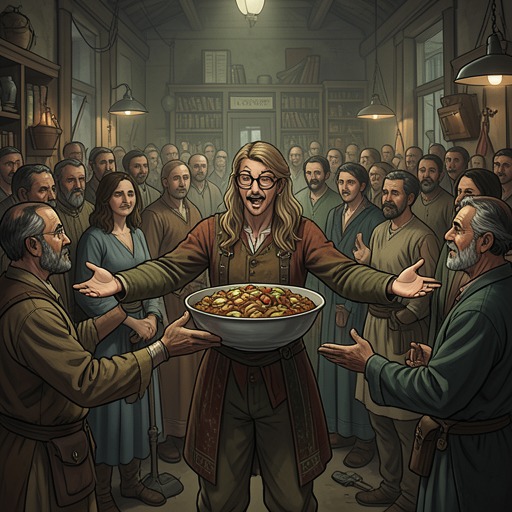
Pipes, Not Buckets
Crazy Mama: 9 Steps to a Not-So-Normal LifePipes, Not Buckets is Hannah Keeley’s metaphor for a life in which blessing circulates rather than accumulates. Its decisive claim is that a person is meant to pass generosity, service, and kindness onward: receiving without giving turns blessing stagnant, while giving makes the person a channel through which further blessing can flow. The image converts a spiritual principle into a household object, then extends it into money, family service, and attention to another person’s needs.
The Image and Its Principle
Keeley introduces the teaching as a law of sowing and reaping. The outcome corresponds to what is planted: sunflower seeds produce sunflowers, watermelon seeds produce watermelons, and planting a dead Christmas tree yields no living tree, however much it is decorated. She invokes 2 Corinthians 9:6 to connect generous sowing with a generous harvest, then applies the rule to conduct: the way to receive blessing is to become a blessing to others.
The contrast between pipes and buckets gives that principle its memorable form. A bucket holds what enters it; a pipe carries it onward. Keeley argues that people are not here merely to collect. When blessing comes in but never goes out, she says, its flow eventually stops. Her metaphor makes accumulation a condition of stagnation, not security, and presents movement and expansion as the proper character of a blessed life.
The Household Pot as Illustration
The teaching grows out of a recurring family nuisance. Keeley’s children make concoctions outside and use her good pots and pans for the experiments. When a pot goes missing, she searches outdoors and finds it filled with mucky sludge, requiring a thorough cleaning before it can be used again. The pot has not become more valuable by holding more; what it has collected has made it foul and temporarily useless.
That domestic scene supplies the distinction between a channel and a container. Keeley compares blessing held back to the sludge gathered in the lost pot: what is meant to move becomes stale when it merely collects. The comparison is deliberately tangible. Rather than treating generosity as an abstract virtue, it gives the reader a missing kitchen pot, a hunt outside, and the unpleasant work of cleaning it as a picture of what happens when resources and care are retained without circulation.
Giving as Practice
Keeley develops the principle beyond money. She warns against clinging to possessions, time, and skill, and against withholding kindness, love, gratitude, or service when an opportunity to give arises. The teaching also reaches into domestic labor: picking up a husband’s underwear or cleaning a child’s kitchen mess can be understood as service offered beyond the immediate recipient. In this account, helping another person is also service to the divine, and the giver should not assume that what is given has simply been lost.
The Golden Rule provides a related formulation: conduct toward others shapes the conduct one receives. Keeley contrasts this with the impulse to put oneself first, which she considers a mistaken route to getting ahead. Generosity is not presented as a decorative extra after success; it is the practice that keeps blessing moving. The corresponding division of responsibility is clear: the person’s task is to bless, while the source of blessing is responsible for its continued provision.
Provision in Ordinary Life
Keeley grounds this confidence in an account of a financially strained period in her family. After they committed themselves to giving and managing money according to the book’s principles, their finances did not transform immediately into surplus. Each month, however, they had enough to meet expenses: they could not splurge, but they also did not sink further into debt. She emphasizes that the change in stress mattered alongside the money; worry and care no longer felt like burdens the family had to carry alone.
She recalls noticing that practical needs were being met as they arose. The cars continued working, appliances did not break down, and clothes did not need replacement. One year, her daughter wanted black high-top tennis shoes for her birthday, but the family could not afford them. Keeley searched for another solution without finding one. Then her sister sent a photograph of a pair of black high-tops, a better brand than Keeley would have considered buying, and asked whether Klara would like them. The sister’s daughter had outgrown the shoes before getting much use from them.
Keeley describes crying as she looked at the photograph on her phone. The emotion, she explains, was not simply about her daughter getting the desired shoes; it was about the thoughtfulness of provision down to a small detail. The episode gives the pipes image a domestic and particular consequence: blessing appears not as a sudden windfall, but as a need being met through another person’s act of sharing.
Love, Circulation, and the Reader’s Role
The chapter also identifies love as especially important among the things a person can sow. On a business trip, Keeley was pleased to discover that a client had booked her in first class. While she was seated with lemon water and a book, she noticed a passenger with a pronounced limp pass by and began praying for her. Keeley then overheard flight attendants discussing the passenger’s difficulty sitting because of pain in her leg. The account begins with Keeley’s comfort and privilege, then turns her attention outward toward someone else’s immediate difficulty; the available episode establishes that act of attention without supplying its resolution.
Together, these examples define Pipes, Not Buckets as both an image and an instruction. Blessing is not meant to be stockpiled until a person feels secure enough to share it; sharing is itself part of the way a blessed life operates. The family’s modest month-to-month provision, the hand-me-down shoes, the kitchen pot, and the airport encounter give the principle different scales, from household habits to spontaneous compassion. Its central contrast remains consistent: a bucket keeps, and a pipe carries. Keeley asks readers to become the latter, allowing what they receive to move through them toward others.