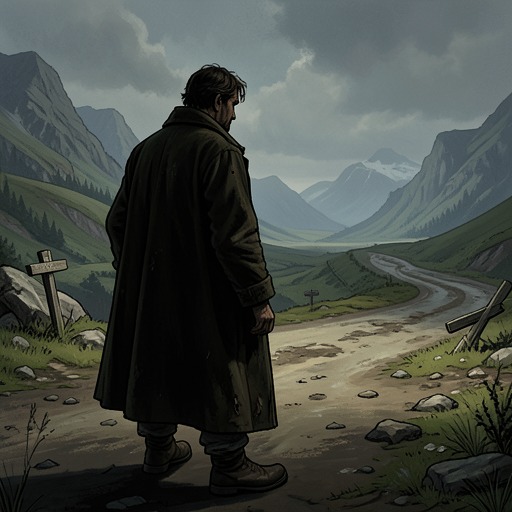
Terah–Abraham father-son relationship
Crazy Mama: 9 Steps to a Not-So-Normal LifeThe Terah–Abraham father-son relationship is framed around an inheritance of vision rather than a narrated exchange between father and son. Before God called Abraham toward the Promised Land, Terah received the same dream of departure. Terah set out but stopped in Haran, where he settled and died; Abraham’s later call therefore follows a paternal story of promise interrupted by bereavement and an unfinished journey.
Family Loss and Inheritance
Terah’s family story is introduced through his firstborn son, Haran, described as his pride and joy. As the eldest, Haran held the position associated with carrying on his father’s name and receiving the inheritance and blessing. His death was thus presented as more than a private bereavement: it also destroyed the future Terah had anticipated for his family. The account stresses this double loss, joining a father’s grief for his son to the collapse of the inheritance bound up with that son’s place in the family.
Abraham enters this story after that rupture. The evidence does not describe a conversation between Terah and Abraham about Haran’s death, nor does it say how Abraham understood his father’s grief. Instead, the relationship is shaped by the sequence of events: Terah’s loss precedes the dream, and the dream precedes Abraham’s own call. That structure makes the family connection significant without supplying unrecorded details about their private life.
A Shared Dream and a Journey
Before God called Abraham to go to the Promised Land, He placed the same dream in Terah’s heart. Terah’s part in the account is active: he gathered his goods, left his hometown of Ur, and set out toward Canaan. The dream is therefore not presented as an aspiration he merely considered. He began the journey that it required, carrying his household and possessions away from the place where his earlier family life had been rooted.
The narrative gives the journey a painful turn when Terah stops in a town named Haran, the same name as his deceased son. The name makes the place inseparable, in the author’s telling, from the loss Terah carried. The account imagines the wound recurring in ordinary acts: saying the town’s name, writing an address, or stepping outside the home would all recall the son whose death had also ended Terah’s expected inheritance. The geographical pause becomes a meeting point between the dream of moving forward and the grief that accompanied him.
Haran and the Unfinished Journey
At Haran, Terah faced a choice as the author interprets it: remain amid his sorrow or gather his belongings and continue toward the dream God had placed in his heart. The account does not say that Terah consciously chose bitterness, or provide a private explanation for his decision to stay. It does state the outcome plainly: according to Genesis 11:31, the family settled there, and the next verse records Terah’s death in Haran. The journey toward Canaan ended without reaching its intended destination.
That ending gives the relationship its central contrast. Terah received the dream and started toward it; the account then turns to Abraham as the person God would later call toward the Promised Land. It does not detail whether Abraham resumed the exact route his father had begun, or describe the circumstances of his response in this passage. What it establishes is a generational pattern: the same dream appears first in Terah’s life and then in the call of his son, while the father’s journey is marked by a stop that the son’s call leaves open as a future possibility.
Narrative Significance
The father-son relationship functions as the hinge between grief and renewed direction. Terah’s loss explains the emotional weight attached to his stopping in Haran, while his initial departure shows that the dream was not absent from his life. The account uses the contrast between setting out and settling to warn against allowing sorrow to become a permanent destination. Terah’s death in the town bearing his son’s name gives that warning a stark conclusion, but it does not erase the earlier fact that he began the journey.
Abraham’s place in this framing is consequently both familial and forward-looking. He is Terah’s son, and he is later called toward the destination associated with the dream first given to his father. Yet the evidence presents no direct exchange, shared decision, or explicit transfer of responsibility between them. Their connection is made through the repeated dream and the difference between Terah’s halted journey and Abraham’s subsequent call. The relationship thus links inheritance not only to what a family hopes to pass on, but also to a direction that remains possible after loss.