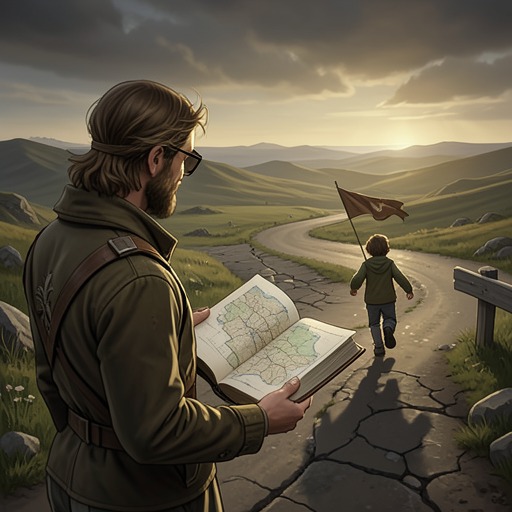
You will go where you're looking
Crazy Mama: 9 Steps to a Not-So-Normal LifeYou will go where you're looking is Hannah Keeley’s expression for the way attention steers both a car and a life. Introduced through a comic roadside mishap, it becomes a principle of directed vision: people tend toward what they keep before them, so present limitations should not determine the future they imagine or pursue.
From Driving Rule to Life Principle
The expression grows out of a drive with Hannah Keeley’s son, Kyler Keeley. Hannah tells him to keep his eyes on the road rather than the sides, using a deep ditch beside the car to demonstrate how a driver can veer toward whatever draws their gaze. As she looks down at the ditch while explaining the danger, the car runs into it; Kyler drops his phone and grabs the dashboard. The lesson arrives through an immediate, unintended demonstration: attention has consequences even when the person steering does not consciously mean to change direction.
Hannah later generalizes the incident into a rule of life. Wherever the eyes go, she says, that is where a person steers, often without consciously choosing to do so. The driving image thus gives the expression its practical force: looking is not merely observing but participating in a direction of travel. The chapter’s question about where a person is looking turns the anecdote into a prompt to examine the future receiving their attention.
Vision Beyond Present Circumstances
The book connects this principle to the claim that vision is necessary for a meaningful future, invoking Proverbs 29:18. It presents vision not as a vague wish but as a future imagined clearly enough to guide action. Hannah’s childhood storm-shelter project illustrates this distinction. At nine, she began digging behind grapevines beside a tool shed, on a neighbor’s property, and recruited neighborhood friends after the work proved more demanding than expected. While they dug, she drew plans for two bedrooms, a dining area, a bathroom, and a reading nook. The shelter was never completed, but she recalls seeing more than a hole in the ground: an imagined structure gave the digging direction.
That example also preserves a tension in the expression. Looking toward a goal can sustain effort, but it does not mean the goal is guaranteed to be completed: Hannah explicitly says the shelter was never carved out. The anecdote supports the value of detailed vision as a motive for continuing toward a dream, without presenting this particular childhood project as a finished success.
The book applies the same orientation to adult circumstances. Financial pressure, conflict among children, and criticism from a spouse are offered as situations that can dominate attention. Hannah argues that readers should look beyond those conditions and imagine a larger future rather than treating present difficulty as the final measure of what is possible. The expression therefore shifts attention away from immediate constraints and toward the direction a person hopes to take.
Identity and the Direction of Attention
The principle also concerns how a person sees the self. In discussing Gideon, Hannah contrasts a diminished self-image with the identity she says God gives: a child of God, endowed with potential and authority. She recalls thinking of herself as just a mom and challenges the tendency to treat a God-given role as inferior by measuring it against worldly standards. In this application, where a person looks includes the standard used to judge personal worth. A focus on perceived deficiency narrows the future; agreement with God’s view is presented as a way to recognize capacities not yet expressed.
The book intensifies that affirmation by declaring readers mighty, full of valor, and able to act beyond their circumstances through God’s strength. It reverses the usual hierarchy between a person and adversity: circumstances are not to be treated as sovereign, because they are described as subject to God. The expression thus works as encouragement and as a redirection of attention—from lack and limitation toward identity, ability, and trust.
Words as a Means of Steering
A further extension links vision to speech. Hannah recounts a long period in which she set goals, divided them into steps, and worked at them, yet felt that progress repeatedly slipped away; one example is gaining $5,000 only to receive a bill for $4,985. She says the course of her life changed when she began speaking her goals aloud, declaring them as though they had already come to pass. The account moves the principle from what a person sees to what a person repeatedly says: spoken words become another way of keeping a desired direction in view.
The chapter introduces this claim through Balaam’s donkey. The donkey’s attempts to stop Balaam do not change the story until the animal speaks; Hannah uses that turn to argue that words have creative power. She asks readers to consider what their words are creating, making speech part of the same forward movement as vision rather than a passive report of circumstances.
From Direction to Supernatural Capacity
In its closing application, the expression joins vision, identity, and ability. Hannah likens the reader to Korben’s superhero character Five and presents the capacity to do what God purposes as something God can work through a person. The superhero image continues the book’s effort to replace an identity defined by limitation with one defined by potential. The expression’s governing metaphor remains directional: attention can fix on obstacles, or it can be trained on a future that calls forth new choices and sustained effort. Its promised destination is not simply achievement, but a life oriented toward what Hannah describes as God-given possibility.