Crazy Vision
Crazy Mama: 9 Steps to a Not-So-Normal LifeCrazy Vision is the book’s first step toward a blessed life: the disciplined act of seeing a future larger than present circumstances and steering toward it. Its central image is a driver who goes where the eyes are fixed. Vision is therefore more than a hopeful idea. It directs attention, shapes choices, and, in the book’s Christian framework, makes room for possibilities that human limits alone cannot produce.
Definition and Governing Image
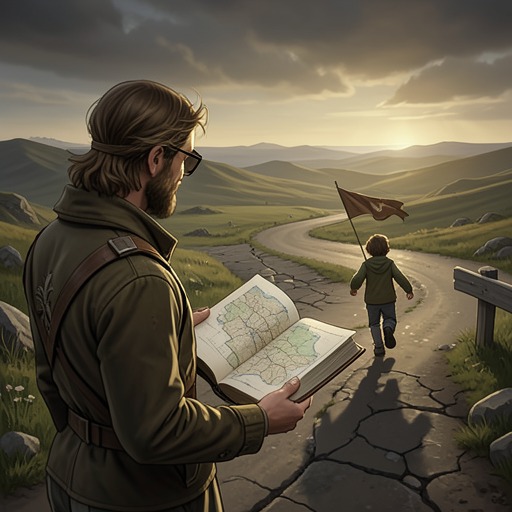
The concept begins with a practical rule drawn from driving: wherever a person looks, that is the direction in which the steering follows. The movement is often unconscious, which makes the principle useful beyond the road. Attention helps determine direction, whether or not the person has deliberately chosen that destination. The author introduces the principle through a summer drive on a rural road with her son, Kyler Keeley, who had received his learner’s permit a month earlier. She was giving him driving advice on their way to the store for groceries; the episode opens the chapter’s larger question of where a person is looking.
The chapter frames vision through Proverbs 29:18, connecting vision with redemptive revelation and obedience. In this account, a person should not treat immediate circumstances as the full measure of what can happen. The alternative is an “unlimited vision”: a future imagined clearly enough to guide present conduct. The book’s repeated contrast is between looking at limitations and looking toward a destination. The first fixes attention on what is presently difficult; the second makes a different course of action imaginable.
Examples of Imagination and Faith
The author argues that many successful ventures began as ways of seeing an opportunity others overlooked. Bill Gates envisioned a personal computer in every household when computers were commonly associated with large corporations. Howard Schultz imagined making coffee fashionable and desirable. Sara Blakely turned a personal frustration with the appearance of control-top pantyhose under white pants into the idea for Spanx: she cut the feet off a pair and wore them under her clothes, then envisioned offering a similar transformation to women more widely. These examples make vision both imaginative and practical: it identifies a possibility and gives someone a reason to act on it.
The chapter’s religious argument goes further than entrepreneurial optimism. It presents large dreams as appropriate when their realization depends on divine help, and cites Ephesians 3:20 in support of the claim that more can be done than a person can presently think or imagine. By contrast, barely-get-by expectations—hoping only to pay rent, for instance, rather than imagining a debt-free home—are described as limiting what a person is willing to pursue. The distinction is not between effort and ease, but between accepting current limits as final and trusting that a larger future is possible.
A Genesis account gives the concept its primary biblical illustration. The patriarch is depicted as older, discouraged, and fearing that he will leave life without children or an inheritance. The account says that the divine promise is at stake, and that he must first receive a vision of what may come. He is brought outside his tent to look at the stars and is told that his descendants will be beyond counting. He believes the promise. For the author, the change in viewpoint matters: remaining inside the tent represents a constricted perspective, while stepping out to look at the stars makes a future beyond present circumstances visible.
Making a Vision Concrete
The author’s childhood storm-shelter project shows how a vivid picture can sustain effort even when the outcome remains incomplete. At nine, she began digging behind grapevines, beside a tool shed, on a neighbor’s property. When the work proved harder than expected, she recruited neighborhood children and promised they could use the shelter in a life-threatening emergency. While they dug, she drew plans for a shelter with two bedrooms, a dining area, a bathroom, and a reading nook. Her neighbors wondered when the hole would be filled in, but she saw a finished shelter rather than an unfinished excavation. She never completed the project, though she came closer than most nine-year-olds would. The episode distinguishes the power of a vision from a guarantee that every imagined outcome will occur: the picture gave direction and helped prolong the work, even without completion.
The chapter draws practical lessons from the shelter. A vision should be held clearly and specified in detail, not left as a vague wish. At the same time, difficulty is expected: the digging became more demanding than anticipated, and the author says it would have been easy to abandon it. She presents supportive companions as part of the work, especially people willing to take up shovels rather than dismiss a dream. The neighbors’ ridicule and the inconvenient location sharpen the contrast between other people’s assessment of the hole and the child’s picture of what it could become. The reader is urged to focus on the destination without confusing present evidence of incompletion with proof that the destination is impossible.
Direction, Discipline, and Discernment
Crazy Vision is not presented as a substitute for action. Its purpose is to orient action: attention stays on the goal, effort continues through testing, and words and choices are expected to align with the future being pursued. The book compares this focus to racehorses wearing blinders, which keep surrounding distractions from pulling their attention away from the prize. It also connects the principle to speaking about the future rather than repeating discouraging accounts of present hardship. In the chapter’s larger sequence, the move toward speaking success follows the instruction to leave fear of other people’s approval behind.
The author’s business experiences qualify any simple equation of ambition with vision. During her public-television show, a lawyer friend asked how she profited from it; she said she paid herself $2,000 for the year and put sponsor money into production. In another period of financial strain, she borrowed against her home to launch a baby-products business, believing she needed money to make money. The venture left the family $35,000 in debt, exhausted its line of credit, and had not sold a product. She says the family stopped pursuing a direction that had not been given to them. Together, these accounts imply that having a large idea is not enough: a desired outcome must also be distinguished from a direction the author believes is rightly guided.
Other episodes broaden the chapter’s emphasis on choosing a direction. The author describes a friend with a history of two broken relationships who was living with a boyfriend and repeatedly fighting with him; her response focused on changing conduct to fit the boundaries she believed God had set. On a business trip, the author first delighted in discovering that she had been booked in first class, then noticed a passenger with a limp and began praying for her. The surviving account records that turn of attention, not its outcome. These examples do not define vision as a detailed plan; rather, they show how the book repeatedly links the life a person wants with the choices and attention brought to present circumstances.
Role in the Book’s Blueprint
As Step 1, Crazy Vision establishes the direction for the book’s later instructions. The author tells readers to look beyond current limitations, imagine a larger future, and hold it so clearly that it feels real before it has happened. She also insists that discouragement, testing, and the need for discipline do not invalidate the vision. The closing blueprint joins belief to obedience and treats a blessed future as something a reader must be willing to pursue through sustained choices.
The concept’s force lies in its combination of image and instruction. The stars beyond the tent, the storm shelter beneath an unfinished hole, the entrepreneur’s product idea, and the racehorse’s blinders all make attention visible as a kind of steering. Crazy Vision asks readers to stop taking the nearest obstacle as the final horizon. But the failed business story supplies an important caution: boldness alone does not establish that a pursuit is sound. In the book’s framework, a vision must be both large enough to exceed ordinary expectations and joined to discernment, faith, and persistent action.