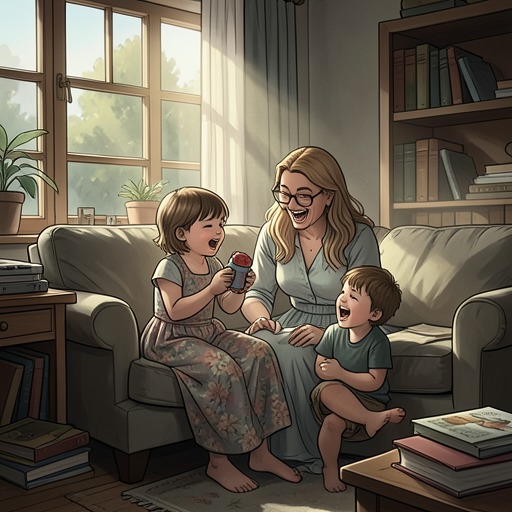
Hannah Keeley–Karis Keeley mother-son relationship
Crazy Mama: 9 Steps to a Not-So-Normal LifeHannah Keeley and Karis Keeley’s relationship is presented in small, vivid episodes of family life: a teenager’s forgotten lunch, his apology for hurting his mother, and the superhero games he shares with his brothers. Across these scenes, practical care and comic banter sit alongside an affectionate picture of their bond. Karis is not defined by a single dramatic turning point; the relationship takes shape through repeated domestic encounters in which Hannah responds to his needs, and he shows concern for her.
Family Position and Everyday Life
Karis is one of Hannah’s three sons, positioned between two pairs of daughters in a busy household. Hannah describes the boys as being regularly bossed around by both their older and younger sisters, but says they could take the pressure because they were superheroes. The family setting gives the mother-son moments their texture: attention and affection unfold amid siblings, household routines, and the ordinary demands of raising children.
Karis is also identified as an aspiring professional baseball player. That detail accompanies Hannah’s account of his apology after she has hurt her face, connecting his identity as a son to her affectionate, lightly teasing way of describing him. The book does not supply a broader biography for him; instead, it makes the relationship legible through these situated moments, where his words and Hannah’s replies reveal more than a formal description could.
Hunger, Forgetfulness, and a Mother’s Response
One afternoon Karis came through the front door, dropped his backpack, collapsed onto the sofa, shut his eyes, and put a hand on his belly. He announced, “Mom, I am so hungry! I need food—now!” Hannah answered with a greeting that gently pointed out that he had skipped over saying hello. He apologized, explaining that he was starving. The exchange begins as a familiar complaint but soon exposes the practical cause: Karis had forgotten to bring lunch to school.
Hannah teases him about how often her teenagers claim to be starving. Karis had once eaten eleven hot dogs at a cookout and, two hours later, was hungry again. In this episode, however, his hunger is not just comic exaggeration. When Hannah asks why he did not buy lunch, he says he does not know; when she asks why he did not buy food, he sits up and asks, “What would I buy it with—my good looks?” Hannah concedes that he is good-looking but points out that his appearance would not buy cafeteria pizza.
She reminds him that she had put $20 on his cafeteria account the other day, so he had money available. Karis reacts with a pained expression, grips his stomach harder, and cries, “I could have bought some food? Aaargh!” He asks her to drive him back to school for pizza. Rather than make the trip, Hannah jokes that he may not survive the journey and checks the refrigerator. She offers leftover vegetable soup and cold cornbread from the previous night’s dinner; his final “Aaargh!” leaves the scene on comic resistance. The exchange shows care taking a practical form—Hannah finds him something to eat—while their banter lets her treat his distress with affectionate humor rather than alarm.
Injury, Apology, and Shared Humor
A separate episode shows the relationship from Karis’s side. After three days of Motrin and ice, Hannah still looked badly bruised and grimaced when she tried to wash her face. As the children heard her grunt at her reflection in the rearview mirror, Karis apologized: “Mama, I’m so sorry about hurting your face.” Hannah tells him that they have already discussed it and that it is not his fault, then jokes that she has cut him out of the will. The joke does not cancel the reassurance; it sits beside it, making room for both her physical discomfort and his concern.
Karis asks whether she will be embarrassed to go out in public looking that way. He then offers to skip school and stay home if she does not want to go out. Hannah recognizes the offer as an attempt to play hooky and laughs, but also answers that she is fine. She turns the moment into a joke about looking like “one bad donkey mama,” and the older children laugh at her euphemism. The younger children, by contrast, wonder why she would want to look like a donkey. The differing reactions place the exchange within a family audience, while Karis’s apology and offer to stay home keep the focus on his concern for his mother.
Brothers, Play, and the Relationship’s Narrative Shape
Karis’s place in the family also appears through imaginative play with his brothers. When the boys were younger, they played superheroes in the woods, pretending to scale trees, run at super speed, and lift cars. They eventually settled into characters: the oldest son, Kyler, became Mighty Man, with super strength, while Karis became Rubber Boy, able to stretch to incredible lengths. These are presented as childhood play and family memory, not literal abilities; their significance is in the shared world the brothers made together.
Taken together, the episodes portray a bond sustained by attention to ordinary particulars. Hannah remembers Karis’s dramatic hunger, the money on his cafeteria account, his apology, and his offer to stay home. Karis, in turn, speaks directly to his mother about his needs and notices when she is hurt. The book does not provide a formal resolution or claim that these moments change their relationship. Instead, their accumulation gives it definition: care is expressed through feeding, reassurance, and concern, while humor allows mother and son to meet everyday frustration without losing warmth.