Terah–Haran father-son relationship
Crazy Mama: 9 Steps to a Not-So-Normal LifeTerah–Haran father-son relationship is defined in this account by loss: Haran is Terah’s firstborn and pride, and his death ends both a father’s hopes for his son and the inheritance associated with him. The relationship then shapes the account of Terah’s journey. A town bearing Haran’s name becomes the place where Terah settles and dies, making grief not merely a memory of the relationship but the force around which the narrative’s warning is built.
Father, Firstborn, and Inheritance
Haran is introduced as Terah’s son and firstborn, born before Abraham. The account stresses what that position meant to Terah: Haran was his pride and joy, and, as firstborn, he was expected to carry on his father’s name and receive his inheritance and blessing. The relationship therefore carries emotional and familial weight at once. Haran is cherished as a son, but his place in the family also embodies Terah’s hopes for continuity and the future.
Haran’s death is presented as the collapse of those hopes. The narrator describes the loss as the death of Terah’s pride and joy, his firstborn, and his inheritance; with Haran, Terah’s dream dies as well. The account does not describe the circumstances of Haran’s death or provide further detail about their life together. Instead, it concentrates the relationship into the before and after of this rupture: the son who was expected to inherit and carry on his father’s name is gone, and Terah is left with grief that touches both love and expectation.
A Journey Shadowed by His Son’s Name
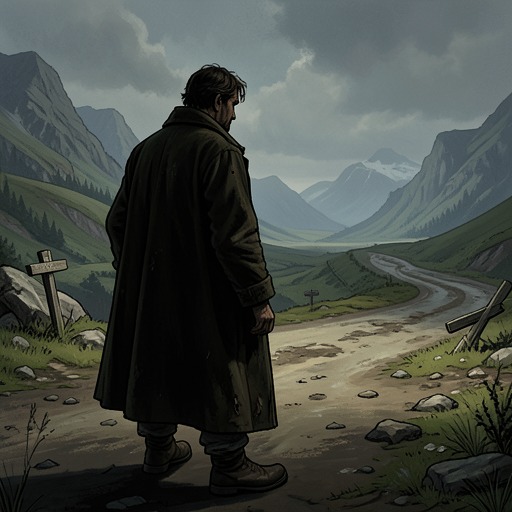
The account links Terah’s loss to a new dream from God: to leave Ur and travel toward Canaan. Terah gathers his goods and sets out, but stops in a town called Haran. That name gives the episode its sharpest connection to the father-son relationship. The dead son and the town share a name, so the place Terah inhabits recalls the person he has lost. The text imagines the reminder as pervasive: the town’s name appears in the address and in ordinary references to where he lives, making the past difficult to leave behind even while Terah has physically begun a journey.
This scene is framed as an illustration of how grief can follow a person into a hoped-for future. Terah’s destination lies elsewhere, but the account places him in a town whose name recalls his son, turning the journey into a test of whether he will continue toward the dream or remain where pain is repeatedly recalled. The force of the episode comes from that contrast: Terah has already left Ur, yet departure alone does not carry him onward. The narrative treats the name Haran not as an explanation of Terah’s inner life beyond what it explicitly states, but as the concrete reminder through which the author makes his grief legible.
Settlement and the Ending in Haran
Terah’s pause becomes decisive when the account cites Genesis 11:31: “when they came to Haran, they settled there.” It follows with the next verse’s stark conclusion: “Terah died in Haran.” The two statements compress movement into an ending. Terah had set out toward Canaan, but the narrative’s cited account places his settlement and death in Haran, the town whose name recalls his firstborn son. The father’s journey thus ends at the point where the past is most insistently present.
The account sets out an alternative, rather than claiming that Terah made a fully described inner decision: he could remain in Haran and dwell in bitterness, or gather his things and continue toward the dream God had placed in his heart. The contrast makes the relationship consequential beyond Haran’s death. The loss is not undone, and the text offers no reconciliation or recovery of the inheritance; instead, it asks whether grief will determine the direction of the survivor’s life. Terah’s death in the town becomes the outcome that gives this warning its gravity.
Narrative and Thematic Significance
The father-son relationship is narrated as a wound that returns through a place-name. Haran first means Terah’s beloved son and lost heir; later, it names the town in which Terah settles. By joining these meanings, the account gives an abstract experience—being unable to move beyond bereavement—a physical setting and a repeated reminder. Its imagined details about saying the town’s name, writing the address, and stepping outside convey how ordinary life can bring the loss back into view.
The episode also places Terah’s story beside Abraham’s later call to the Promised Land: God’s dream for Terah comes before Abraham is called, but Terah’s journey, as presented here, stops short of its intended destination. The account uses that contrast to make the relationship more than family background. Haran’s death is the personal loss at the center of Terah’s grief; Terah’s settlement is the narrative consequence through which the author warns against allowing sorrow to close off a hoped-for future. The ending remains bleak and specific: Terah dies in Haran, while the question of moving forward is carried outward as a lesson for the reader.