“Every man must have somewhere to go”
Crime and Punishment“Every man must have somewhere to go” is Semyon Zaharovitch Marmeladov’s insistence that no person can endure having nowhere to turn. Spoken amid poverty, shame, and his own failures, the phrase makes need sound less like a claim to deserve help than a basic condition of being human. Its return to Rodion Romanovitch Raskolnikov’s mind gives the plea a second force: a declaration first made in a tavern becomes a question bearing on Raskolnikov’s own urgent decision.
The phrase as a claim to refuge
Marmeladov explains the saying through the experience of asking for money when he already knows the answer will be no. He calls this petition hopeless in the fullest sense: the prospective lender knows Marmeladov cannot repay him, and Marmeladov knows the lender will refuse. He even asks why anyone should help him out of compassion, since Mr. Lebeziatnikov has told him that modern science forbids compassion. The reasoning leaves no practical argument for assistance. Marmeladov nevertheless goes to ask, because a person without anyone else to approach still has to go somewhere.
The phrase therefore does not promise that refuge will be welcoming, or that a request will succeed. It names the need that persists when success is foreclosed. Marmeladov addresses Rodion Romanovitch Raskolnikov as though he were the listener who had asked why he did not work or perform his duty, although those questions came from the innkeeper. This displaced address turns a public rebuke into an appeal to one particular witness. Raskolnikov asks why Marmeladov goes to a lender he expects to refuse him; Marmeladov’s answer is that the alternative is not self-sufficiency but having nowhere to turn.
Poverty, shame, and the need to be heard
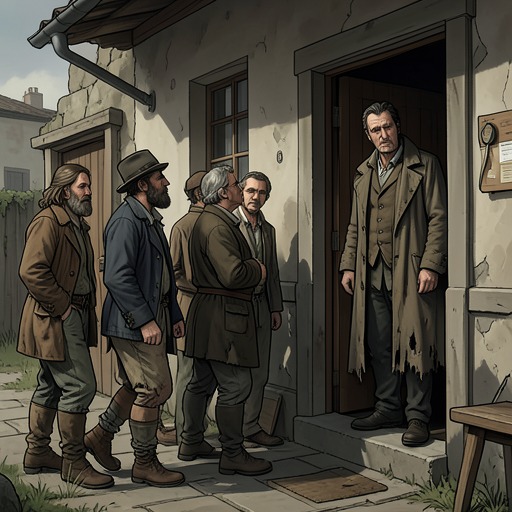
Marmeladov connects the expression to his daughter’s situation. When she first went out with a Yellow ticket, he says, he too had to go somewhere; he adds parenthetically that his daughter has a yellow passport. His account makes the plea inseparable from public exposure. The men at the counter laugh, and the innkeeper smiles, but Marmeladov hurries on, saying that everyone already knows and that nothing remains secret. He accepts this exposure with humility rather than contempt, then challenges his listener to look at him and call him a pig.
The challenge complicates the phrase’s appeal. Marmeladov does not present himself as blameless: he describes himself as useless and recalls that he lay drunk while Mr. Lebeziatnikov beat his wife. Nor does he hide his relapse into drinking. But he asks to be regarded as a person even while admitting to conduct that invites condemnation. The need for somewhere to go thus includes the need to address someone who will hear the confession, rather than reduce the speaker to his failures. The laughter around him makes that need visible by showing how easily his appeal can be treated as a spectacle.
Marriage and the force of having nowhere to turn
Marmeladov uses the same language to describe the circumstances in which Katerina Ivanovna married him. After her first husband’s death, she was left with three children in a remote district and in extreme poverty; her relations had rejected her. Marmeladov, then a widower with a fourteen-year-old daughter, offered her his hand because he could not bear to watch her suffering. He emphasizes that Katerina Ivanovna was educated, cultured, and of distinguished family, yet she consented to marry him while weeping and wringing her hands. In his account, the decisive circumstance was that she had nowhere to turn.
The phrase here describes constraint as well as refuge. Katerina Ivanovna’s marriage is not presented as an uncomplicated choice made from affection: Marmeladov explains her consent through calamity and the absence of alternatives. He then recalls that he performed his duties conscientiously for a year and did not drink, but lost his position after changes in the office. Only after that loss, he says, did he return to drink; a later position in the capital was lost through his own weakness. The expression gathers these different pressures without making them identical. Katerina Ivanovna’s destitution, Marmeladov’s employment, and his relapse all involve the narrowing of possible places to turn, while his own account distinguishes forces beyond his control from a failure he attributes to himself.
The saying returns to Raskolnikov
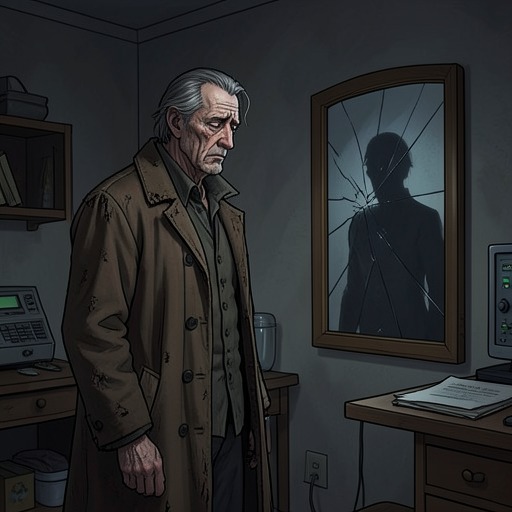
After Raskolnikov reads his mother’s letter, Marmeladov’s question comes suddenly back to him: what does it mean to have absolutely nowhere to turn? The recollection arrives as he is torturing himself with old questions that have grown into an urgent demand for action. He thinks that he must decide quickly, rather than passively accept his lot and give up any claim to activity, life, and love. The narrative places Marmeladov’s words beside that crisis, not as an answer to it but as a remembered measure of desperation.
The wording shifts in the return. Marmeladov’s spoken sentence says that every man must have somewhere to go; in Raskolnikov’s recollection, it becomes the assertion that every man must have somewhere to turn. The first stresses a destination, the second the act of seeking one. Raskolnikov recognizes the thought that follows as familiar: it had been a dream a month earlier and even the day before, but now has taken on a menacing, unfamiliar shape. Marmeladov’s refrain consequently links two different forms of pressure without equating them. A plea born of visible poverty and humiliation becomes, in Raskolnikov’s inward crisis, an insistence that a person cannot indefinitely remain suspended between decision and surrender.