“One death, and a hundred lives in exchange”
Crime and Punishment“One death, and a hundred lives in exchange” is the decisive formula in a tavern student’s argument that killing a despised pawnbroker could be justified by the good her money might accomplish. The phrase turns a moral question into a calculation: one life is set against many possible acts of assistance. Its force in the story comes from both the apparent simplicity of that arithmetic and the unease it leaves unresolved. Rodion Romanovitch Raskolnikov overhears the discussion at a moment when he is already considering the same possibility, but the argument belongs to the student, not to Raskolnikov.
Origin and Context
The student begins by describing the pawnbroker as sickly, spiteful, and harmful, and argues that she may die soon in any case. Against that single life he places young people left without help and the possibility that her stored money could support good deeds, redirect people’s lives, and keep families from destitution, ruin, and vice. He imagines the money otherwise being buried in a monastery. The conclusion, “One death, and a hundred lives in exchange,” compresses this contrast into a maxim; the accompanying assurance that “it's simple arithmetic!” makes the reduction explicit.
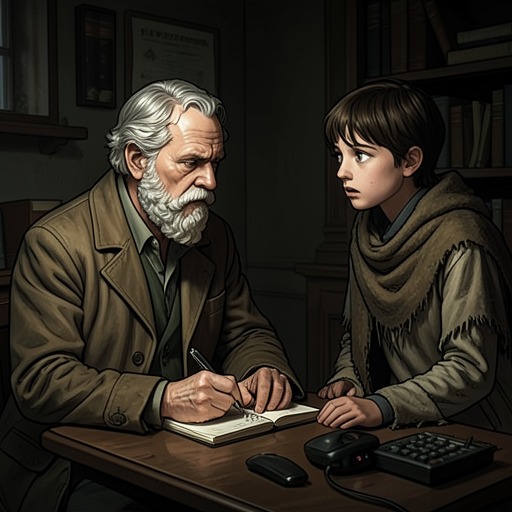
The speech is not a detached philosophical lecture. The student is talking with an officer in a tavern, and he first says, with warmth, that he could kill the old woman without a pang of conscience before clarifying that he was joking. He then presents the case as a serious question. The shift from provocative remark to extended argument gives the formula a double character: it is both an abstract claim about justice and a test of whether its speaker will accept its practical consequences.
The Calculation and Its Challenge
The argument treats the pawnbroker’s life as having little or negative value because, in the student’s account, she harms others and will soon die. Her money, by contrast, is assigned a large potential value through the good it might finance. The proposed exchange therefore depends on more than counting lives. It depends on judging which life is worth less, predicting what the money could achieve, and treating a killing as a means to those predicted benefits. The confident arithmetic conceals these judgments inside what sounds like a simple equation.
The officer accepts that the woman may not deserve to live, but answers that nature must be allowed to take its course. The student counters that people must correct and direct nature, then invokes duty and conscience while questioning what those terms mean. The officer’s most pointed challenge is practical: would the student kill the woman himself? The student says he would not and describes his contribution as argument about the justice of the act. His refusal exposes a gap between defending a principle at a distance and accepting responsibility for carrying it out. Raskolnikov’s judgment sharpens that gap: if the student would not commit the act, Raskolnikov thinks, there is no justice in the proposal.
Money, Need, and Human Value
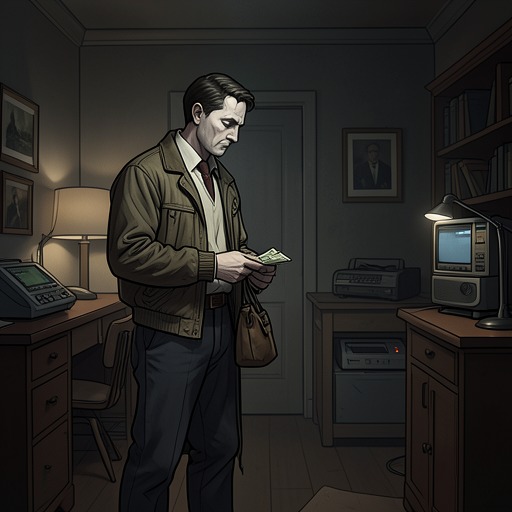
Other scenes make the novel’s surrounding economy of money and need concrete without proving the student’s proposed exchange. In an earlier visit to the pawnbroker, Raskolnikov brings an old silver watch engraved with a globe. After deductions for interest on that pledge and a previous loan, she gives him only a rouble and fifteen copecks. The transaction makes calculation immediate and personal: an object connected to him is assessed through debt, time, and a small sum of cash. It does not, by itself, establish that violence could justly redistribute wealth.
The story also presents need through the Marmeladov family. Semyon Zaharovitch Marmeladov describes seeking a loan from someone he knows will refuse because he cannot repay it; he says he goes anyway because a person with nowhere else to turn still needs somewhere to go. He recounts how poverty leaves Sofya Semyonovna Marmeladova with almost no prospect of respectable earnings, while hungry children depend on the household. After she returns home with thirty roubles, she silently puts the money on the table. Later, Marmeladov admits that he has taken thirty copecks she gave him for a drink. These episodes show money passing as desperate support, obligation, and loss. They give weight to the student’s concern about preventable suffering while also setting actual human need against his abstract confidence that one death can be balanced by many benefits.
Raskolnikov’s mother’s letter supplies a further contrast between calculation and sacrifice. She explains that her annual pension is one hundred and twenty roubles, that she had borrowed fifteen roubles against it, and that Avdotya Romanovna Raskolnikova had taken a hundred-rouble advance from her employer chiefly to send Raskolnikov sixty roubles. Reading the letter, Raskolnikov interprets the proposed marriage to Pyotr Petrovitch Luzhin through its practical costs and benefits, and worries about what his mother will have left to live on. These sums illuminate how financial necessity shapes choices within the family; they do not make those choices equivalent to the student’s proposed killing. Together, the scenes reveal a world where money measures survival and sacrifice, but where a human life cannot be made morally interchangeable with a sum or an anticipated benefit merely by doing the arithmetic.
Narrative Role and Significance
The discussion becomes consequential because of when Raskolnikov hears it. He is already carrying the beginning of his own idea about the pawnbroker when he happens upon the tavern conversation. He is violently agitated by the coincidence and later regards the exchange as having had an immense influence on his action, almost like a guiding hint. The narration thus gives the student’s formula a role beyond its immediate debate: it becomes an external articulation of a thought Raskolnikov had been developing in isolation.
That role does not make the student’s reasoning a verdict endorsed by the story, nor does it establish that Raskolnikov simply adopts every part of it. Instead, the scene places a proposed justification beside its limits. The student can describe lives saved and money put to good use, yet declines to act; the officer distinguishes human judgment from nature; and Raskolnikov recognizes that willingness to perform the deed matters to the claim of justice. The phrase’s memorable arithmetic is therefore also a dramatic warning about what its neatness leaves out: who decides that another person’s life is expendable, who bears responsibility for the decision, and whether projected good can erase the act by which it is pursued.