Katerina Ivanovna’s consumption
Crime and PunishmentKaterina Ivanovna’s consumption is a continuing physical vulnerability that makes the deprivation of her household more dangerous and more visible. The narrative identifies her weak chest and tendency to consumption, while her husband, Semyon Zaharovitch Marmeladov, describes her winter illness, cough, and worsening condition. When Rodion Romanovitch Raskolnikov later sees her at home, her flushed cheeks, strained breathing, and repeated coughing give that report an immediate presence. The illness is not a separate episode detached from the family’s circumstances: cold, hunger, relentless domestic work, and cramped housing all surround it.
Illness and reported symptoms
Marmeladov recounts that Katerina Ivanovna caught cold during the winter and began coughing and spitting blood. He emphasizes that her chest was weak and that she was already prone to consumption. His account presents the illness as something he notices and fears, even while admitting that he has worsened the family’s circumstances through his drinking. The details establish a serious condition, but the narrative supplies no medical treatment or recovery; its evidence concerns symptoms and the pressure they place on everyday life.
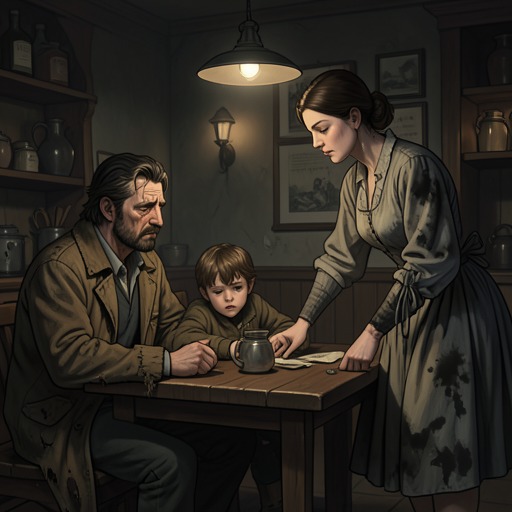
The room Raskolnikov enters makes the physical strain observable from another angle. Katerina Ivanovna paces with her hands pressed to her chest, breathes in short, broken gasps, and coughs while smoke drifts in from adjoining rooms. Her cheeks are flushed, and her eyes have a feverish brightness. These observations are presented through Raskolnikov’s encounter with the family, complementing Marmeladov’s earlier account without turning illness into a clinical history. The contrast between the husband’s anxious explanation and the visitor’s immediate view places her symptoms both within family testimony and within the scene of domestic life.
Household hardship and exposure
The illness unfolds in a home where the family has little protection from material hardship. Marmeladov says that the room is cold and that he sold Katerina Ivanovna’s stockings and a mohair shawl that had been given to her, using the money for drink. The shawl’s sale matters as more than a lost possession: it removes something of hers while leaving the household exposed to the cold he associates with her illness. His confession connects his conduct to her physical vulnerability, though it does not make the illness reducible to that single cause.
The family’s room is crowded with the signs of poverty. Raskolnikov sees children’s garments among the disorder, a candle-end for light, and the family’s furniture compressed into a room that functions almost like a passage. Smoke from the neighboring rooms enters while Katerina Ivanovna coughs. The scene does not establish that any single feature caused her consumption; it shows instead that her illness is endured in surroundings offering little comfort or separation from the household’s pressures. Even the weak tea served to Raskolnikov comes from Nastasya’s cracked teapot, a small detail within a setting of scarcity rather than evidence of any treatment for Katerina Ivanovna.
Work, care, and the family’s limited resources
Katerina Ivanovna continues to shoulder domestic labor despite her frailty. Marmeladov says she works from morning until night, scrubbing, cleaning, and washing the children, and describes cleanliness as a standard she has maintained since childhood. Her illness therefore appears beside sustained effort, not simply inactivity or dependence. The family has three young children, and the account of her work makes clear how much daily care rests on her even as her health is failing.
Paid work offers little relief. Marmeladov says that respectable labor without particular skill could bring her less than fifteen farthings a day, and that a civil counsellor had not paid her for six linen shirts she made. The dispute over the collars ended with her being turned away, leaving the children hungry. In his recollection, she walks about wringing her hands while their food has been scarce for days. These circumstances do not prove a direct medical cause, but they show the practical world in which illness must be borne: work is exhausting and poorly rewarded, payment is uncertain, and the children’s immediate needs compete with their mother’s limited strength.
Dignity and narrative significance
The narrative also records Katerina Ivanovna’s insistence on dignity amid deprivation. She scrubs floors and eats black bread, yet resists being treated disrespectfully. Marmeladov explains that she wanted the landlady to know of her former honors, including a certificate of merit that she kept after her medal had been sold. Her attachment to these memories gives the account of illness a social and personal dimension: she is not defined solely by symptoms, but by a past and a self-respect that hardship has not erased.
When Raskolnikov arrives, he finds her pacing and apparently absorbed in thought, while the children occupy the same cramped room and one tries to comfort another. Her coughing continues in the smoke-filled space, without privacy from the neighboring rooms or respite from family demands. The scene brings together the central pressures surrounding her consumption: a vulnerable body, inadequate resources, responsibility for children, and a determination to preserve dignity. The evidence leaves her later medical course unstated; what it establishes is the severity of her condition and the harsh conditions under which she lives with it.