Poverty and social humiliation
Crime and PunishmentPoverty and social humiliation are linked forces in the novel: deprivation limits what people can eat, earn, and choose, while shame pushes them toward secrecy, dependence, or self-abasement. The contrast between being poor and being reduced to begging, the Marmeladov family’s attempts to survive, and Rodion Romanovitch Raskolnikov’s isolation show how economic need becomes a social and moral condition, not merely a shortage of money.
Material Deprivation and Social Exclusion
Raskolnikov is crushed by poverty, yet his practical circumstances have become difficult even for him to attend to: he has abandoned ordinary concerns and lost the desire to manage them. His fear of his landlady is less about what she might materially do than about being stopped on the stairs, pressed for payment, and forced to invent excuses. He would rather slip past her unseen than endure the humiliating exchange. His withdrawal thus has an economic setting, but it is also a defense against the exposure and negotiation that poverty requires.
The same deprivation is registered in his body and surroundings. He has scarcely eaten for two days, and his thoughts sometimes feel tangled and weak. He is dressed in conspicuous rags, though the crowded streets near the Hay Market contain such a variety of people that even an unusual appearance attracts little attention. His room, in Raskolnikov's garret, is a low, six-pace cupboard with peeling yellow paper, three old chairs, dusty books and manuscripts, and a sofa in rags that serves as his bed. The landlady has stopped sending meals for a fortnight; he has not protested, though he goes without dinner. When Nastasya brings weak, stale tea and two lumps of sugar, he gives her coppers to buy bread and the cheapest sausage. These details make poverty an ongoing limit on nourishment, comfort, and action, while his disregard of practical needs deepens his isolation.
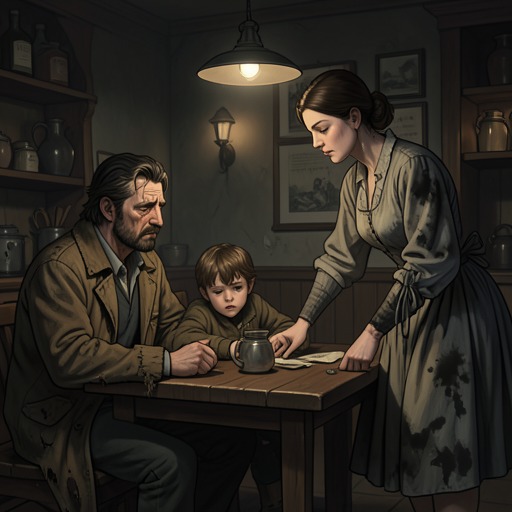
Semyon Zaharovitch Marmeladov gives that social pressure a public vocabulary. Speaking from his own experience, he distinguishes poverty, which may leave a person some dignity, from beggary, which expels a person from society through deliberate humiliation. He describes himself as willing to abase himself and identifies the tavern as the place to which he has been driven. His account of seeking a loan is especially revealing: he knows in advance that the person he approaches will refuse because repayment is not expected. He nevertheless goes, explaining that a person with nowhere else to turn must still have somewhere to go. The scene frames assistance not as a simple transaction but as a need that persists even when the petitioner anticipates rejection. Marmeladov also recounts how Mr. Lebeziatnikov beat his wife, Katerina Ivanovna, and stresses that his wife’s suffering affects him even while he is unable to help her.
The Marmeladov Household Under Pressure
The family’s finances are described through small possessions and unmet needs. Marmeladov has sold Sofya Semyonovna Marmeladova’s stockings and a shawl that had been given to her, spending the proceeds on drink. The family lives in a cold room, while Katerina Ivanovna works from morning until night and cares for their three children. Her health is already poor, and the household’s hardship compounds it. Marmeladov acknowledges his own failure, but his remorse does not restore what the family has lost or provide for the children.
The account of Sofya Semyonovna’s earnings makes the lack of viable choices explicit. Marmeladov argues that a respectable poor girl without special talent cannot earn even fifteen farthings a day through honest work, however continuously she works. He gives the example of an official who has not paid her for six linen shirts and sent her away over their collars. Meanwhile, the children have gone without a crust for three days. In that situation Katerina Ivanovna tells Sofya Semyonovna that she contributes nothing, a cruel remark Marmeladov attributes to illness, desperation, and the children’s hunger rather than treating it as her settled judgment.
Marmeladov recalls the consequence without presenting it as a triumph. Sofya Semyonovna leaves at six and returns around nine with thirty roubles, which she lays silently on the table. She covers her head and face with the family’s large green shawl and lies down without addressing anyone. Katerina Ivanovna later kneels beside her and kisses her feet; the two fall asleep in one another’s arms. The money meets an immediate household need, but the scene also records the shame and grief surrounding the means by which it was obtained. Poverty drives the family into dependence on Sofya Semyonovna’s sacrifice, while the response between stepmother and stepdaughter reveals an intimacy that their earlier exchange had obscured.
Debt, Sacrifice, and Family Obligation
Raskolnikov’s mother’s letter shows deprivation extending across the family even in his absence. His mother explains that her pension is only 120 roubles a year and that a previous fifteen-rouble payment to him had to be borrowed against it. She had been unable to send more until the debt was paid. She also reveals that Avdotya Romanovna Raskolnikova took a governess’s position with a hundred-rouble advance, part of which was deducted from her wages, chiefly so she could send Raskolnikov sixty roubles the previous year. The family had described that money as savings, concealing the debt behind the gift.
The letter casts such support as loving, but Raskolnikov reads its economic terms as a source of humiliation and danger. He dwells on his mother and sister’s hopes concerning Pyotr Petrovitch Luzhin, and on the practical arrangements for their journey: they must travel cheaply, while his mother raises money from her pension. His resentment focuses not only on expense but on the unequal expectations he sees in the proposed marriage. The women’s dependence on another person’s generosity appears to him precarious, and their willingness to hope does not reassure him. The letter therefore joins affection to material vulnerability: family members help one another, but the help is financed by borrowed money, reduced wages, and expectations of future support.
Poverty, Calculation, and Moral Judgment
The novel places these intimate shortages beside a broader argument about whether wealth can justify harm. In a conversation overheard by Raskolnikov, a student portrays an old moneylender as useless and harmful, then imagines that her money could assist many people and rescue families from destitution. He reduces the proposed act to an exchange of one life for many. The argument turns poverty into a problem of arithmetic: money withheld from the needy is treated as a resource that might be redirected for social benefit. Its apparent clarity is set against the novel’s detailed accounts of actual people, whose need does not make them interchangeable figures in a calculation.
Raskolnikov’s own circumstances sharpen that tension without making poverty a sufficient explanation for his later choices. In the small, airless-feeling room where he has withdrawn from other people, his thinking about a crime has been growing for a month. Later, during his visit to Alyona Ivanovna's apartment, he conceals an axe beneath his coat while his hands feel weak and numb. These scenes connect material strain, bodily depletion, isolation, and action, but they do not establish that deprivation mechanically dictates what he does. Instead, the novel sets the seduction of abstract calculation against the specific costs borne by people like the Marmeladovs and Raskolnikov’s family. Poverty narrows their choices and exposes them to humiliation; the moral question is what others, and the impoverished themselves, claim may be done in response.