Raskolnikov accompanies Marmeladov home
Crime and PunishmentRodion Romanovitch Raskolnikov accompanies Semyon Zaharovitch Marmeladov home after Marmeladov asks him to come along. The visit turns Raskolnikov’s abstract knowledge of the family’s poverty into a direct encounter with their cramped living conditions, hunger, and domestic crisis. It also exposes the unease behind his brief act of charity: he leaves money for the family, then immediately questions whether he should have kept it.
The Journey Home
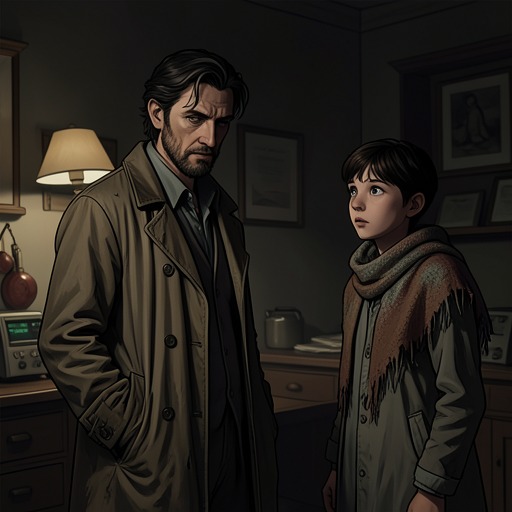
Marmeladov raises his head and asks Raskolnikov to accompany him to the lodging where his wife, Katerina Ivanovna, and the children are staying. Raskolnikov has already wanted to go and has intended to help him. Because Marmeladov is unsteady on his feet, he leans heavily on Raskolnikov during the short walk of two or three hundred paces. As they approach, his agitation grows.
Marmeladov says that he is less afraid of being struck than of seeing Katerina Ivanovna’s face and hearing the children cry. He fears that they may not have had food, particularly if Sofya Semyonovna Marmeladova has not brought any. His anxious anticipation makes the return home more than a simple escort: before the household appears, he already imagines the distress his absence and drinking have caused. He nevertheless continues toward the family’s room, with Raskolnikov supporting him.
The Family’s Lodging
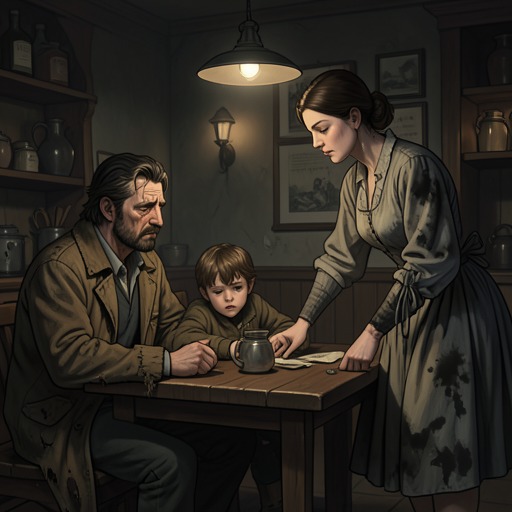
They climb to the fourth storey of a building in Saint Petersburg. At the top of the increasingly dark staircase, the family’s door stands ajar. Their room is roughly ten paces long and lit by a candle-end. Rags and children’s clothes lie about; a torn sheet separates off the far corner, where the bed is presumed to be. The few furnishings include two chairs, a worn sofa, and an uncovered wooden table. Although the family has a room of its own, it functions almost like a passage between the staircase and the adjoining rooms.
Noise and activity from the adjoining rooms spill into the family’s space. People there are playing cards and drinking tea, while tobacco smoke drifts through the partly open inner door. Katerina Ivanovna paces in the room, pressing her hands to her chest. She is described as thin and ill, with an agitated manner and interrupted breathing; the closeness of the room and the smoke contribute to an atmosphere of strain. The scene locates the family’s hardship not in a private refuge but in a room exposed to the sounds and intrusions of the surrounding lodging.
The children are also present in the shared disorder. The youngest, a six-year-old girl, has fallen asleep on the floor beside the sofa. A boy stands crying in a corner, while his older sister tries to comfort him and watches their mother anxiously. These details give physical form to Marmeladov’s fear on the walk: the children’s need is already visible when Raskolnikov arrives, before Katerina Ivanovna has discovered what has happened to the household’s money.
Marmeladov’s Return
Marmeladov does not enter the room standing. He drops to his knees in the doorway and pushes Raskolnikov ahead of him. Katerina Ivanovna initially takes Raskolnikov for someone passing through to the adjoining rooms. When she turns toward the outer door, she sees her husband kneeling and immediately confronts him, demanding to know where the money and his clothes have gone.
She searches his pockets, but finds nothing. Katerina Ivanovna recalls that twelve silver roubles had remained in the chest and concludes that Marmeladov has spent them. She then pulls him farther into the room as he submits to the search. His response presents the punishment as a consolation to him, but the scene’s consequences fall across the household: the sleeping child wakes and cries, the boy becomes more frightened, and the older girl trembles. Katerina Ivanovna points toward the children and cries out that they are hungry.
The confrontation draws the attention of people from the adjoining rooms. Curious onlookers gather at the doorway, and some begin to enter; their amusement at the scene intensifies the family’s exposure. Amalia Fyodorovna Lippevechsel pushes through the crowd and tries to restore order, again threatening Katerina Ivanovna with eviction. Raskolnikov does not answer Katerina Ivanovna’s accusation that he has been drinking with Marmeladov. He leaves without speaking, while the domestic crisis remains unresolved.
The Coins and Raskolnikov’s Reconsideration
As he goes, Raskolnikov puts his hand into his pocket and leaves on the window the coppers he received in exchange for his rouble at the tavern. The gift is small beside the twelve silver roubles that Katerina Ivanovna says are missing, but it is a concrete response to the children’s need. He makes the gesture without drawing attention to it, then, on the stairs, changes his mind and considers going back for the coins.
He decides that taking them back would be impossible and that he would not have done so even if he could. Yet his thoughts do not settle into uncomplicated generosity. He reflects on the cost of maintaining appearances and on Sofya Semyonovna Marmeladova’s precarious position as a possible source of money for the family. His dark speculation treats their dependence as both a source of support and a continuing danger: if that source fails, the family may have nothing for the next day. He recognizes that the household has wept over its circumstances and become used to them, then generalizes bitterly about people’s capacity to adapt to almost anything.
Significance of the Visit
The episode links an act of practical aid to Raskolnikov’s unsettled judgment. He has gone with Marmeladov intending to help, sees the family’s need at close range, and leaves his remaining change; almost at once, he measures the gift against his own wants and questions its wisdom. His response is neither simple detachment nor a lasting commitment to the household, but a moment of assistance entangled with self-reproach and cynicism.
The scene also stages the family’s hardship through successive thresholds: the dark staircase, the open doorway, the room that serves as a passage, and the crowd pressing in from adjoining rooms. Marmeladov’s fearful anticipation becomes a public confrontation, while the children’s distress makes the consequences of his lost money immediate. Raskolnikov exits the room, but the family’s need follows him into his thoughts, where compassion and contempt for human endurance remain in unresolved tension.