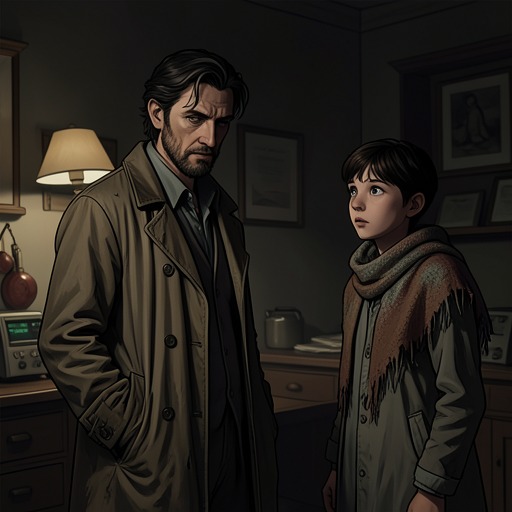
Raskolnikov dreams of a horse being beaten to death
Crime and PunishmentRaskolnikov dreams of a horse being beaten to death in a childhood setting, where he watches a crowd torment a mare while walking with his father. The dream turns a remembered landscape into a scene of public cruelty and helpless witness. Its decisive force lies in the contrast between the child’s distress at the mare’s death and the adult Raskolnikov’s plan to kill: on waking, he confronts the violence he has been trying to imagine as an act he could carry out.
Before the Dream
Before falling asleep, Rodion Romanovitch Raskolnikov is in a state of morbid irritability. His attention moves erratically: he watches flowers in gardens, then counts the thirty copecks he has left and tries to reconstruct what he has spent. He recalls giving money to a policeman and to Nastasya, and reckons that he may have given forty-seven or fifty copecks to the Marmeladovs. The arithmetic soon loses its purpose in his mind.
Hunger draws him into a tavern, where he drinks a glass of vodka and eats a pie while walking away. He has not drunk vodka for a long time, and even this small amount leaves his legs heavy and makes him drowsy. On Petrovsky Island he can go no farther; he turns into the bushes, sinks onto the grass, and falls asleep. The abrupt passage from restless movement to sleep frames the dream as a break in his waking control, not as a deliberate recollection.
The Childhood Setting
The dream places him at about seven years old, walking with his father on a holiday evening in the little town where he was born. Its landscape feels unusually exact: a level, open stretch of country, a distant copse, and a dusty road leading past a tavern toward a graveyard. The tavern had frightened him when he passed it as a child. It was associated with shouting, drunkenness, fighting, and people whose appearance made him cling to his father.
The road also leads to a church where the family attended services in memory of Raskolnikov’s grandmother. The dream recalls the rice pudding brought to the service, the old icons, and the priest, as well as the graves of the grandmother and a younger brother who died in infancy. Although Raskolnikov never knew his brother, he had been taught to honor the child’s grave with a cross and a kiss. The remembered church and graves establish a childhood world of family, religious observance, and reverence for the dead, set close beside the tavern’s disorder.
The Cart and the Mare
In the dream, the tavern is crowded with townspeople, peasant women, and other onlookers, many of them drunk. A large cart stands outside, but it is drawn by a small, worn mare rather than by the powerful horses such a load would ordinarily require. Mikolka, the cart’s owner, insists that the animal should pull the passengers at a gallop. People climb aboard, laugh, and encourage the spectacle; their amusement depends on an expectation the mare cannot meet.
The Beaten Mare struggles to move under the cart’s weight. Mikolka responds to her failure with escalating violence, while people in the crowd join in or urge the attack forward. The scene ends with the mare dead and the crowd’s excitement giving way to the plain recognition that Mikolka has killed her. The dream does not present this as an accidental loss: the crowd’s laughter, the repeated demand that the mare perform, and the owner’s angry insistence make the death the consequence of cruelty sustained in public.
Awakening and Significance
As a child in the dream, Raskolnikov cannot accept his father’s attempt to move him away from the scene. He sobs over the mare and clings to his father; his distress becomes so intense that he wakes. He is gasping and terrified, then recognizes that the scene was a dream. The narrator’s account also emphasizes the peculiar vividness of dreams arising in a morbid state: their carefully remembered details can remain powerful even after waking. That description links the dream’s force to the troubled condition in which Raskolnikov has fallen asleep.
Awake, Raskolnikov imagines taking an axe and killing Alyona Ivanovna, then recoils from the prospect of carrying out the act. He recalls that an earlier visit intended as an experiment had already shown him that he could not bear it, and that the idea had seemed vile and horrifying. The dream therefore does not simply predict violence; it places his contemplated violence beside an image of helpless suffering that he experiences as intolerable. The child’s response to the Beaten Mare stands in sharp contrast to the adult’s attempted preparation for murder, exposing the moral conflict his reasoning has not resolved. As a dream episode, it brings that conflict into a form shaped by remembered fear, family devotion, and an act of cruelty he cannot watch without protest.