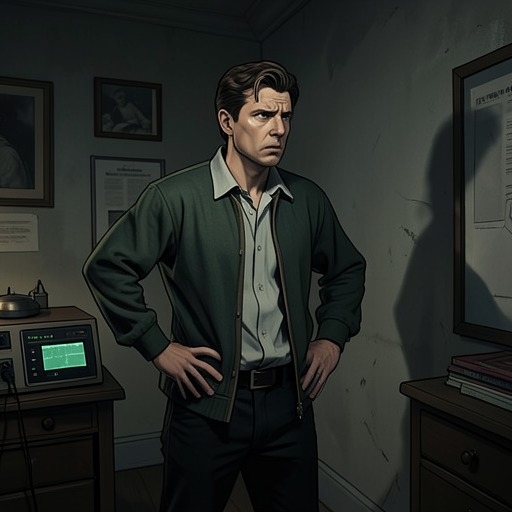
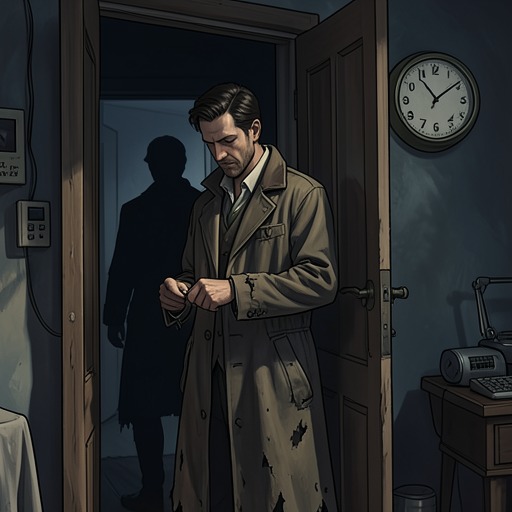
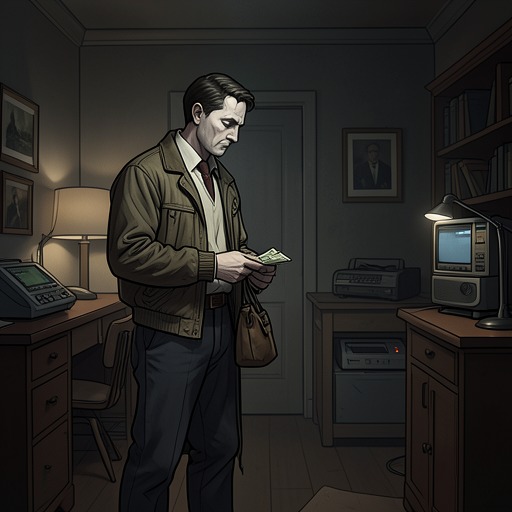
Raskolnikov murders Alyona Ivanovna
Crime and PunishmentRaskolnikov murders Alyona Ivanovna after entering her apartment under the pretext of bringing a pawn pledge. He kills her with an axe, takes a purse, and searches for valuables among her locked belongings. The sequence is decisive not only because it establishes that Raskolnikov has carried out the killing, but because the act’s apparent mechanical execution gives way to hesitation, fear, and confused attempts to proceed with the theft.
Background and the Pledge
At an earlier visit, Raskolnikov had brought Alyona an old-fashioned flat silver watch with a globe engraved on its back and a steel chain. The interest on his previous pledge was already overdue, and he asked her to wait while he promised to pay for another month. On the day of the murder, he again presents a pledge as the reason for coming. This repeated pawn transaction supplies a recognizable pretext: he approaches not as a stranger but as a customer returning with the object he had said he would bring.
The watch and the later pledge are not merely incidental props. Alyona looks first at what he has brought, then scrutinizes the visitor himself. Raskolnikov depends on the familiar business of the pawnshop to get inside, but his strained manner and her mistrust make the encounter precarious. The ordinary exchange of pledge and appraisal becomes the threshold to violence.
Gaining Entry
Alyona does not immediately open the door. Raskolnikov hears movement at the lock and suspects that she is listening from inside. He rings again, deliberately making a small noise and speaking aloud so that he will not seem to be hiding. When the latch is finally released, he holds the door toward himself, preventing her from shutting it. She keeps hold of the handle, and he advances when she remains in his way. Alarmed and apparently unable to speak, she steps back; Raskolnikov passes into the apartment without being invited.
Once inside, he identifies himself and offers the pledge he had promised. Alyona glances at it but continues to examine him closely. Her suspicious attention intensifies his fear: he thinks she may have guessed what is happening and imagines that, if she keeps looking at him in silence, he might flee. He responds with a sudden, hostile challenge about whether she recognizes him and says he can take the pledge elsewhere. The exchange shows how close the plan comes to breaking down before he acts.
The Killing
Alyona turns toward the window to untie the wrapped object and examine it in the light. The apartment’s windows are shut despite the stifling heat. As she faces away, Raskolnikov unbuttons his coat and frees Alyona Ivanovna’s axe from the loop, keeping it under the coat rather than taking it fully out. His hands feel weak and numb, and he fears dropping it; he also becomes dizzy. These details make the pause before the attack a struggle to carry out the act, not a calm interval of control.
When Alyona turns back toward him, Raskolnikov acts. He draws the axe out, swings it with both arms, and strikes her with its blunt side. The account describes the action as nearly mechanical and says that he scarcely seems conscious of using his own strength. After the first blow, however, his strength returns. He strikes again, and Alyona dies. The sudden change from faltering preparation to repeated action marks the scene’s irreversible turn: the attempted pawn transaction has become murder.
Searching the Apartment
Afterward, Raskolnikov sets the axe down and searches Alyona’s pocket for the keys. He is trembling, but he remembers being unusually collected and careful, trying not to get blood on himself. He takes the keys on their steel ring and hurries into the small bedroom. Its furnishings include holy images, a clean bed covered with a silk patchwork quilt, and a chest of drawers. The keys’ jingling brings back a brief impulse to abandon the search and leave.
That hesitation is followed by another fear: Alyona might still be alive. Raskolnikov goes back to check, takes up the axe again, and raises it, but does not strike. Convinced she is dead, he returns to the bedroom. The sequence alternates between practical actions and sudden doubts, showing that the killing has not given him composure or a clear path forward.
He tries the small keys in the chest of drawers, but they do not fit. Then he recalls that a larger, deeply notched key may belong to a strongbox. Searching beneath the bed, he finds a long box with an arched, red-leather lid studded with steel nails. The large key opens it. At the top are garments, including a red-brocade coat lined with hare fur, a silk dress, and a shawl. He wipes his hands on the brocade, thinking that the red fabric will make the marks less noticeable, then is alarmed by his own action.
A purse hanging on a string around Alyona’s neck also catches his attention. Because the string will not come free easily, he cuts it with difficulty, avoiding the use of the axe against her. The purse is full; he puts it in his pocket without looking inside. He leaves two crosses on the body and returns to the bedroom with the axe. The attempts to open the chest, identify the large key, and remove the purse show the theft unfolding amid haste and repeated errors rather than as a smooth execution.
Consequence and Narrative Significance
The scene ends with Raskolnikov still searching, not with a settled escape or an account of what he has gained. Although he has taken the purse, he has not examined it, and his efforts to find valuables are interrupted by fear, mistaken keys, and renewed uncertainty. The sharp contrast between the violence of the act and the small, awkward tasks that follow keeps the consequences immediate: he must handle objects, make choices, and continue moving through the apartment after crossing the boundary into murder.
The narrative’s attention to the watch, the wrapped pledge, the keys, the strongbox, the clothes, and the purse slows the action into a sequence of material particulars. The murder is not presented as an abstract conclusion to a plan; it is followed by the stubborn resistance of locks and knots, and by Raskolnikov’s shifting attention to the objects around him. His outward care—keeping the axe beneath his coat, trying not to get marked, and seeking a way to open the box—coexists with a mind repeatedly overtaken by hesitation and alarm. That friction defines the event’s significance: the killing is accomplished, but the practical and psychological control he appears to need afterward remains unstable.