Raskolnikov's garret
Crime and PunishmentRaskolnikov's garret is at once an oppressive dwelling and the private workshop for a plan he has been concealing. Set beneath the roof of a five-storied house, the room compresses his life into a cramped, neglected space: the landlady's open kitchen lies on the route out, while inside the garret he sleeps among dusty books and manuscripts and hides materials beneath his bed. Its importance lies in this double function. It is a refuge from other people, but also the place where isolation becomes preparation.
Setting and Access
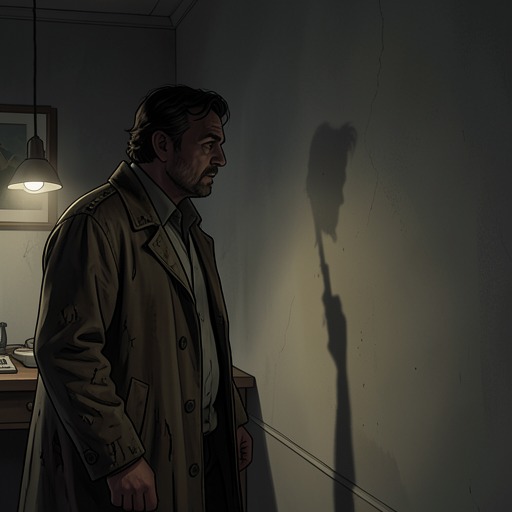
The garret is under the roof of a high, five-storied house and is described as more like a cupboard than a room. Raskolnikov comes out of it on a hot evening in early July and walks slowly, hesitantly, toward a bridge. Before leaving, he has managed to avoid meeting his landlady on the staircase. That small evasion matters because departure is not simple: the landlady lives one floor below, where her kitchen door invariably stands open, and he must pass it whenever he goes out.
The staircase therefore joins the private room to the obligations waiting outside it. The landlady has provided the garret, dinners, and attendance, but Raskolnikov is hopelessly in debt to her and fears encountering her. Passing the kitchen brings on a sick, frightened feeling; he scowls and feels ashamed. The room’s confinement is thus not only a matter of low ceilings and small dimensions. Even the way out exposes him to an indebted relationship he would rather evade.
Interior and Material Condition
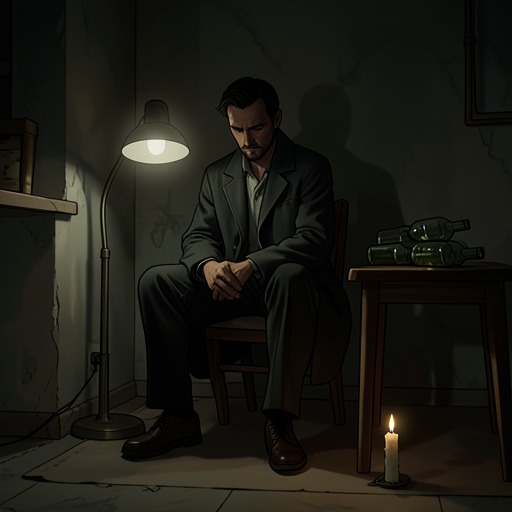
After a broken night’s sleep, Raskolnikov wakes irritable and ill-tempered, looking with hatred at the room. It is about six paces long, with dusty yellow paper peeling from the walls. The ceiling is so low that a man taller than average would feel ill at ease and continually fear knocking his head against it. The dimensions turn ordinary movement into an awareness of restriction.
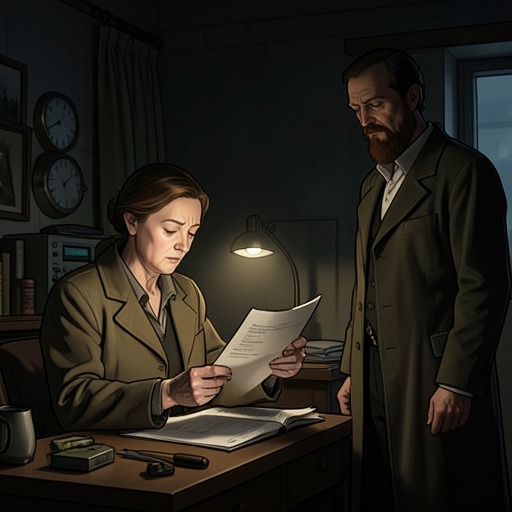
The furniture continues the same pattern of scarcity. Three old chairs stand in the room; a painted table in the corner holds manuscripts and books, thick with dust from long disuse. A large, clumsy sofa takes up almost an entire wall and half the floor. Its chintz covering has become ragged, and it serves as Raskolnikov’s bed. He often sleeps on it without undressing or using sheets, wrapped in his old student’s overcoat. He uses a small pillow, stuffing clean and dirty linen beneath it to make a bolster. The room offers the bare means to sleep and store a few possessions, but little order or comfort.
Withdrawal and the Room's Uses
The garret also gives physical form to Raskolnikov’s withdrawal. He has got away from everyone, as if enclosed in a shell, and even the sight of a servant entering the room can make him writhe with nervous irritation. His attention has narrowed to a single preoccupation. The room’s disorder, which might ordinarily be only a sign of neglect, feels agreeable to him in this state of mind.
That withdrawal has practical consequences. For a fortnight the landlady has stopped sending meals, yet Raskolnikov has not thought to complain and goes without dinner. Nastasya, the cook and only servant, is content with his mood and has largely abandoned sweeping and tending the room; she comes in with a broom only about once a week. When she wakes him after nine, she brings tea and asks whether he will have some, remarking that he must be nearly starving. The garret is consequently not a self-sufficient refuge: food and care still depend on people beyond it, even as Raskolnikov recoils from their presence.
After eating only a few spoonfuls of bread and soup, he lies again on the sofa but cannot sleep. His recurring daydream carries him far from the dusty enclosure: he imagines an oasis in Egypt, a resting caravan, camels, palms, and cool water running among stones and clean sand. The contrast is sharply drawn. The imagined water is fresh and open; the actual room remains cramped, stale, and materially neglected. A clock striking interrupts the reverie and returns him to the urgency he has been avoiding.
Concealment and Preparation
When he realizes how late it is, Raskolnikov rises abruptly and listens at the door. The staircase is quiet, apparently while everyone sleeps. His haste follows: he is alarmed that he has slept and done nothing, and worries that it may already be six. The garret becomes a work space in which a plan is translated into small, exact physical acts.
He tears a strip from a worn, unwashed shirt kept among the linen beneath his pillow. About two inches wide and sixteen inches long, it is folded and sewn inside his wide summer overcoat, beneath the left armhole. His hands shake, but the stitching leaves nothing visible from outside. He had prepared needle and thread earlier and keeps them on the table. The concealed loop is designed to carry Alyona Ivanovna’s axe: hidden beneath the coat, its head can hang from the loop while Raskolnikov steadies the handle through his pocket. A full, sack-like coat helps conceal what his hand is holding. He has devised this arrangement a fortnight before, making the garret not just his present hiding place but the place where the method was privately worked out.
He also retrieves a prepared pledge from a small opening between the sofa and the floor, fumbling in the left corner. The pledge is a smoothly planed piece of wood about the size and thickness of a silver cigarette case, paired with a slightly smaller, smooth piece of iron. He has fastened them together with thread, crossing and recrossing it, then wrapped the parcel carefully in clean white paper and tied it so that it will be difficult to untie. The contrast with the shirt-strip is telling: one object is hidden in clothing; the other is arranged to look like a carefully wrapped parcel. Both depend on concealment, and both have been assembled from ordinary materials kept or found rather than purpose-made equipment.
Narrative Significance
The garret concentrates the pressures of Raskolnikov’s circumstances without making them interchangeable. Its small scale, worn furnishings, and interrupted access to meals establish material deprivation; his fear of the landlady and irritation at Nastasya’s presence show how that deprivation is entangled with dependence on others. The room becomes a shell, but not a place of rest: sleep fails, a daydream is cut short, and an overdue plan reasserts itself.
Its physical details also give the preparations their force. The sofa is a bed, a hiding place for linen, and the source of material for the sewn loop; the table holds the tools prepared in advance; the gap beneath the sofa conceals the false pledge. In the same cramped interior, disorder and meticulous planning coexist. The garret’s decisive narrative role is to turn an inward, concealed intention into objects that can be carried outside, while preserving the poverty and isolation from which that intention has taken shape.