Raskolnikov’s flight from the murder scene
Crime and PunishmentRaskolnikov’s flight from the murder scene is a tense sequence of hurried concealment and near discovery, but it is also a portrait of a mind losing its ability to plan. Rodion Romanovitch Raskolnikov washes himself and the axe, finds the apartment door open, and becomes trapped inside when a visitor arrives. He escapes through a temporary refuge in an empty flat, leaves the building, and later returns the axe to the porter’s room. Each practical step brings him closer to safety while exposing how little control he has over his actions.
Cleaning and the Open Door
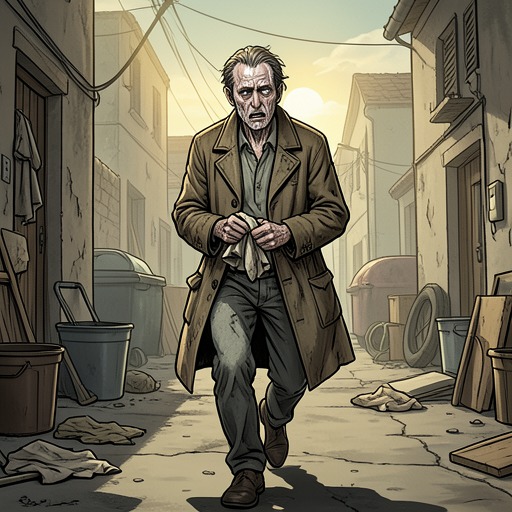
A growing blankness takes hold of Raskolnikov after the killings. He loses track of what matters and turns instead to small, immediate tasks: a bucket half full of water stands on a kitchen bench, and he uses it to wash his hands and the axe. He takes soap from a broken saucer on the window, cleans the blade, and spends about three minutes rubbing the wooden handle where marks remain. He wipes the axe with linen hanging to dry in the kitchen and examines it at the window. No trace remains on it, though the wood is still damp. He hangs it in the loop beneath his coat.
He then checks his overcoat, trousers, and boots in the dim kitchen. At first, he sees marks only on the boots and rubs them with a wet rag, yet he knows he is not examining himself thoroughly. The routine offers no reassurance: he stands in the middle of the room, unable to decide whether he is reasoning clearly or should be doing something entirely different. His impulse is to flee, but the entryway presents a problem he has overlooked. The outer door, which he had rung earlier, stands at least six inches open, without lock or bolt engaged. He realizes that Lizaveta Ivanovna must have entered somehow. The open door turns a detail he failed to consider into a direct reminder that his account of the scene is incomplete.
The Visitor at the Door
Raskolnikov waits while two voices shout and quarrel somewhere distant, perhaps in the gateway. When the voices stop, a door below opens and someone goes downstairs humming. He begins to leave, but then hears footsteps climbing. Their measured, heavy pace grows clearer as the person passes floor after floor. By the time the steps reach the third floor, Raskolnikov feels unable to move; the approach has become, in his perception, like a dream of pursuit.
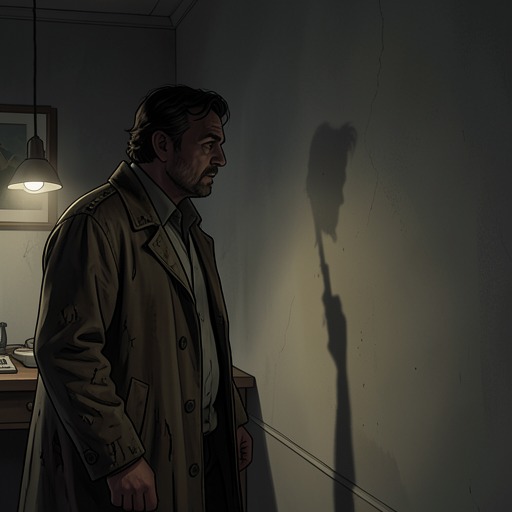
As the visitor reaches the fourth floor, Raskolnikov slips back into the apartment and closes the door. He quietly fixes the hook in its catch and crouches beside it, holding his breath. The visitor stands on the other side, as Raskolnikov had stood earlier when separated from Alyona Ivanovna by the same door. The visitor pants and rings the bell loudly. Raskolnikov grips the axe. The scene’s suspense comes from this enforced stillness: he is close enough to hear the person outside, but can neither identify the visitor nor safely leave.
Escape Through the Empty Flat
Eventually, a young man on the stairs calls out that he is studying the law and that something is plainly wrong, then runs downstairs. Raskolnikov opens the apartment door only after the sound has stopped. He goes out abruptly, closes it as thoroughly as he can, and descends. Even outside the apartment, the possibility of being remembered makes every direction dangerous: he fears that being stopped could expose him, but imagines that passing unnoticed could also lead others to remember him.
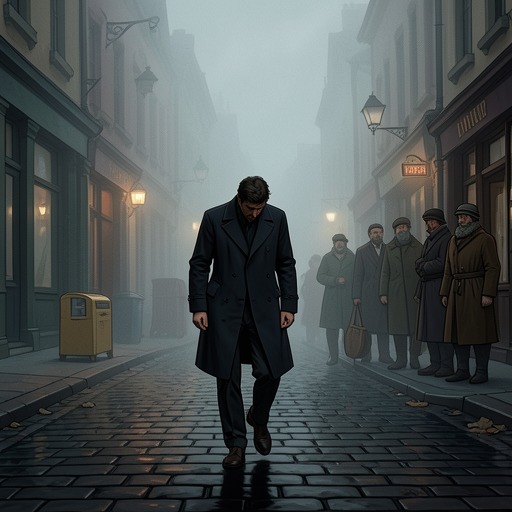
On the second floor he sees an empty flat with its door wide open, the same flat where painters had been working. They have just left; a pail, a broken pot containing paint, and brushes remain in the freshly painted room. Raskolnikov slips behind the wall just as the workers reach the landing. They turn and continue upward, talking loudly, toward the fourth floor. He waits, then tiptoes out and runs down. The workers’ departure creates his chance to hide, while their return upstairs directs attention away from his descent. He passes through the gateway and turns left into the street.
Returning the Axe
His escape from the building is not the end of the practical danger. Raskolnikov later finds himself back on the staircase before he remembers that he still has the axe. He recognizes that he must return it without attracting notice, yet he cannot consider alternatives or weigh the risks. The porter’s room is closed but unlocked; he opens the door, finds that the porter is absent, and puts the axe beneath the bench, covering it again with the piece of wood that had concealed it before.
He encounters no one on the way to his room, and the landlady’s door is shut. Once inside, he throws himself onto the sofa without taking off his clothes. He does not sleep, but sinks into blank forgetfulness, while fragments of thought crowd his mind without settling into a coherent idea. The axe has been returned, but his apparent success does not restore composure or command of himself.
Narrative Significance
The episode is organized around interruptions that repeatedly alter Raskolnikov’s immediate choices: the open door, the visitor’s ascent, the young man’s alarm, the painters’ movements, and the forgotten axe. The narrative slows around ordinary objects and sounds—a bucket, a soap dish, a hook, footsteps on the stairs—so that escape becomes a succession of exposed decisions rather than a single clean break. His careful washing and inspection sit beside failures of attention; he scrutinizes the axe but overlooks the open door, then leaves with the axe still in his possession.
The sequence also keeps the danger partly unseen. The visitor remains unidentified in the evidence of the scene, and the approach is registered first through footsteps and breathing. That delay sustains uncertainty while placing the reader close to Raskolnikov’s narrowed, unstable attention. His route out depends less on a composed plan than on openings he does not control: a door left ajar, a temporarily empty flat, absent occupants in the porter’s room. The return to the axe and the collapse on the sofa complete the episode with a double consequence: he has escaped immediate notice and restored the borrowed object, yet remains unable to think or rest coherently.