Raskolnikov’s poverty
Crime and PunishmentRodion Romanovitch Raskolnikov’s poverty shapes the conditions of his daily life: he has left university for lack of money, goes without meals, wears conspicuous rags, and sleeps in a cramped, neglected room. Yet deprivation is not presented as a single explanation for his choices. It is both an immediate physical pressure and the background to his increasing disengagement from the ordinary tasks by which people manage hardship.
Identity and Material Circumstances
Raskolnikov is crushed by poverty, but his response to it is not steady practical anxiety. He has ceased attending to matters of everyday importance and has lost the desire to attend to them. The distinction matters: the circumstances remain severe even as concern about them seems to recede. His indifference does not resolve his need; it leaves him less able or willing to address it.
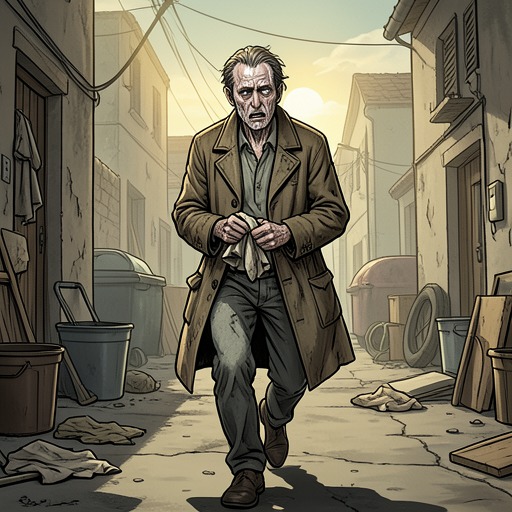
His appearance makes that deprivation public. His clothes are so shabby that even someone accustomed to poor dress might be ashamed to be seen in them. In the streets around the Hay Market, however, crowded with traders and working people and marked by many kinds of establishments, unusual clothing attracts little notice. The setting makes his rags ordinary to passers-by, but not to him in every circumstance: he especially dislikes meeting acquaintances and former fellow students. Poverty is thus at once visible and partially concealed by the variety of the neighborhood; social recognition, rather than the street’s general gaze, sharpens his discomfort.
The account also makes deprivation bodily. At one point Raskolnikov has scarcely tasted food for two days, and his thoughts seem tangled while he feels weak. The shortage is not abstract hardship but hunger and diminished energy, accompanying a mind already under strain. The narrative holds these conditions together without treating hunger as a complete account of his state.
Food, Money, and Daily Survival
His meals depend on small, uncertain acts of provision. After waking late, he receives weak, stale tea from Nastasya, served from her own cracked teapot with two yellow lumps of sugar. He gives her coppers and asks her to buy bread and the cheapest sausage available from the pork butcher. Nastasya offers yesterday’s cabbage soup instead, explaining that she had saved it for him. The exchange shows both the narrowness of his means and the informal, improvised character of his access to food: a handful of coins must cover a basic purchase, while a saved portion of soup may be the more substantial alternative.
Even this help exists within a strained household arrangement. The landlady has stopped sending meals, and Raskolnikov has not thought to protest, although he goes without dinner. Nastasya, the cook and only servant, has largely stopped cleaning his room as well, entering with a broom only about once a week. His deprivation therefore appears not only as an empty purse but as a breakdown in the small routines of lodging, meals, and care. He avoids dealing with the landlady less because her demands present a real terror than because he dreads being detained by complaints, payment demands, threats, and the need to invent excuses.
Cash remains scarce enough to be counted and allocated. While walking, he works out that he has thirty copecks left after spending twenty on a policeman, three on Nastasya for the letter, and roughly forty-seven or fifty on a poor family the previous day. He soon forgets why he took the money from his pocket, but the arithmetic briefly exposes how little remains and how quickly even a small sum is spoken for. The episode places calculation beside distraction: he can reckon each expense, then lose hold of the purpose of the reckoning.
Education and Family Support
The consequences extend beyond daily subsistence. In a letter, his mother explains that he gave up university some months earlier because he lacked the means to support himself, and that he had also lost his lessons and other work. His absence from study is therefore tied directly to financial necessity, while the loss of work compounds the problem of how he might maintain himself.
The letter also reveals how limited and encumbered his family’s assistance has been. His mother lives on a pension of one hundred and twenty roubles a year. The fifteen roubles she sent four months earlier had been borrowed against that pension, and she could not send more until the debt was paid. She now reports that it has only just been cleared. Earlier, his sister took a governess position and accepted a hundred-rouble advance, chiefly so that she could send Raskolnikov sixty roubles the previous year. The family had described that money as coming from her savings; the letter corrects that account. Support reaches him, then, through borrowing, advance payment, and concealment, not through a dependable reserve. The sums and the delayed disclosures make visible how his education and survival are entangled with sacrifices made by relatives who have little to spare.
Isolation, Space, and Narrative Significance
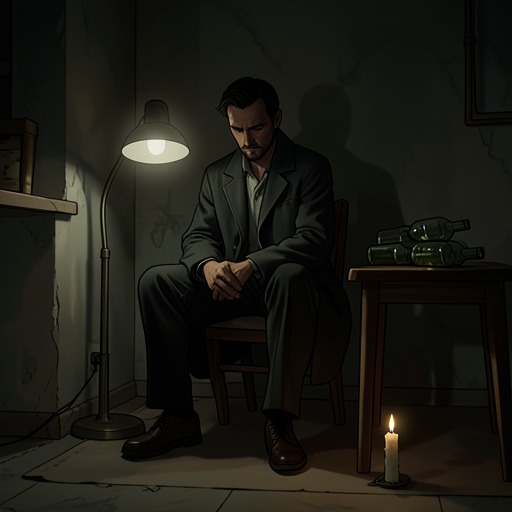
Raskolnikov’s room gives poverty an enclosing form. It is a tiny, low-ceilinged space about six paces long, with dusty yellow paper peeling from the walls, three rickety chairs, and a painted table bearing manuscripts and books left untouched long enough to gather thick dust. A large sofa takes up much of the room and serves as his bed. He often sleeps on it without undressing, wrapped in his old student’s overcoat, using his linen beneath a small pillow as a bolster. The objects that might suggest study or ordinary domestic life remain present, but the room’s disrepair and his manner of sleeping make their neglect unmistakable.
The room also becomes a refuge that intensifies withdrawal. Raskolnikov has got away from everyone, as if enclosed in a shell, and even the sight of a servant entering can provoke nervous irritation. He hates the room when he wakes in it, yet the disorder suits his present state of mind; when he considers returning home after a walk, the thought of the cramped space fills him with loathing. That contradiction makes the garret more than a measure of material want: it is both the place where his isolation gathers and a place from which he recoils.
Poverty remains a concrete condition throughout these scenes, visible in food, clothing, debt, lost study, and the worn furniture around him. Its narrative force lies partly in this accumulation. The shortage of money repeatedly narrows the practical options available to Raskolnikov, while his retreat from practical concerns makes those needs harder to meet. At the scene of the murder, his hands feel weak, numb, and wooden as he holds the axe beneath his coat. That detail keeps bodily vulnerability present at the moment of violence, without making deprivation alone an explanation for what he does.