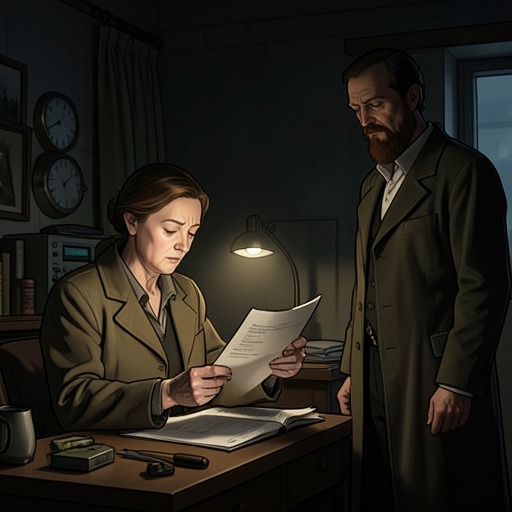
Rodion Raskolnikov and Dounia's sibling relationship
Crime and PunishmentThe relationship between Rodion Romanovitch Raskolnikov and his sister, Avdotya Romanovna Raskolnikova, is shaped by fierce affection and an unequal exchange of sacrifice. She has already taken on debt and hardship to help him, while he sees her proposed marriage to Pyotr Petrovitch Luzhin as a further surrender made for his sake. His love becomes protective protest, but the family’s poverty leaves him painfully unsure what he can offer in return.
Family Bond and Separation
Their closeness is conveyed first through the letter that brings news from home. When it arrives, Raskolnikov wants to be alone with it; after his visitor leaves, he kisses the letter and studies the familiar handwriting of the mother who taught him to read and write. His response gives the news of his sister’s life an intimate force before he has even opened the pages.
The letter explains that Avdotya Romanovna has recently come to live with their mother and that the two will not be separated again. Their separation had left Raskolnikov with incomplete knowledge of his sister’s troubles. He had asked for an account of what she endured in the household of Mr. Svidrigailov, but their mother had not been able to tell him the whole truth at the time. She feared that, if he knew, he would abandon everything and come to their aid, even on foot. Her concern rests on her understanding of his character: she believes he would not tolerate his sister being insulted.
Raskolnikov, for his part, insists inwardly that he knows Avdotya Romanovna’s capacity to endure hardship. He recalls that she was nearly twenty when he last saw her and says he has thought about that endurance for two and a half years. Yet his awareness of her strength does not reassure him. He fears that the very quality he admires—the ability to bear a great deal—makes it easier for the family to ask her to bear more.
Sacrifice Before the Engagement
The mother’s letter reveals a concrete earlier sacrifice. Avdotya Romanovna took a position as governess with the Svidrigailovs and received one hundred roubles in advance, with part of her salary to be deducted each month. The debt made it difficult to leave the position, and she had taken the money chiefly to send Raskolnikov sixty roubles when he urgently needed it. The family had told him that this money came from her savings; the letter now corrects that account. His sister had borrowed against her own future earnings to support him, while he had not known the real cost of the help.
The letter also recounts how Avdotya Romanovna’s reputation was cleared after the scandal involving Mr. Svidrigailov. The servants’ testimony helped establish her innocence. Marfa Petrovna then apologized, embraced her, and went from house to house telling people the truth, even showing them Avdotya Romanovna’s letter to Mr. Svidrigailov. The public campaign restored her standing, and several families asked her to give lessons. She refused. The exoneration therefore brings respect and new possibilities, but it also precedes the news that she has agreed to marry.
Marriage as a Family Bargain
Their mother presents Pyotr Petrovitch Luzhin as a well-to-do, dependable suitor who is eager to travel to Saint Petersburg. Raskolnikov reads the proposed marriage through the pattern of sacrifice already disclosed in the letter. He suspects that Avdotya Romanovna is accepting a man she does not love in order to improve her family’s prospects, and especially to help her brother return to university and secure a future. In his view, the marriage risks turning her endurance into a bargain: comfort for the family purchased with her freedom and peace of mind.
His reaction is not simply a rejection of Luzhin as an individual. Raskolnikov fears that his sister and mother have made him the unspoken center of their decision. He imagines the benefits they hope to secure for him—education, a position, and eventual prosperity—and recoils at the thought that these hopes might be paid for by Avdotya Romanovna’s submission. He also compares the proposed marriage with the desperate life of Sofya Semyonovna Marmeladova, arguing that an outwardly respectable arrangement could carry its own form of humiliation if it binds his sister to a man she cannot respect. This is his interpretation of the choice, not a statement that the letter itself gives her motives in those terms.
Protective Love and Its Limits
Raskolnikov’s response culminates in an emphatic refusal to accept the sacrifice. He tells himself that Avdotya Romanovna must not make this bargain for him and extends the protest to their mother as well. The force of his reaction shows how deeply he feels responsible for them, even while he is living on their assistance. Their mother’s pension is only one hundred and twenty roubles a year; she has borrowed against it, and the earlier help sent to Raskolnikov came at a cost he did not understand. He sees the contradiction sharply: he wants to forbid his sister’s sacrifice but cannot point to the resources or position that would give him the right to do so.
That contradiction gives the relationship its unresolved tension. Avdotya Romanovna’s earlier support for her brother is established by the loan-funded money she sent him; the claim that she now accepts Luzhin for the family’s sake is Raskolnikov’s anguished inference from the news. He loves her enough to refuse the idea of her being spent for his benefit, yet his own dependence makes that refusal difficult to turn into protection. The bond is therefore both a source of loyalty and a measure of his helplessness: each sibling’s concern for the other is real, but poverty makes care arrive entangled with debt, concealment, and painful choices.