Sofya Semyonovna Marmeladova
Crime and PunishmentSofya Semyonovna Marmeladova, known as Sonia, is Semyon Zaharovitch Marmeladov’s daughter and Katerina Ivanovna’s stepdaughter. Her story is presented through her father’s confession: a young woman whose education and choices are sharply limited by poverty, she becomes a source of material support for a struggling household. Her help brings brief relief, but her father’s repeated dependence on her money makes that relief precarious.
Family and Background
Sofya Semyonovna Marmeladova grows up in a crowded, poor household with her father, stepmother, and three young children. Semyon Zaharovitch Marmeladov describes Katerina Ivanovna as generous in feeling but spirited and quick-tempered, and says that his daughter endured difficulties with her while growing up. The family’s needs fall especially heavily on the women: Katerina Ivanovna works from morning to night at cleaning and washing, while the children’s hunger and the adults’ illness leave little room for security.
Her father’s alcoholism further undermines the household. He admits that he has sold her stockings and a shawl that had been given to her in order to buy drink. Katerina Ivanovna’s health is weak, and the family lives in a cold, crowded room. Semyon Zaharovitch Marmeladov presents his drinking both as a cause of misery and as a response to his awareness of it; that explanation does not undo the harm, but it places his daughter’s sacrifices within a household where her father’s conduct repeatedly consumes resources the family needs.
Education and Limited Prospects
Sofya Semyonovna Marmeladova has little formal education. Her father says that he tried to teach her geography and universal history four years earlier, but lacked adequate knowledge and books; their lessons ended at Cyrus of Persia. The books they did possess were later lost. In adulthood, she read romantic works and, through Mr. Lebeziatnikov, obtained Lewes’ Physiology, from which she recounted passages to the family. The small, uneven record of her reading shows both her curiosity and the material constraints that prevent it from developing into a conventional education.
Her prospects for earning a living through respectable work are raised by her father as an urgent question rather than an abstract one. The family has hungry children, Katerina Ivanovna is ill, and Semyon Zaharovitch Marmeladov is not reliably providing for them. In this setting, the lack of education is not simply a biographical detail: it narrows the routes to income available to a young woman already carrying responsibilities for the household.
The Yellow Ticket and Its Consequences
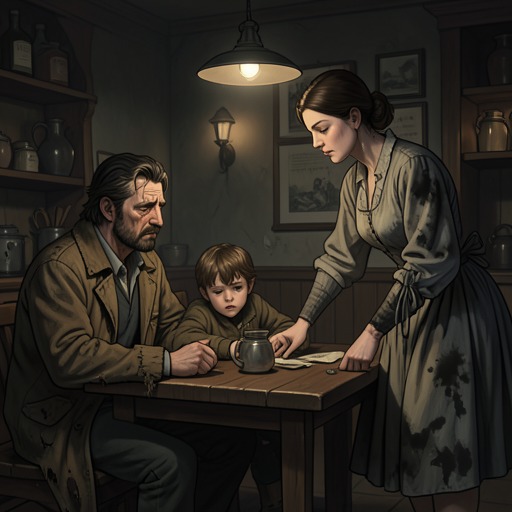
The crisis comes when there is no food for the children and pressure is put on Sofya Semyonovna Marmeladova to obtain money. Her father, who says he was drunk and lying down at the time, recounts that she left in the early evening and returned several hours later with thirty roubles. She placed the money on the table without speaking, then covered herself with a large shawl and lay facing the wall. Katerina Ivanovna later went to her, knelt beside her bed, and remained there with her. The account gives the exchange its domestic consequences: the money meets an immediate need, while the family’s response registers the gravity of what she has undertaken.
After information and conflict within the lodging household, Sofya Semyonovna Marmeladova is forced to take a Yellow ticket. The resulting restriction means she can no longer live with her family. The landlady, Amalia Fyodorovna Lippevechsel, will not allow her to remain there, and Mr. Lebeziatnikov also objects. Although he had previously sought her attention, he later invokes his education as a reason he cannot share rooms with her. Sofya Semyonovna Marmeladova consequently visits mostly after dark, bringing comfort to Katerina Ivanovna and giving the family what she can. Her exclusion from the home does not end her family role; it makes that role more precarious and less visible.
Money, Appearance, and Family Dependence
When Semyon Zaharovitch Marmeladov finds work again, the household briefly changes its routine. Katerina Ivanovna and the children treat his return to employment as a source of hope: they move quietly while he rests, prepare coffee and cream, and arrange a uniform and other clothing for eleven roubles and fifty copecks. Sofya Semyonovna Marmeladova contributes money for the time being, but says she cannot visit often and may come only after dark. Her contribution helps make the family’s temporary improvement possible while her circumstances keep her apart from it.
That improvement does not last. Semyon Zaharovitch Marmeladov later admits that the thirty copecks he has spent on drink came from his daughter, who gave him the last money she had. He recognizes that she needs money to maintain her appearance, including clothing and shoes, but takes the funds anyway. The episode turns ordinary purchases into evidence of a double burden: the money is necessary for her own livelihood, yet her father treats it as available for his immediate use. His remorse is real within his account, but it does not prevent the taking or repair the resulting dependence.
Narrative Significance
Sofya Semyonovna Marmeladova’s character emerges through what she gives and what the narrative reports others doing in response. She speaks little in her father’s account: at the moment she brings home the thirty roubles, she places the money down silently, and later she gives him thirty copecks without rebuke. Her father reads that silence as more painful than blame. The contrast between her limited speech and the weight of her actions makes her material support—not a stated theory or public declaration—the clearest measure of her place in the family.
The same pattern informs Rodion Romanovitch Raskolnikov’s response to his mother’s letter. As he considers his sister’s decision to marry Pyotr Petrovitch Luzhin, he invokes Sofya Semyonovna Marmeladova as an example of a woman made to bear the cost of family need. He sees the two situations as distinct in circumstance but connected by sacrifice: his sister’s proposed marriage may secure support for him and their mother, while Sofya Semyonovna Marmeladova’s earnings help sustain her own household. This comparison makes her experience part of the novel’s wider examination of poverty, constrained choice, and the way the costs of survival are transferred onto women.