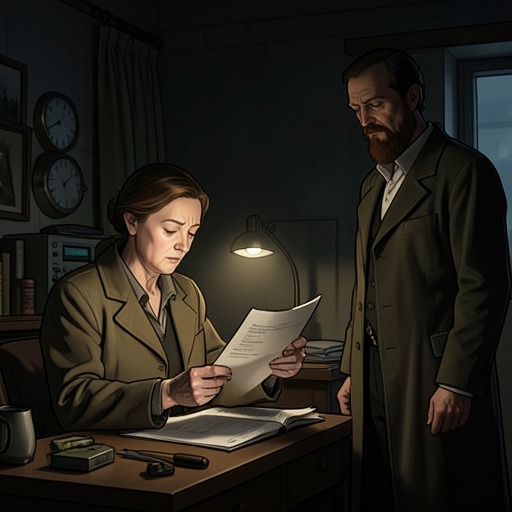
The Svidrigailov affair and Dounia’s restoration of her reputation
Crime and PunishmentThe Svidrigailov affair and Dounia’s restoration of her reputation is a family crisis recounted in Raskolnikov’s mother’s letter: Avdotya Romanovna Raskolnikova’s resistance to her employer’s advances is first misread as guilt, then vindicated by evidence that reverses the scandal’s public verdict. Her ordeal moves from the constraints of paid service into a town-wide campaign of humiliation, before the same social network that condemned her becomes the means of restoring her name. The episode also changes the family’s circumstances and precedes the news that Avdotya has agreed to marry Pyotr Petrovitch Luzhin.
Employment and the concealed pursuit
Avdotya Romanovna Raskolnikova had taken a governess’s position in Mr. Svidrigailov’s household and received a hundred roubles in advance. Part of her salary was to be withheld each month to repay it. The arrangement had a direct consequence when the household became intolerable: leaving at once would mean abandoning the position before the debt was cleared. The family had also concealed the advance’s purpose from Rodion Romanovitch Raskolnikov. Most of it had enabled Avdotya to send him sixty roubles the previous year, which their mother had described as money from Avdotya’s savings. The letter corrects that account and makes her sacrifice part of the affair’s background.
At first, Mr. Svidrigailov treated Avdotya rudely, making disrespectful and jeering remarks at table. His conduct worsened when he was drinking and returned to what the letter describes as his old regimental habits. The later explanation was that he had conceived a passion for Avdotya from the beginning, disguising it with contemptuous behavior. His hopes, his age, and his status as a father and head of a family may have intensified his anger, but the letter presents these as possible explanations rather than certain motives. Eventually he made an open proposal, offering inducements and suggesting that he would leave everything to take her to another estate or abroad.
Avdotya could not simply leave without facing the consequences of the debt, while an immediate departure also risked distressing Marfa Petrovna and causing a rupture in the household. A scandal, the letter stresses, would itself fall upon Avdotya. She remained for another six weeks, enduring the situation without writing her mother the full story because she feared causing her further distress. Her silence thus forms part of the pressure: she maintained contact with her mother while withholding the circumstances that might have made her suffering legible to her family.
Expulsion and public disgrace
The crisis broke when Marfa Petrovna accidentally overheard her husband pleading with Avdotya in the garden. She interpreted the scene as evidence against Avdotya, blamed her, and refused to hear her explanation. During the confrontation Marfa Petrovna struck her and ordered that she be sent away immediately. Avdotya’s departure was made conspicuously degrading: her linen and clothes were thrown into a plain peasant’s cart without being folded or packed, and she had to travel seventeen versts into town in an open cart with a peasant while a heavy shower fell.
The expulsion did not end the punishment. For a month, gossip about the scandal circulated through the town and surrounding district. Avdotya and her mother were afraid to attend church because of the contemptuous looks, whispers, and remarks directed at them. Acquaintances avoided them, and people no longer bowed to them in the street. The letter also reports that some shopmen and clerks planned to smear the gates of their house with pitch, while the landlord began telling them they would have to leave. These details show how an accusation could threaten not only Avdotya’s personal standing but also the family’s access to ordinary public life and housing.
Marfa Petrovna helped spread the accusation. Familiar with people throughout the neighborhood, she repeatedly came into town and complained about her husband and the affair, carrying her version from one household to another. The public humiliation therefore grew through social circulation rather than through any formal judgment. Avdotya bore it more steadily than her mother and tried to comfort and cheer her, even while her own name remained under suspicion.
Evidence and the reversal of the accusation
The decisive change came when Mr. Svidrigailov returned to his senses and repented. He produced a letter Avdotya had been forced to write and give him before Marfa Petrovna discovered them in the garden. In it, Avdotya refused personal explanations and secret meetings, reproached him for his conduct toward his wife, and insisted that he was a father and head of a family. She also condemned his treatment of a vulnerable young woman already burdened by hardship. The letter’s existence turned the scene Marfa Petrovna had misread into evidence of Avdotya’s refusal, not consent.
Testimony from the servants reinforced the written proof. They had seen and known more than Mr. Svidrigailov supposed, and their evidence cleared Avdotya’s reputation. Marfa Petrovna was taken aback and became convinced of Avdotya’s innocence. The reversal depends on evidence that had existed during the scandal but had not been heard: Avdotya’s own words, preserved in the letter, and the servants’ knowledge of the household. The same private household whose power had enabled the accusation now supplied the means to refute it.
Public restitution and consequences
On Sunday, Marfa Petrovna went to the Cathedral, prayed in tears, and then came directly to Avdotya and her mother. She told them the full story, wept, embraced Avdotya, and asked forgiveness. Her recognition of the wrong was followed by an equally public effort to repair it. That same morning she visited households around town, affirmed Avdotya’s innocence and the nobility of her conduct, and showed people the letter in Avdotya’s own handwriting.
Marfa Petrovna continued these visits for several days, reading the letter wherever she went and allowing people to take copies. The sequence became almost a public itinerary: households expected her on particular days, and listeners gathered even when they had already heard the letter read elsewhere. Raskolnikov’s mother regards this repetition as excessive, but it also answers the breadth of the original gossip. Marfa Petrovna had helped carry the accusation through the community; now she carried the evidence of Avdotya’s innocence through the same network. The affair’s public character makes private remorse insufficient on its own, so restoration also has to be public.
Avdotya’s reputation was re-established, while the disgrace of the affair settled upon Mr. Svidrigailov as the person responsible. The reversal was material as well as social: several families asked Avdotya to give lessons, though she refused. The improved respect toward her helped bring about a change in the family’s fortunes. Her mother’s letter then reports that Avdotya has a suitor, Pyotr Petrovitch Luzhin, and has already consented to marry him. The episode’s ending therefore joins vindication to a new prospect, without erasing the coercion, debt, and public shaming that preceded it.
Narrative significance
Because the episode reaches the reader through a letter, its account is both a revelation and an explanation addressed to Rodion Romanovitch Raskolnikov. His mother explains why she withheld the truth: she feared he would abandon everything and come to defend his sister, potentially ruining himself, while Avdotya would not have wanted that sacrifice. The account also reveals that the money he had received came at a cost borne by Avdotya, not from savings as he had been told. The family’s concealed hardship and her protection of him thus form part of the event’s emotional stakes.
The affair exposes the unequal conditions of Avdotya’s employment. She faces an employer’s sexual pursuit while an advance payment makes departure difficult; when the employer’s wife misreads the situation, the resulting disgrace falls first on the woman with less power to control the household or the town’s account of events. Avdotya’s letter and the servants’ testimony eventually overturn that judgment, but only after Marfa Petrovna chooses to use her own social influence to correct what she had helped create. The episode’s central reversal is consequently not just a change in belief: the evidence moves through the same community that had made the accusation consequential, and Avdotya’s restored reputation alters what can follow for her family.