Yellow ticket system
Crime and PunishmentThe Yellow ticket system enters the narrative not as an abstract regulation but through the rupture it produces in Sofya Semyonovna Marmeladova’s family life. A yellow ticket, also referred to as a yellow passport, is associated with her being forced to go out under that designation; afterward, she cannot continue living with her family. The account emphasizes both the constraint behind her situation and the continuing ties that exclusion fails to sever.
The Ticket and Its Circumstances
Semyon Zaharovitch Marmeladov recalls that when his daughter first went out with a yellow ticket, he had to go somewhere because he had nowhere else to turn. His remark places the ticket within a wider condition of desperation: he describes seeking help despite knowing in advance that he would receive nothing. The ticket’s significance in this passage is thus bound to the family’s lack of recourse, rather than to an explanation of the system’s formal rules.
Marmeladov says Sofya was forced to take the ticket after an unfortunate occurrence and information supplied by people he calls ill-intentioned. He singles out Darya Frantsovna as having played a leading part, ostensibly because she had been treated disrespectfully. The account supplies his explanation of how Sofya came to bear the designation, but does not set out an official procedure or establish details beyond his reported version.
Exclusion from the Household
The ticket changes where Sofya can live. Their landlady, Amalia Fyodorovna Lippevechsel, will not allow her to remain in the household, although Marmeladov says Amalia had previously supported Darya Frantsovna. Mr. Lebeziatnikov also objects to Sofya’s presence. He first tries to make advances to her, then invokes his education and dignity as grounds for refusing to share rooms with her. His reversal exposes how quickly a claim to respectability becomes a means of excluding her.
Katerina Ivanovna defends Sofya and will not let Mr. Lebeziatnikov’s objection pass. The dispute over whether Sofya may remain in the rooms therefore becomes a direct conflict over her place in the family home. The outcome is that she cannot live there: she lodges separately with the Kapernaumovs, a poor family of tailors, in a room partitioned off from theirs.
Continuing Family Ties
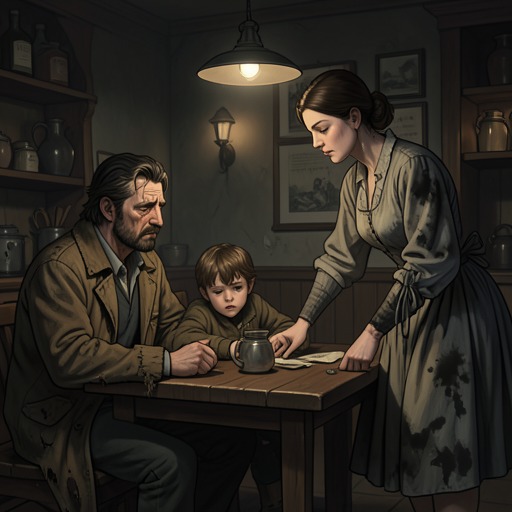
Separation does not end Sofya’s relationship with the household. She comes to visit mostly after dark, comforts Katerina Ivanovna, and gives the family whatever she can. Against the force of the ticket’s social consequences, these actions preserve a practical and emotional connection: she is barred from living with her family, yet continues to care for them.
Marmeladov’s account makes the ticket both a mark associated with Sofya’s changed circumstances and the immediate cause, in his telling, of her removal from the home. The contrast between her exclusion from shared rooms and her repeated visits gives the system’s impact a domestic scale: it divides a family’s living arrangements without erasing its dependence on her or her attachment to them.