Crimson Lake township
Crimson LakeCrimson Lake township is a remote settlement shaped by rainforest, wetlands, and the desire for distance. For Ted Conkaffey, arriving there means finding a place where his public disgrace seems less immediately present; for the novel, the town’s isolation is not empty scenery but a force that shapes how people live, whom they encounter, and what can remain concealed.
Landscape and Setting
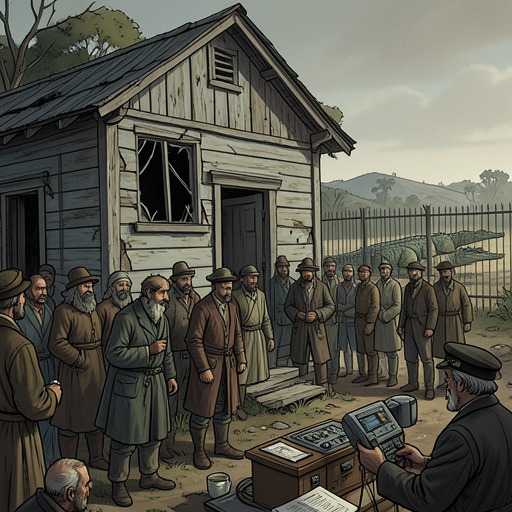
Ted’s account of Crimson Lake township presents a small settlement pressed on by the natural world. Moss and vines cover surfaces, while rain and dampness are constant and rivers and lakes swell against roads. Along the rivers, abandoned houses sit partly concealed by vegetation. The landscape seems capable of absorbing traces of the past, an image that makes the town feel like a possible refuge for people hoping to leave their histories behind.
The house Ted finds stands at the edge of the lake at Crimson Lake, on land that had been inherited by owners too old to live there and left unoccupied for years. From its porch, he looks across the water toward cane fields where farmers are back-burning. The house’s neglect and position beside the wetlands place him at the settlement’s margins, physically removed from the more populated world he has left.
Isolation and Local Life
The township’s remoteness shapes its social atmosphere. Ted finds that residents in the small towns on his route north seem less concerned with one another’s business than people in the city. At Crimson Lake, he reads community notices at a local store: practical advertisements sit beside a funeral notice for Teresa Miller, who died in a car accident six months earlier. The notice offers a small, ordinary sign of community life without making the town feel welcoming or intimate.
Homes around Crimson Lake are dispersed across properties and wetland outcrops. Some residents have gardens that let them remain at home for days without going out among other people. Ted imagines the area as a place where runaways might settle, and where illicit stills or concealed marijuana crops might exist. These are his impressions rather than confirmed discoveries, but they reflect how the settlement’s distance and cover invite speculation as well as solitude.
Contrasts Within the Township
Crimson Lake is not a conventional tourist destination. It is too remote and wild to attract organized tours, and locals are described as unwelcoming. Rickety docks and solitary fishermen mark the waterfront. Visitors who enter the water may assume that crocodiles cannot travel between lakes, but narrow creeks connect the backwaters and can carry dangerous animals between them. The landscape thus resists being treated as a collection of separate, safe leisure sites.
South Crimson Lake has a markedly different character from Crimson Lake proper. Paved driveways, an outdoor café, and a line of large houses near the national park distinguish it from the poorer, more neglected homes elsewhere. Warning signs tell drivers to watch for cassowaries crossing from the park toward the wetlands. The contrast makes clear that the township’s isolation is not experienced uniformly: wealthier residents occupy a more polished enclave, while other parts of the settlement are defined by neglect and withdrawal.
Narrative Significance
For Ted, Crimson Lake offers distance from city attention and the possibility that a painful history might recede. Yet the town’s landscape does not simply erase what people bring to it. Its concealed homes, connected waterways, and divided neighborhoods create a setting in which withdrawal is possible but never equivalent to safety or a clean break. The same remoteness that makes Crimson Lake a refuge also gives it a shadowed quality, linking the town’s appeal to the risks and uncertainties of living beyond easy reach.