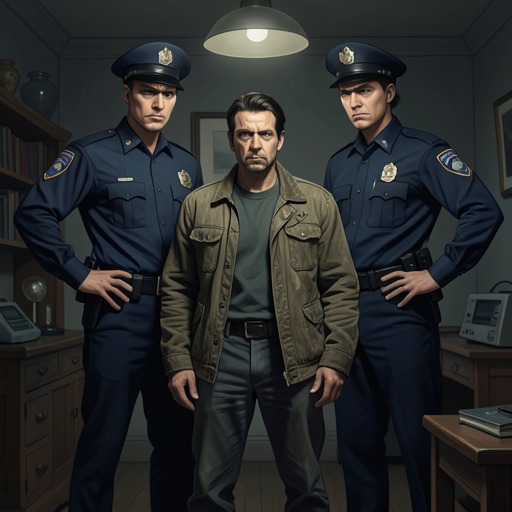
Damford and Hench’s raid on Ted’s house
Crimson LakeDamford and Hench’s raid on Ted’s house is a coercive search that becomes a narrow reversal in Ted’s ongoing struggle with the two officers. They kick in his front door before he can answer, enter amid a cheering crowd, and begin searching under a warrant. But moments before they arrive, Fabiana hides a bag containing six photographs. The officers leave without finding it: for once, their intrusion does not end with Ted at their mercy.
Background and Stakes
The raid takes place against the background of the accusation that has made Ted a public target. The case rests in part on the memory and identification of Claire Bingley, whose condition after her abduction and assault was already evident in interviews shown at Ted’s trial. Her face was badly bruised after her release from hospital; she suffered night terrors and difficulty eating, and her eyes moved restlessly as she struggled to speak. Her interview consisted of fragments, some lucid and others confused. In one repeatedly played clip, she echoed a counsellor’s question about whether she had said her attacker was a policeman. The raid itself does not resolve the truth of Claire’s identification, but the larger context makes the forced entry part of a life in which accusation has become visible and physical: the crowd outside cheers when the officers kick in the door.
The earlier roadside events also show how small uncertainties became consequential evidence. At 12:47 p.m., Marilyn Hope and her daughter Sally saw Ted pull off the highway and park near Claire; Sally remembered the exact time because she checked the car clock and worked out that they had thirteen minutes to reach her dance lesson. Two minutes later, Jessica and Diana Harper saw Ted talking to the girl, although witnesses could not agree whether the back passenger door was open. Other passing motorists disputed whether Ted’s gesture was a goodbye or a beckoning motion; their testimony about that movement lasted three days. These details do not explain why the officers obtained the site-search warrant, a reason the scene does not specify. They do, however, establish the atmosphere in which ambiguous observations have acquired a weight that Ted cannot easily escape.
The Entry and the Concealed Photographs
Just before the officers arrive, Ted and Fabiana have found a small zip-lock bag of photographs curled to fit inside a jar. Fabiana recognizes their significance and reacts with alarm. When the pounding begins and Hench’s voice rises above the crowd, she pushes the bag into the front of her underwear and pulls down the borrowed T-shirt she is wearing. The concealment is immediate and bodily; the photographs pass from exposed evidence to something the officers will have to find by searching her.
Damford and Hench do not wait for Ted to open the door. They kick it in again, making a spectacle of their entrance for the people gathered outside. Hench orders Ted to raise his hands and announces that they have a warrant for a site search. The officers take in the kitchen: coffee grounds are scattered around the sink, and Fabiana stands beside Ted with mussed hair and nervous fingers at the neck of her shirt. The disordered scene gives them an apparent reason to suspect that something has just happened, but it also makes Fabiana’s presence difficult for them to interpret. Their surprise does not stop the search.
The Search and Its Limits
Ted tells the officers they will find nothing. Hench pokes him in the stomach, then tells him to remove his shirt and put his hands on the sink. He slips a finger into the waistband of Ted’s boxers and snaps the elastic. The search is thus not confined, in practice, to cupboards and drawers: Hench uses physical humiliation and probes Ted’s clothing while the concealed bag remains either on Ted or on Fabiana. The officers have not yet established which of them has it.
Fabiana interrupts their attention by asking whether the warrant includes a body search. She bets that it does not, and specifies that it is for the premises only. Her intervention turns the warrant’s stated scope into a point of resistance. The officers turn on her and ask her name, but the scene does not show them locating the photographs or establishing that she has them. Hench nudges Ted with his hip as he passes, apparently testing whether a bag hidden in Ted’s waistband or crotch will crackle. He searches the cupboard, opens drawers, and shuffles loudly through the cutlery. Damford watches Fabiana, trying to determine whether she is concealing the photographs. Their search is active and intimidating, but its central uncertainty persists.
Departure and Reversal
Ted repeats slowly that they will find nothing and tells Damford to believe him. The officers knock over more things as they leave and pause to look through the doorway into Ted’s bedroom. They have entered with the authority of a warrant and the force of a public performance; they depart without the photographs. Ted understands this as a change in the balance between them: for the first time, he has won against Damford and Hench. The victory is limited to this search, not a resolution of his wider legal or public predicament, and its cost is still apparent in his sickness after he shuts the door.
Back in the kitchen, Fabiana places the photographs on the table. Her role as Ted’s protector in the search is over, and she looks at her hands as if uncertain whether she did the right thing. Ted opens the bag and lays out six photographs, each curled from its time inside the coffee jar. They show different teenage girls in the same pose, lying on beds, a carpet, the back seat of a car, and couches. Each girl has an arm raised across her eyes, shielding her identity. The discovery gives the raid its concrete object and consequence: the officers came close enough to search Ted’s body and home, but Fabiana’s concealment kept the photographs beyond their reach. The scene ends not with a clean triumph, but with the evidence exposed between two people who have just survived the search and must now face what it contains.