Fabiana's Secret Recording of Ted's Interview
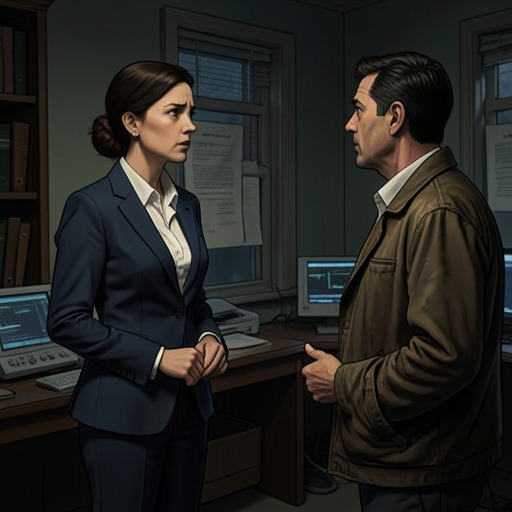
Crimson LakeFabiana's Secret Recording of Ted's Interview is covert footage of Fabiana Grisham speaking with Ted Conkaffey on his back porch, later published as a news video. Its significance lies in the change of status it imposes on an apparently private conversation: Ted understands it as a discussion he was tricked into having, while the resulting story presents it as his first public appearance since the charges were dropped. The footage becomes both a vehicle for his account and another force shaping how the public sees him.
The recording and its disclosure
Ted discovers the recording when he sees Fabiana's report on a screen. He recognizes the setting as his own back porch and concludes that Fabiana must have been carrying a hidden camera. The extent of the recording is alarming to him: he believes it captured their whole conversation, not merely a prepared statement or a short exchange intended for publication.
The surprise depends on the mismatch between the encounter as Ted experienced it and the encounter as the video makes it appear. He insists that there was no public appearance and no interview in the sense suggested by the report; he feels tricked. That reaction identifies the central ethical and narrative tension surrounding the object. The recording gives Fabiana material that can be edited and circulated, but Ted had not understood himself to be participating in a public interview.
What the report says the footage reveals
The headline describes an unheard defence witness in the Conkaffey case, and the accompanying report identifies Ted as a weathered, bearded man speaking to the Sydney Morning Herald reporter. It presents him as raising the possibility that the thirteen-year-old victim's real attacker was in the same area when Ted was seen approaching her. The report therefore turns the conversation into a claim about the case, rather than simply a return to public life after the charges were dropped.
That claim sits against a confused evidentiary history. Ted's recollection of the roadside encounter is explicitly a composite, assembled from what he remembers, what he heard at trial, newspaper accounts, and stories passed to him in jail. In his remembered scene, he pulls into a highway bus stop and parks ten to fifteen metres from a pale girl; passing motorists later supply sharply specific times, including 12:47 and 12:49, while witnesses disagree over the nature of his gesture beside the car. The recording's account of another possible attacker thus enters a story already shaped by observation, disputed interpretation, and retelling.
The prosecution's case had also acquired a potent visual record of Claire Bingley. Ted had watched interview tapes in court, where Claire appeared traumatized and struggled to speak coherently; the prosecution repeatedly played a clip in which she echoed a counsellor's question about whether the man was a policeman. Ted broke down while watching the tapes, and a photograph of him with his head in his hands appeared on the cover of the Herald beneath the headline Crocodile Tears. The covert video adds a new media image to that existing sequence: not a courtroom still, but a conversation presented as a public intervention.
Publication and immediate consequences
Ted reads the report as a betrayal and fears its consequences. The publication makes him feel exposed and unsafe; as he scrolls through the articles, his first response is that he is finished. The video has not settled the question of his guilt. Instead, it gives renewed visibility to the case and places his own words within a frame that he did not choose.
Amanda Pharrell responds with anger at Fabiana for recording the conversation secretly. She also cautions that the coverage could change the situation for Ted, for better or worse, and that its effects might not last. Her reaction differs from his: while Ted is overwhelmed by the public consequences, Amanda quickly returns her attention to the search for the obsessive fan they are investigating. The recording consequently sits alongside another active case rather than replacing it, intruding on the partnership's work and making concentration more difficult for Ted.
The footage within the unresolved case
The language of the report matters because the case had not ended with a finding that Ted was innocent. He had not been acquitted of the charges relating to Claire's rape and attempted murder. The prosecution withdrew the charges halfway through the trial, stating that the evidence was not strong enough to satisfy a properly instructed jury beyond reasonable doubt. Ted understands that this was not the same as the authorities declaring that he had not committed the crime; he remains uncertain whether the case could return and knows that public belief may outlast the proceedings.
Against that background, the report's description of a witness not heard at trial makes the footage appear to reopen a question that the legal process left unsettled. Yet the available account does not establish that the video proves the existence or identity of another attacker. It records Ted discussing a possibility, and the news framing presents that possibility as something that may complicate public perceptions of his guilt. The distinction between a lead, a claim, and a proven fact is essential to understanding what the recording changes—and what it does not.
Circulation and afterlife
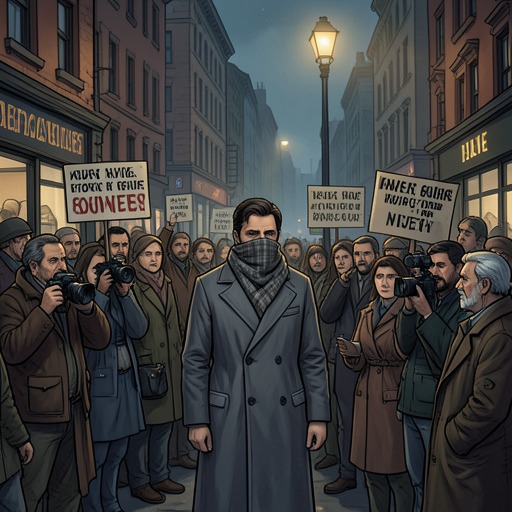
The recording continues to matter beyond Ted's immediate shock. Later, Amanda tells him that a group called Innocent Ted began after the interview footage. Its members are trying to obtain a written statement from Trevor Fuller for their blog and to find phone-tower records that might show who else was in the area on the day Claire was abducted. The video has therefore become a starting point for a form of public inquiry: strangers who believe Ted use the renewed attention to seek corroborating material, rather than treating the published conversation itself as a resolution.
The object's significance is consequently double. It exposes Ted to an unwanted return to public scrutiny, because his private account is converted into a story with a headline, an audience, and an implied argument about guilt. At the same time, its circulation attracts people willing to investigate evidence that might otherwise remain overlooked. The recording does not erase the uncertain memories, contested witness details, or unresolved legal status surrounding the case. It gives those uncertainties another public life, one in which Ted's own account is heard but never fully under his control.