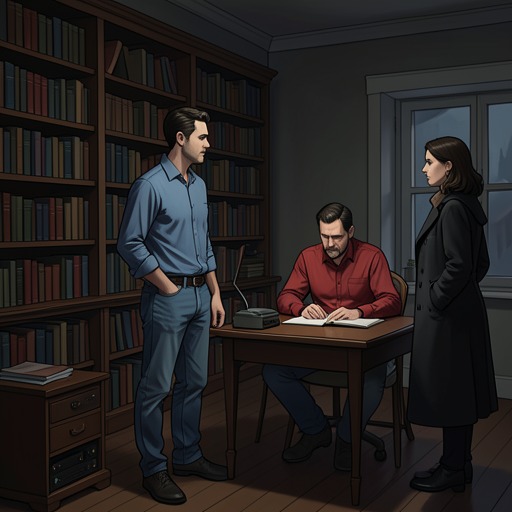
Harrison’s framing of Ormund Smitt
Crimson LakeHarrison Scully’s framing of Ormund Smitt turned fabricated fan mail into a means of suspicion and misdirection. By sending Jake Scully threats that appeared to come from Ormund, Harrison encouraged his father to fear an invented pursuer, attached Ormund to Jake’s car, and concealed his own part in the events leading Jake to the river. The deception depended not on a single false message but on a sequence designed to make one lie appear to confirm another.
The fabricated correspondence
The scheme becomes clear when Amanda Pharrell identifies the letters as Harrison’s, not Ormund’s. Harrison had composed them himself and emailed them to his father, making the supposed fan’s threats seem to arrive from outside the family. The correspondence therefore served two purposes at once: it gave Jake a reason to fear Ormund and gave Harrison a way to influence what Jake believed without appearing to be the source of that fear.
The invented voice was crafted to resemble that of a disturbed, intensely devoted fan. The letters’ threats against Harrison himself helped make the danger seem personal and unpredictable, rather than a straightforward attempt to target Jake. Their apparent author was presented as someone whose fixation on the family had crossed into menace. This performance mattered because Jake was meant to interpret the messages as evidence of a real person’s growing hostility, not as words written by his son.
The later letters escalated the fiction by presenting Ormund as someone who had been inside the family home and had watched its private life. Their claims made the supposed threat feel closer and more invasive than the earlier messages. But that escalation also exposed a weakness in Harrison’s construction: the account had become so extreme that, once examined alongside the other clues, its carefully performed fan persona could be recognized as part of the deception.
Making Ormund look like the source
Harrison did more than forge the letters. He told Ormund where Jake’s car was, knowing that Ormund would go to it. Ormund’s resulting presence at the car placed his fingerprints and fibres there, creating physical traces that could make him appear connected to the larger affair. The car thus became a device for translating Harrison’s written fiction into circumstantial suspicion: the letters supplied an apparent motive and threat, while Ormund’s contact with the vehicle seemed to supply corroboration.
Amanda’s explanation emphasizes that Harrison selected a local person rather than an arbitrary name. Ormund’s attachment to Jake made him predictable: Jake was the centre of Ormund’s life and purpose, so a disclosure about the car was likely to draw him there. Harrison could exploit that attachment without needing Ormund to understand the role he was being made to play. The choice also made the accusation more plausible within the story Harrison was constructing, because a local fan might plausibly have access to places connected with Jake.
The letters’ supposed authorship and the evidence at the car reinforced each other. The correspondence encouraged Jake to believe that Ormund was dangerous; Ormund’s presence at the car could then look like confirmation that the letters had named the right person. In fact, the evidence did not arise independently of Harrison’s actions. He had steered Ormund to the car and created the messages that shaped their interpretation. The apparent pattern was therefore manufactured from connected pieces rather than discovered from unrelated clues.
The message that drew Jake away
Amanda’s account also explains why there was no genuine phone call or message from Ormund summoning Jake. The last letters threatened Harrison, making Jake fear what the supposed fan might do to his son. Harrison then woke his father and presented a fresh message as though it came from an online stranger who wanted to meet by the river and discuss Jake. He added that he was afraid, placing himself in the position of the threatened son and giving Jake an urgent reason to intervene.
Jake went in Harrison’s place, believing that he was going to confront the person threatening his son and keep that person away from him. The deception depended on this reversal: the letters made Jake think Harrison was the target, while Harrison used Jake’s protective response to bring Jake to the meeting instead. The fabricated message did not merely add another false detail to the fan story. It converted the fear produced by the earlier letters into an action by Jake.
Exposure and significance
The framing is exposed through the convergence of details: the messages were written by Harrison, the supposed threats against Harrison were part of the performance, Ormund’s contact with the car had been deliberately prompted, and the final invitation to the river came through Harrison rather than through a real message from Ormund. Amanda’s reconstruction replaces the apparent sequence of an obsessive stranger closing in with a sequence of choices made by Harrison to control what his father saw and how he responded.
The episode reveals how a false narrative can acquire the appearance of proof when its author also arranges the circumstances that seem to support it. Ormund’s actions were real, but Harrison had manipulated the conditions under which they would be interpreted. Jake’s fear was real as well, yet it had been deliberately cultivated through fabricated correspondence and a false report of an immediate threat. The framing therefore worked through both evidence and trust: Harrison shaped the clues, then relied on his father’s concern for him to make the final deception effective.