Lauren Freeman
Crimson LakeLauren Freeman is a seventeen-year-old whose death at Kissing Point shapes the histories of Amanda Pharrell and Ted Conkaffey in different ways. The case presents Lauren as a popular, beautiful girl and records that Amanda, her friend, killed her; later, Ted’s close reading of the published account makes Lauren’s case a test of whether an apparently settled story can withstand scrutiny.
Identity and portrayal
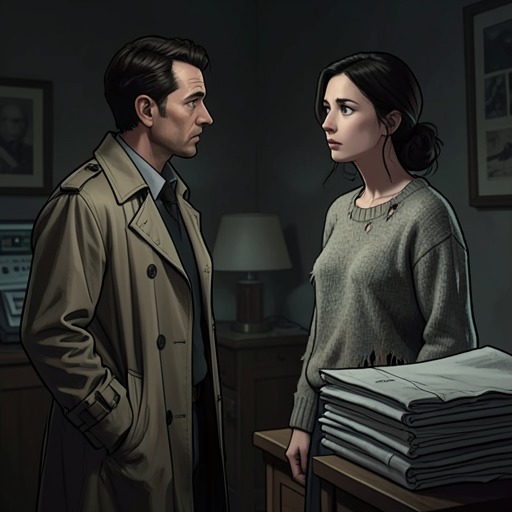
In the account Ted reads, Lauren is described as popular and beautiful. A photograph shows her on a cliff top, looking toward the horizon with her fingers passing through the yellow hair of a Labrador beside her. Ted imagines her on the edge of a promising adult life and notes that she would have been about a foot taller than Amanda. These details establish the contrast through which the book initially frames the two girls, rather than providing a full account of Lauren’s life beyond the case.
Lauren and Amanda Pharrell were friends. On the afternoon of the killing, Lauren picked Amanda up from school, and the two sat talking in Lauren’s 1989 Hyundai Sonata. The evidence does not explain the history or depth of their friendship, but their presence together in the car makes that relationship central to the case’s account of what followed.
The night at Kissing Point
Lauren parked in a small clearing about one hundred metres from the main road down the mountain at Kissing Point, with the rear of the car facing the road. The reconstruction says that each girl was believed to have consumed a 275-millilitre bottle of raspberry-flavoured Vodka Cruiser. Lauren’s cousin’s bank account would show a purchase the previous night, made on behalf of his underage relative; Lauren’s autopsy recorded a blood-alcohol level of 0.02.
The car contained ordinary items associated with a teenage girl, including mascara, fast-food wrappers, receipts, and an old black jumper. A Myer shopping bag, taped shut at the top, held a folded woollen blanket. After the girls had talked for about ten minutes, they left the car; the account states that Amanda then attacked Lauren. It records nine knife wounds and says Amanda admitted the attack at trial. A light rain had just begun. Lauren died, and her killing became the central crime in the account of Amanda’s past.
The case account under scrutiny
Ted’s investigation of Lauren’s death begins with a discrepancy in the book Murder in the Top End. Its account says that Amanda’s clothes were found in the brush a few metres from the car and suggests rain washed blood from them. Ted studies the photographs: the clothes are piled together, while a pictured T-shirt appears spotless. He reasons that rain might wash exposed fabric, but would be less likely to remove traces protected in the folds of a pile. The sequence described in the book, he concludes, does not fit comfortably with the photographs; he considers it possible that Amanda removed her clothes before the attack.
The discrepancy turns Lauren’s case, for Ted, from a received narrative into an unresolved question. The book’s portrait of Lauren as a beautiful, socially successful girl also sits uneasily beside the schoolmates’ portrayal of Amanda as a deeply socially dysfunctional misfit. Ted sees that those descriptions do not readily explain why Lauren would be alone with Amanda in the car, and concludes that someone is lying. The evidence presented here leaves that doubt open rather than identifying who is responsible for the inconsistency.
Narrative significance
Lauren is not developed through an extensive personal history; her presence is mediated by the crime record, photographs, and the judgments of other people. That limited perspective is itself consequential: the idealized image of the girl on the cliff and the practical details of the car and its contents both become part of Ted’s effort to test what the case claims happened. Lauren’s killing is therefore not only the event that led to Amanda’s conviction, but also the point at which Ted’s attention to physical details begins to unsettle an apparently coherent account.
Her case also echoes the book’s concern with public judgment. Ted knows that being regarded as guilty can persist even when a legal process does not establish guilt: he was never acquitted of the charges involving Claire Bingley, because the prosecution withdrew them during trial after deciding the evidence could not satisfy a properly instructed jury beyond reasonable doubt. At a bar, men recognize him and refuse to serve him. That experience does not establish anything about Lauren’s case, but it sharpens the distinction the novel draws between a person, the evidence available about them, and the story a community chooses to believe.