Murder in the Top End
Crimson LakeMurder in the Top End is Eleanor Chapman’s book about Amanda Pharrell and the death of Lauren Freeman. In Ted Conkaffey’s hands, it becomes more than a published account of a notorious case: its portrait of Amanda shapes his first attempt to understand his new friend, while its photographs and reconstruction prompt him to question whether the accepted account of the night is complete. The book’s influence thus depends on a tension between the authority of a detailed narrative and the doubts its details provoke.
Subject and Role in Ted’s Reading
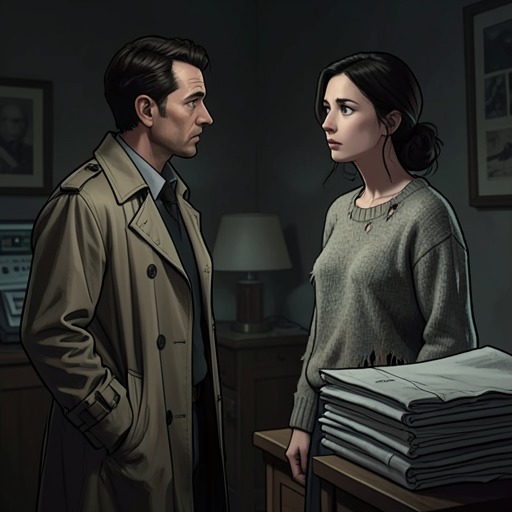
Ted reads the book while trying to reconcile the Amanda he knows with the Amanda described by former classmates. At Cairns Train Station, he watches Amanda come down the stairs with her yellow bicycle and mentally compares the scene before him with the figure presented in Chapman’s account. Reading gives him a ready-made image of his companion, but it also makes him aware of the gap between a public case history and a person encountered in the present.
The account describes Amanda’s school reputation through interviews with classmates and stories of friendships that supposedly collapsed without warning. According to this portrait, she might withdraw from a budding friendship, stop communicating, avoid eye contact, and hide rather than explain the break. Ted’s thoughts liken the pattern to a wary fox approaching a house for food before bolting back into the woods. The comparison captures how the book frames Amanda as elusive and difficult to approach, but it also shows how its narrative turns reported behavior into a vivid, simplifying image.
Chapman’s book also recounts Amanda’s uneven experience at school. She is described as quiet and academically capable in written work, yet unsuccessful in performance or group tasks. One story concerns a teacher unexpectedly reading her essay aloud: Amanda allegedly overturned her desk and ran from the room. These accounts build a coherent picture of social estrangement, but Ted’s effort to fit his present-day partner into that picture leaves the portrait open to question rather than making it a final explanation of her character.
The Account of Lauren Freeman’s Death
The book reconstructs the meeting between Amanda and Lauren at Kissing Point. Lauren, seventeen, drove a 1989 Hyundai Sonata to a small clearing roughly one hundred metres from the main road; Amanda was in the passenger seat after Lauren had picked her up from school. The narrative notes that both girls were believed to have consumed an individual bottle of a pre-mixed alcoholic drink. It also reports that the car contained ordinary belongings, while a taped shopping bag from Myer held a folded woollen blanket. Those particulars place the account in a specific setting and give Ted concrete evidence to examine rather than a general description of the case.
The book’s account says that the girls sat talking in the car for about ten minutes before Amanda attacked Lauren. It then describes Amanda undressing and presents rain as the explanation for why her clothes were clean. Ted stops at this part of the narrative and turns to the accompanying photographs, particularly an image of Amanda’s T-shirt on a laboratory table. The clothes, including the T-shirt, had been found together in a pile in the brush. To Ted, their condition and arrangement do not sit comfortably with the book’s explanation that rain had washed them clean.
Photographs, Gaps, and Doubt
Ted reasons from the folds in the piled clothes: although rain might have washed away some traces, he doubts it would have cleared every part of clothing bundled together. He concludes that the clean clothes could instead be explained if Amanda had taken them off before the attack. That inference does not, on its own, establish what happened between the girls. It changes the question Ted asks of the account, however, from whether its explanation sounds plausible to what the sequence leaves unexplained about Lauren’s presence and actions.
A further tension arises from the way the book presents the two girls. Lauren’s photograph shows her as beautiful and poised, while the accounts of Amanda emphasize social difficulty and disturbing behavior. Ted cannot easily reconcile that public image of Lauren with her association with Amanda. If the classmates’ stories are accurate, he wonders, why were the girls together? The contrast does not prove that any one account is false, but it makes the book’s settled portrait feel unstable. Ted’s conclusion that someone was lying marks a turning point: he no longer treats the published reconstruction as a closed explanation.
Investigation and Public Narratives
The book moves Ted from reading into action. After noticing what he considers a discrepancy, he finds Chapman’s email address on her website and asks her to call him. The request follows from the doubts raised by the photographs and the account’s chronology: the book has not simply given him information about Amanda but has supplied material that he wants to test with its author. His attention to the case becomes urgent enough to displace his planned time with Amanda and further exploration of Jake Scully’s connection to Llewellyn Bruce.
The book’s significance also sits beside the larger problem of public certainty in Ted’s life. He was never acquitted of the charges concerning Claire Bingley; the Director of Public Prosecutions withdrew them midway through his trial, explaining that the evidence could not properly satisfy a jury beyond reasonable doubt. The withdrawal did not declare him innocent, and Ted understands that the case might return if stronger evidence emerged. Elsewhere, Fabiana Grisham tells him that Australia does not regard him as innocent, while the silent refusal of men in a bar to serve him makes public recognition feel immediate and isolating. Against that background, his reading of Chapman’s book carries a particular pressure: a published story can define how a person is seen, even when Ted himself finds reasons to question how confidently its claims are presented.
The book is therefore both a source and an object of investigation. Its interviews and photographs offer Ted a structured account of Amanda and Lauren, but the details also expose uncertainties that the narrative’s explanation cannot settle for him. By prompting him to compare testimony, image, and circumstance, Murder in the Top End advances the mystery while showing how readily a compelling account can harden into a public judgment.