Rise
Crimson LakeRise is a book whose account of a pursuing presence turns fear into an uneasy form of desire. In the passage Amanda reads to Ted, the speaker does not simply dread being caught: the attention of the thing following him has become something he both resists and wants. Amanda’s interpretation connects that contradiction to Jake and the giddy feelings he gets from addiction, making the book a point where the language of pursuit and the costs of exhilaration meet.
The passage and its pursuer
The excerpt from Rise begins with an admission that the speaker can sometimes ignore the presence. That temporary reprieve does not mean it has gone away: it knows and loves the speaker, and part of him feels guiltily hungry for that love. The language makes the pursuer intimate as well as threatening. It is not described only as an approaching danger; it offers a form of attention that the speaker has come to desire.
That desire is bound to light. The speaker wonders whether the journey has been made for the light that falls on him, and describes being drawn to the glow even though it leads the Mephistopheles-like creature to follow. Darkness might provide concealment, but hiding there also seems to risk losing the way back to the warmth of the mountaintop. The passage therefore gives its conflict two opposing costs: remaining visible draws the pursuer nearer, while seeking safety may mean surrendering the very warmth the speaker values.
Amanda’s interpretation of Jake
Amanda reads this tension through Jake’s addiction. In her account, the warmth and glow stand for the giddy feelings he gets from it: the attraction is not reducible to ignorance of danger, because the pleasure itself helps keep him exposed to what follows. The speaker’s guilty hunger gives that interpretation its particular force. What threatens to consume him is also attached to a gratification he has reason to seek again.
Ted initially describes the figure as something hunting Adam, while observing that Adam seems to like it, or at least does nothing to stop it. Amanda’s response sharpens the distinction between being pursued and being wholly unwilling to approach the pursuer. Her reading does not present the attraction as proof that the danger is harmless; rather, it locates the trap in the speaker’s divided response. The text’s light is both a source of warmth and the means by which the pursuing presence can keep following.
From Rise to Rapture
Amanda places the passage in a sequence that continues into Jake’s last book, Rapture. There, she points to a later description in which the pursuer has come so close that the speaker expects to fall into its embrace. The language she reads links that anticipated encounter to having flirted with glory and to a beast arriving as time runs down to claim its prize. The movement from Rise to Rapture is thus not simply from danger to safety: the later passage brings the attraction and the threat to a more imminent reckoning.
That progression lends retrospect to Rise’s ambivalence. Its speaker still imagines a choice between the light and the darkness, but the later writing, as Amanda presents it, suggests that the pursuit has advanced toward an embrace the speaker expects rather than escapes. Rise occupies an important point in that arc because it gives the attraction a clear emotional shape before the anticipated culmination described in Rapture.
Reading and recognition
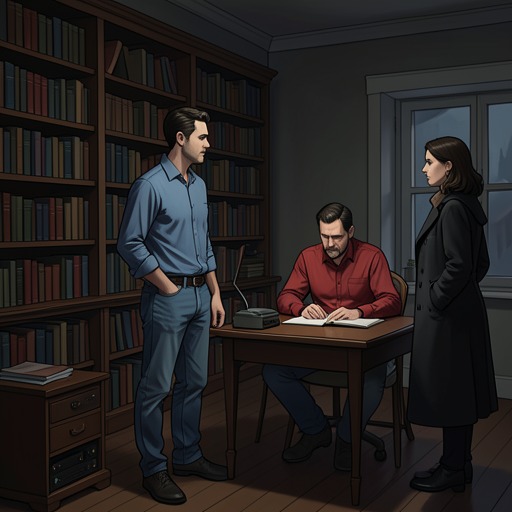
The meaning of the passage emerges through a shared act of reading rather than through explanation alone. Amanda switches books and reads from Rise; Ted responds to the image of the pursued figure and recognizes the name Mephistopheles, while Amanda also searches the name on the computer. She then connects it to Mr Mistoffelees, a character in the musical Cats. The exchange moves between literary association and interpretation, as the pair work out what kind of creature the passage evokes and what its pursuit might mean.
The scene also distinguishes the text’s symbolic figure from Amanda’s account of Jake’s experience. The speaker’s pursuit supplies an image; Amanda relates its warmth and glow to the pull of addiction. That reading leaves the passage’s central contradiction intact: the light offers something the speaker wants, yet it also keeps the pursuer on his trail. Rise matters here less as a complete explanation of Jake than as a text whose imagery lets Amanda and Ted approach that contradiction together.