Saltwater crocodile
Crimson LakeSaltwater crocodiles are both a physical danger in the wetlands near Cairns and a force shaping how people interpret events there. Their presence first appears as a boundary in Ted Conkaffey’s daily life; later, their habits become central to questioning whether a crocodile could explain Jake Scully’s disappearance.
Presence in the Wetlands
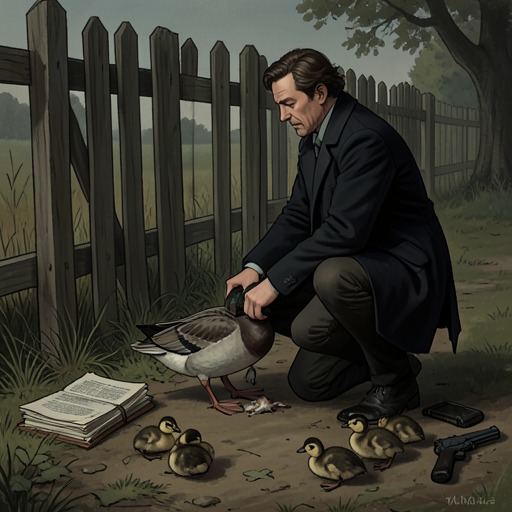
At the rented house where Ted lives, a wire fence separates the yard from the water and keeps crocodiles out. The fence recalls the restrictive boundaries of Ted’s imprisonment, giving the animals an indirect role in his sense of confinement: danger lies beyond the property, while the barrier offers a measure of security. At night, their calls from the wetlands make their presence perceptible without bringing them into view. The animals are not simply an abstract threat, however. Ted recognizes that a wounded goose and its chicks are exposed near crocodile habitat, and opens a gate he had previously left unused. The scene places vulnerable wildlife and human caution in the same landscape, where the possibility of crocodiles shapes decisions even when none is seen.
Behavior and Human Risk
The account distinguishes the danger posed by saltwater crocodiles from the idea that they are constantly hunting people. A doctor with thirty years of experience says she has never treated a genuine crocodile-attack victim. She describes roughly five near misses and two fatalities in a typical year, while characterizing the animals as lethargic and their attacks as dependent on circumstances. Large males may defend territory during mating season; during aestivation season, crocodiles may be stocking up before a long period of reduced activity. Familiar human routines can also become a risk when people repeatedly enter the water at the same place and time.
The doctor’s description makes opportunism, rather than relentless pursuit, central to the threat. Crocodiles more often wait in mangroves for waterbirds than take on a full-grown person, and most human fatalities involve children, whose size and presence in the water make them more vulnerable. This account complicates the local landscape’s ominous reputation: the animals are dangerous, but their behavior is not presented as arbitrary or uniformly aggressive. Human proximity, timing, and routine all matter.
The Crocodile and the Wedding Ring
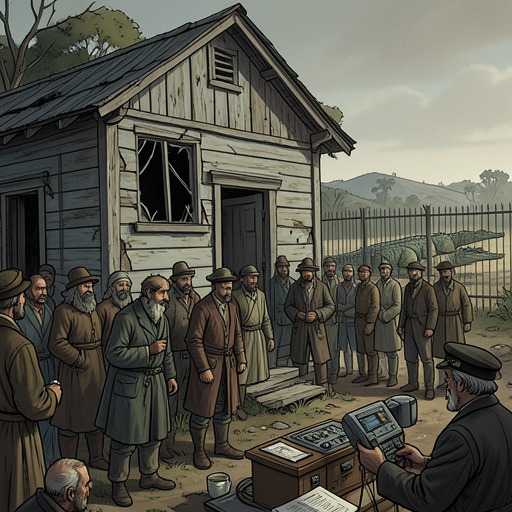
The connection between saltwater crocodiles and Jake Scully’s disappearance becomes material when his wedding ring is found inside a seven-foot crocodile. The animal had been captured as a nuisance animal near Pine Creek, then killed and butchered at Macalister’s at Oak Beach. Its remains were too degraded to determine whether they were human, so the ring’s discovery raises the possibility that the crocodile had consumed human material without establishing that Jake was its source.
Amanda Pharrell explains why the object could survive when other material did not: crocodiles’ highly corrosive digestive systems can break down substances including bone, clothing, and leather, while the ring was found deep in the intestinal tract. Its platinum had sustained little damage, suggesting it was recovered after biological material had substantially degraded. The ring therefore offers a stark but incomplete clue. It links Jake to a crocodile, yet the unidentified remains leave open what, if anything, the animal had consumed.
An Incomplete Explanation
The doctor’s assessment tests the crocodile explanation against Jake Scully’s size and the circumstances of his disappearance. Saltwater crocodiles can take large animals, she acknowledges, but they are described as opportunistic rather than relentless predators; attacking a full-grown man would be unusual. Her imagined sequence—a large male drawing Jake from the bank, or Jake entering the water himself—does not make the disappearance feel routine or readily explained.
Ted adds a detail that sharpens the uncertainty: security-camera stills appear to show Jake walking toward his car in a hurry. The doctor wonders whether he was rushing to meet someone. That possibility shifts attention from the crocodile’s capacity to the circumstances that brought Jake near the water. The animal remains a plausible part of the explanation, but its presence cannot settle what happened to him.