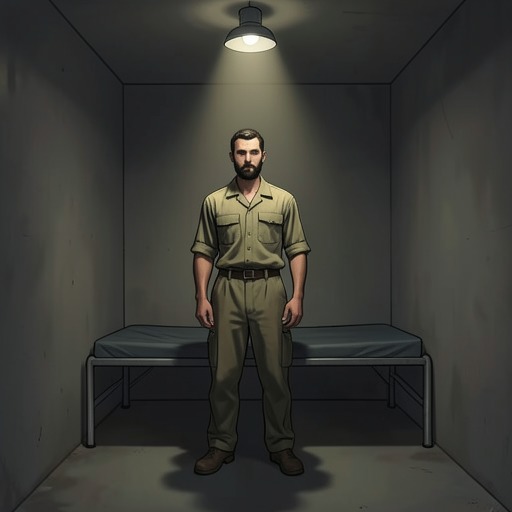
Ted Conkaffey's psychological trauma
Crimson LakeTed Conkaffey’s psychological trauma is the continuing effect of being accused in the Claire Bingley case and imprisoned before the truth of the accusation was resolved. It unsettles his memory, interrupts intimacy, and reshapes his family life: the day at a roadside bus stop becomes both an event he cannot stop recalling and a story he knows he cannot reconstruct with certainty.
Memory and the accusation
Ted Conkaffey’s account of the day Claire Bingley disappeared is explicitly unstable. He describes it as a composite assembled from what he remembers, what he heard at trial, newspaper reports, and information whispered to him while on remand. He even allows that nightmares may have supplied some details. The memory feels clear to him, yet he calls it more fabrication than history and acknowledges that believing it does not make it true. This contradiction is central to the trauma: the event returns with force, but its details have been shaped by the legal and public narratives that followed.
The roadside scene was also made into a sequence of evidence. Ted Conkaffey remembers pulling into a bus stop area and noticing Claire Bingley beside the road, with her pink Pokémon backpack on the ground. A passing driver and her daughter placed his car there at 12:47 pm; two minutes later, two more witnesses saw him speaking with the girl. The witnesses disagreed about whether a rear door was open, and later testimony could not settle whether his hand gesture meant goodbye or beckoned her closer. The dispute over that gesture occupied three days of trial testimony. These details do not resolve what happened; they show how small uncertainties became fixed points around which the case, and Ted Conkaffey’s recollection, were organized.
The courtroom returning in ordinary life
The prosecution’s account does not remain confined to the courtroom. While Ted Conkaffey is close to Stella Scully, the prosecutor’s accusations surface in his mind and disrupt the moment. He pulls away and becomes overwhelmed by the remembered language and images of the case. The scene makes the intrusion legible as an involuntary return: present contact gives way to the courtroom, and Ted Conkaffey cannot simply choose to remain in the present.
His distress also emerges when he watches recordings of Claire Bingley’s interviews during the trial. She had recently left hospital, her face was visibly bruised, and the footage showed her struggling to speak coherently. The prosecutor described her eye movements as a post-traumatic stress symptom; she also had night terrors and difficulty eating. At times she spoke in fragments, and at others she repeated a counsellor’s question about whether the person who took her was a policeman. Ted Conkaffey later wonders whether Claire Bingley might have heard investigators or family members discuss his occupation, but the evidence presented here does not settle that question. His own reaction to the tapes is clear: he breaks down during the third hour, and photographs of him with his head in his hands appear in the Sydney Morning Herald beneath a headline calling his tears crocodile tears. His suffering becomes public imagery, interpreted as evidence against him rather than understood on its own terms.
Panic, exhaustion, and anger
The remembered accusations can overwhelm Ted Conkaffey physically. During the encounter with Stella Scully, he struggles to breathe, becomes disoriented, and tries to fend off the returning images. The episode ends the intimacy and leaves Stella Scully alarmed and disgusted. The scene shows how the accusation has entered his body as well as his thoughts: even a moment unrelated to the case can be overtaken by its courtroom version.
After Fabiana leaves, the bus-stop scene repeats in Ted Conkaffey’s mind as he lies awake. The replay draws in the circumstances of his life before the accusation: he had been exhausted by work, making mistakes, and returning home to a marriage already strained by the arrival of a baby. He recalls failing to help or comfort Kelly enough and argues with her in his thoughts, with blame circling back to himself. His recollection does not offer a simple account of the relationship’s breakdown; it places legal trauma alongside fatigue, conflict, and the pressures of new parenthood.
Prison intensifies and then depletes his anger. In the first weeks, he describes himself as consumed by rage, but says it eventually burned down to an ashen tiredness rather than disappearing altogether. He fears that it will return. His anger also takes a troubling direction toward Claire Bingley: he knows she had undergone a terrible ordeal and says his resentment is not really for her identification of him, but for her having been at the roadside that day and for what the event did to his life. The admission exposes a displaced, shame-laden response, not a claim that Claire Bingley was responsible for the harm done to her.
Family separation and lasting effects
The accusation extends into Ted Conkaffey’s imagined future with his daughter, Lillian Conkaffey. He wants Sean to begin discussing custody with Kelly, but believes public hostility would make ordinary contact unsafe for Kelly and the child. He anticipates that photographers might pursue an image of him with Lillian, and that any visits would be supervised and scrutinized. Even this limited possibility matters to him: he fears that his daughter will grow up without knowing who he is, and imagines missing the ordinary milestones through which a parent is remembered.
His response to that separation is marked less by the force of anger than by exhaustion. He considers whether he should demand contact, threaten legal action, or insist on photographs, then recognizes that prison has left him too depleted to act from the fury he once felt. The future remains unsettled in his mind, accompanied by fear that renewed anger will arrive when he has recovered enough to feel it. At the same time, he is uncertain when Kelly stopped believing him. He recalls her defending him at first, then listening as investigators laid out the case; he suspects that Frankie could no longer believe him, but presents this as uncertainty rather than knowledge.
Narrative significance
Ted Conkaffey’s trauma is rendered through recurrence and contradiction rather than a single stable recollection. Precise times, witness disagreements, trial footage, a newspaper photograph, and remembered accusations all press upon the same roadside event, while his account insists that memory has absorbed material from sources beyond his own experience. The result is not simply uncertainty about a past scene: it is a life in which public evidence and private recollection continually overlap.
That overlap also prevents the narrative from treating Ted Conkaffey’s distress as proof of either guilt or innocence. His panic, resentment, grief over Lillian Conkaffey, and exhaustion describe consequences of accusation and imprisonment; they do not independently settle the case. The tension between what he vividly remembers and what he knows he may have reconstructed gives the trauma its lasting form: he is forced to live with an accusation that has become inseparable from the memory through which he tries to understand it.