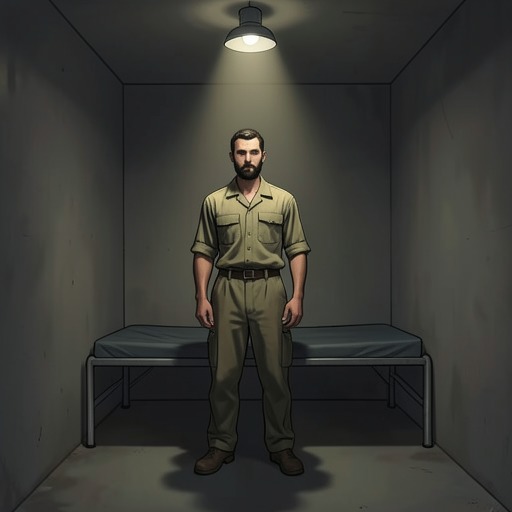
Ted Conkaffey–Amanda Pharrell partnership
Crimson LakeThe Ted Conkaffey–Amanda Pharrell partnership begins as an unlikely hiring arrangement and develops into a working alliance tested by the disappearance of Jake Scully, hostility from the Crimson Lake community, and the partners’ very different but intersecting histories. Amanda gives Ted a chance on a case file as a favour to Sean, despite having said she does not know Sean; their collaboration then becomes more than an experiment when they take on Jake’s disappearance and eventually establish a firm under both their names. Its defining tension is that the two investigators work together while carrying distinct forms of public suspicion, and increasingly understand that neither can be reduced to the label others place on them.
An Unusual Start
Amanda first approaches Ted with the expectation that he might begin work for her within the week. Ted is surprised to hear that Sean has apparently arranged this, and Amanda confirms that she is prepared to give him a chance as a favour to someone she does not know. Her offer is practical rather than assured: she proposes that they return to her office, where Ted can choose a case file and undertake an unpaid trial to show whether he is any good. The first version of their partnership is therefore provisional, built on a test rather than an established confidence in his abilities.
The work she initially has in mind is routine private-investigation work, including infidelity and insurance cases. But Amanda is already dealing with a more urgent matter: Jake Scully’s wife has hired her because the Queensland Police have made no progress and have not kept her informed after three weeks. When Amanda explains the commission, Ted does not withdraw from the prospect. He asks where they should begin, and she responds that they must first establish ground rules if he is going to work with her. That exchange marks a shift from the proposed trial to a shared case, while making clear that cooperation will require an agreement about how they operate.
The arrangement places Ted beside Amanda in a small private-investigation business in Crimson Lake township, but it does not erase the circumstances that brought him there. His police career has ended after the Claire Bingley case. The testimony about the roadside encounter that formed part of that case includes a blue Hyundai Getz passing at 12:47 p.m. and a red Kia passing at 12:49 p.m.; witnesses disagreed about whether Ted’s gesture to the girl was a goodbye or an invitation to approach. The precise ambiguity matters to the partnership’s background: Ted enters Amanda’s working life not as an investigator with a clean professional history, but as a man whose actions have already been interpreted through a public accusation.
Working the Jake Scully Case
Amanda and Ted’s first major shared investigation is Jake Scully’s disappearance. Amanda has been commissioned by Jake’s wife, who has lost confidence in the Queensland Police response. Ted’s question about where to start is an early sign of active participation: he is not merely being accommodated at the office but begins taking responsibility for the work. Amanda, for her part, sets the terms and directs the investigation, while making room for Ted to contribute as a colleague rather than simply as a favour to Sean.
Their working styles do not always align. When they interview Ray outside Trinity Baptist Church, Amanda’s rapid questioning leaves Ted concerned that she has alienated a witness. He tells her that Ray is unlikely to help them again. Amanda does not treat the loss of his cooperation as decisive: she says they no longer need him and that their next priority is to find Sam and learn what he knows about Jake’s disappearance. The difference reveals a recurring friction in their method. Ted is attentive to the consequences of how a witness is handled; Amanda is willing to press hard and move on when she judges that a new lead matters more.
That friction does not dissolve their partnership. Amanda continues to act on the case, and Ted remains beside her as they approach Ormund Smitt. In a Skype conversation with Ormund, Amanda introduces Ted as her partner while explaining that they are investigating Jake’s death. Ormund’s dismissive response unsettles her, and she glances back at Ted. The scene makes the partnership visible to an outside observer: Amanda presents them as a joint investigative unit, even in a conversation where the person they are questioning tries to belittle her and waste their time.
Unequal Stigma, Shared Pressure
Ted and Amanda do not arrive at their partnership with identical histories. Ted was interrogated for fourteen hours by Davo, Morris, and Frankie, colleagues who were also his friends. Because the inquiry included an attempted-murder allegation, the detectives handed him to homicide investigators; he spent the night in the cells at his own station and was ordered to stand trial. The Director of Public Prosecutions later withdrew the charges midway through the trial, saying the evidence could not properly satisfy a jury beyond reasonable doubt. Ted was never acquitted, and the unresolved status of the case left him fearing that he could be arrested again. This history shapes the professional and emotional conditions under which he agrees to work with Amanda.
His treatment by police continues after the partnership begins. Hench jabs him with a baton during a stop, and Damford and Hench later obtain approval to search Ted’s home after his letterbox is damaged by an explosion. During the search they break household items and empty food across his kitchen floor. Amanda is present, positioned beside Ted’s geese and the injured bird Woman; after Ted goes outside, she crouches beside Woman and puts an arm around her. Her quiet attention to the bird takes place while the officers are wrecking the house, making care a small but concrete counterpoint to the intrusion. The scene also places the partners within the same encounter with police power, though Ted is its immediate target and Amanda responds by protecting the vulnerable animals around them.
The community’s suspicion reaches beyond official encounters. At a bar, Ted asks for a beer and is met with silence from the bartender and another customer, who recognize him; other men in the room begin watching. He leaves, shaken by the speed with which recognition turns a routine request into public exclusion. Later, Fabiana Grisham tells him that Australia knows he is not innocent. Ted rejects her judgment, but the exchange shows how the allegation persists socially even after the prosecution is withdrawn. The partnership cannot shield him from that public verdict; it gives him a colleague and a shared purpose within a town where his presence remains charged.
A Shared Outsider Position
Amanda’s own reputation also shapes the relationship, though in a different way. Her past conviction means that others may approach her as a dangerous person before considering her work as a detective. Ted, by contrast, has not been acquitted after his charges were withdrawn, and public suspicion continues to treat the unresolved accusation as proof. The two forms of stigma are not interchangeable, but their effects make a common language of exclusion possible. Ted notices this kinship while watching Amanda wait in the shade near Ormund Smitt’s house, straight-backed with her eyes closed. He reflects that he has begun to share habits of the pariah group: he hardly sleeps or eats, feels deeply paranoid, and has altered his appearance with a thick beard. He also recognizes their surroundings as a makeshift community of vulnerable animals who accept his care.
The partnership is tested again when Amanda becomes distressed over the case. She insists that the investigation belongs to them and tells Ted that neither of them is a freak, whatever they have done. Her declaration does not make their pasts equivalent or settle the danger surrounding them; it refuses the idea that their worst public labels exhaust their identities. Ted’s response is not to abandon the case. As he drives home, he weighs whether to flee Crimson Lake, return to Sydney, or leave Amanda to face the consequences alone. His uncertainty shows that partnership has become a real obligation: escape might protect him temporarily, but it could expose Amanda and leave her to manage the fallout without him.
The Partnership Takes a Name
By the end of the narrative, the working arrangement has acquired a visible form. Amanda rides past the Shark Bar and the office, where a new sign reads Conkaffey & Pharrell. Ted had wanted to add the word Investigations; Amanda opposed it because she did not want a label that would limit what the business could become. Ted considers the description accurate, while Amanda treats the wording as a question of possibility and definition. Their disagreement is modest but characteristic: he prefers a clear account of the work they do, while she resists allowing a fixed label to set its boundaries.
The sign also records a change in how the pair identify themselves. What began as a favour-based trial and an uncertain arrangement over case files is now a joint firm bearing both surnames. Amanda makes the decision about what the sign should say, but Ted has a place in the name and has remained involved through the investigations and the hostility that followed them. When she visits him, three days after he came to see her in hospital, he is outdoors in the afternoon sun, has put on weight, and has shaved his beard. The vigilante attacks have stopped, although cars still sometimes slow outside his property. The partnership has not removed the danger or the history behind it, but the new sign and their continuing work show that neither has simply left the other to bear it alone.