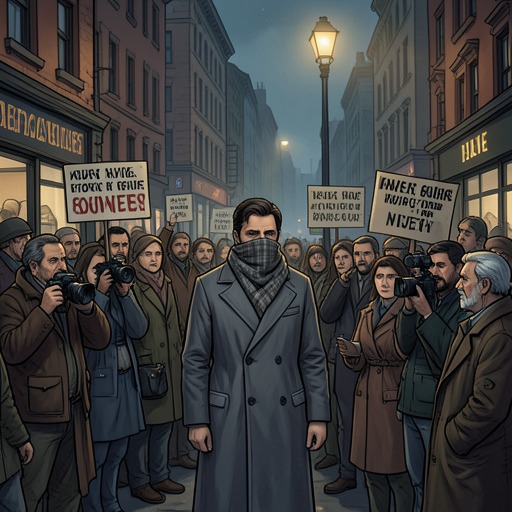
Ted Conkaffey’s arrest and remand
Crimson LakeTed Conkaffey’s arrest and remand mark the collapse of his working and family life into a prolonged legal limbo. Arrested a week after Claire Bingley reappeared, he was questioned first by police colleagues who were also his friends, then held for 241 days; the later withdrawal of charges did not amount to an acquittal, and the case remained an unresolved threat.
Background and the roadside encounter
In Ted’s reconstructed account, the events that led to his arrest begin beside an isolated highway near Mount Annan. He describes Claire as thirteen, standing by the road barrier markers with a pink Pokémon backpack. His car had pulled into the bus stop area, stopping between ten and fifteen metres away. A blue Hyundai Getz carrying Marilyn Hope and her daughter Sally passed at 12:47 pm; Sally later supplied that precise time from the car’s clock. The pair said Ted’s car had pulled off suddenly and parked close to the girl.
Two minutes later, sisters Jessica and Diana Harper drove past in a red Kia and saw Ted talking with Claire. They could not agree whether the car’s rear door was open. Other passing witnesses also disagreed about Ted’s gesture beside that door: some recalled a farewell, others a beckoning motion. Their testimony about this small, consequential ambiguity occupied three days at trial. Ted says he then walked around the front of the car, drove away, and did not look back.
The narrative does not present this recollection as a stable record. Ted explicitly describes it as a composite assembled from what he remembers, what he heard at trial, newspaper reports, and things whispered to him while he was on remand. He allows that nightmares may have shaped some details, even as the fatal moments seem unmistakably clear to him. The scene that precedes the arrest is therefore both a contested evidentiary account and a memory Ted knows he cannot fully verify.
Arrest and interrogation
A week after Claire’s return, Ted went to work at New South Wales Police headquarters on Charles Street, Parramatta. He was a drug-squad detective, occupied with a suspected cocaine-importing gang alongside Davo, Morris, and Frankie. The morning began as routine: he had kissed his wife and infant daughter goodbye, stopped for toast and coffee, and gone to his office. At around ten, he began noticing whispers and unusual looks. Davo, Morris, and Frankie were called away to an interview room; shortly before lunch, a colleague from the fraud squad told Ted that the station chief wanted to see him.
The questioning began with Davo, Morris, and Frankie. Ted regarded their role as a conflict of interest, but they were upset by the allegations and no one stopped them from questioning him. After a couple of hours without the answers they wanted, they handed him to homicide detectives because the prospective charges included attempted murder. Ted could not bring himself to eat through fourteen hours of interrogation. He spent that night in the cells at his own station, trying to attract the attention of officers he knew as they passed his door. They had been ordered not to speak to him. In the course of a day, he had gone from colleague and friend to someone treated as an enemy.
The arrest also shattered the expectations Ted had tried to offer Kelly during an earlier call. He had believed the matter would soon be resolved if evidence placed him elsewhere at the time of the abduction, and imagined that the couple might seek compensation and take a holiday. Kelly told him that Claire had selected his photograph from a lineup. Ted’s response—that this could happen—did not reassure her; she was horrified. The identification became a central fact of the case and an early turning point in the couple’s understanding of what they faced.
Remand and the case against him
Ted was imprisoned for 241 days. His recollection of the arrest is framed by the stark change between the ordinary morning he expected and the confinement that followed: the station meal was his last meal not issued by the state for months. He describes survival in prison as requiring total physical and emotional submission, a strategy he understood as the most efficient way to endure time and remain sane.
The prosecution’s case also depended on Claire’s identification and her post-traumatic interviews. Ted watched recordings of the interviews in court alongside the jury. Claire had been released from hospital not long before they were made, and the recordings showed a child struggling to speak coherently, with symptoms the prosecutor identified as post-traumatic stress, as well as night terrors and difficulty eating. Her speech moved between fragments of recollection and confusion. Ted focused on the fact that she referred to a policeman, while questioning whether the word might have come from her contact with investigators or from conversations she had overheard. The evidence does not establish that explanation; it shows the uncertainty around how the statement arose.
Some interview material was replayed repeatedly by the prosecution, including Claire repeating a counsellor’s question about whether the person who took her was a policeman. Ted broke down while watching the recordings in the third hour of the interview tapes. The resulting image of him with his head in his hands appeared on the cover of a newspaper the next day under the headline Crocodile Tears. The episode joined the courtroom record to a public image that cast his visible distress as suspect rather than exculpatory.
Withdrawal of charges and continuing uncertainty
Ted was committed to stand trial, which meant the Director of Public Prosecutions considered the evidence sufficient for a possible conviction. Halfway through the trial, however, the prosecution withdrew the charges, stating that the evidence could not properly satisfy a jury beyond reasonable doubt. The withdrawal did not declare Ted innocent, and he was never acquitted of the charges concerning Claire. In the account Ted gives, prosecutors also avoided proceeding to a possible acquittal that would have prevented him from being charged again; the allegations were set aside, potentially to return if stronger evidence emerged.
The legal outcome therefore ended the immediate prosecution without restoring certainty. Ted no longer worked as a police officer, and none of his former friends spoke to him again. He woke each day expecting that he might be rearrested and sent back to prison. Kelly’s position had also changed under the pressure of the evidence and the public scrutiny: Ted remembers that she had initially defended him, but later listened as colleagues laid out the proposed timeline, including Frankie, whom she trusted. He could not say exactly when she stopped believing him. The arrest and remand thus extend beyond the loss of liberty: they leave Ted without his former career, with his marriage and family life under strain, and with no legal resolution that can definitively close the case.