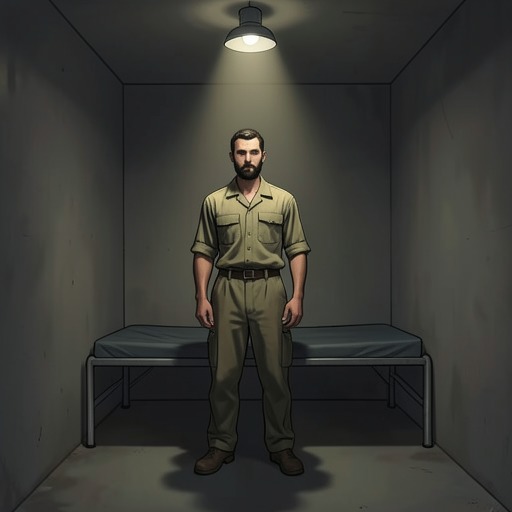
Ted Conkaffey’s post-incarceration trauma
Crimson LakeTed Conkaffey’s post-incarceration trauma is presented not as a past ordeal that ends at the prison gate, but as a condition that returns through dreams, bodily alarm, and fear of being recognized or arrested again. His memories of the case against him are unstable and painful, while the habits that helped him endure prison offer little guidance for living freely. Release changes his circumstances without restoring the safety or identity he had before his arrest.
The case as an unsettled memory
Ted’s account of the day he encountered Claire Bingley is explicitly a composite rather than a reliable, continuous recollection. It draws together what he remembers, what he heard at trial, newspaper accounts, and things told to him in remand custody; some details may also have come from nightmares. He says that the memory feels clear even though he knows it is not wholly true. The distinction between remembered experience and later information is therefore part of the trauma itself: the scene persists, but its pieces cannot be securely separated.
The surviving details were also turned into contested evidence. Marilyn Hope and her daughter Sally placed Ted’s car at the roadside at 12:47 pm, recalling the time from the car clock. Two minutes later, Jessica and Diana Harper saw him speaking with Claire. Witnesses could not agree whether the rear door was open, or whether Ted’s later gesture was a goodbye or an invitation to come closer; testimony about the gesture lasted three days. These disagreements do not establish what happened, but they show how small, uncertain observations became fixed points in a case that continued to occupy Ted’s mind.
The prosecution’s use of Claire’s interview recordings gives that uncertainty another, painful form. Ted had to watch the recordings in court beside the jury. Claire had been interviewed soon after leaving hospital and was visibly distressed; her speech moved between fragments, and the prosecutor described her eye movements and other difficulties as symptoms of post-traumatic stress. At times she repeated the counsellor’s question about whether the person who took her was a policeman. Ted’s recollection of the case is thus entangled with courtroom playback and repeated questioning, not only with what he himself remembers seeing.
Nightmares and the prison body
The dreams replay the collapse of Ted’s former life. In one recurring scene, Morris and Davo circle him in an interrogation room while Frankie stands in the doorway, avoiding his gaze. These are former colleagues and friends: they had worked together, shared meals and social time, and Frankie had been close to Ted’s wife, Kelly. In the dream, that shared life drains away as Ted finds himself on the other side of the interrogation table. The remembered bonds make the scene more than a replay of questioning; it stages the loss of his place among people he once trusted.
Other dreams return to imprisonment and its repeated disappointments. Ted sees Kelly through prison glass, her face distorted by the barrier, and waits for the people who come to his cell to release him; instead, they bring food or paperwork from his lawyer. He remembers the strain of remaining physically composed while every sound provokes adrenaline, and the image of himself as solid stone that might crumble. In a separate confrontation with Kelly, news that Claire selected his photograph from a lineup leaves him struggling to breathe. His certainty that the mistake will soon be corrected gives way to the reality of the identification and the burden it places on their relationship.
After release, sleep remains a point of vulnerability. Ted wakes drenched in sweat on the porch while crocodiles bark in the darkness. Cramps, twitches, and stabbing pains sometimes snap him out of nightmares, alongside noises and voices he knows are not real. He is grateful for these interruptions because they cut the dreams short, but the relief is limited: his body has become an alarm system that wakes him through distress rather than allowing rest.
Rules learned in custody
Ted describes survival in prison as submission to routine. The inmate reads the handbook, keeps his cell and uniform immaculate, files papers, and treats staff and other prisoners courteously. Even a fight or a cell inspection has a prescribed response: drop to the ground and await instructions, or remain quiet and present belongings for review. Following the rules removes the need to make independent judgements in situations where a mistake could be dangerous. Ted imagines the inmate as a precisely cut cog, safe so long as it fits the prison machine.
That discipline offers order, but its usefulness depends on the institution that supplies the rules. After his release, Ted recognizes that he has let his own organization slip. He has been drinking, living in a neglected rental on the edge of Crimson Lake, sometimes going days without showering and forgetting to eat until hunger forces him to notice. His decision to unpack his belongings and stop sleeping on a blanket marks an effort to establish a life outside prison’s imposed routine. He calls a furniture store in Cairns but does not order a television, afraid of seeing himself. The practical task of furnishing a home and the refusal of a reflective screen together register how difficult it is for him to inhabit an ordinary domestic identity again.
Public fear and legal uncertainty
The end of imprisonment does not settle Ted’s legal position. The charges in Claire’s case were withdrawn during his trial because the prosecution judged the evidence insufficient to meet the required standard; that decision was not an acquittal or a declaration that he had not committed the crime. Ted remains unsure whether the case is still being investigated and wakes with the expectation that arrest could come again. In the rear-view mirror, he recognizes that he is no longer the man he was before custody, and fears that the underlying terror will remain even if the case never returns to court.
That fear also shapes ordinary encounters. At a hospital, a receptionist’s attention to the phone receiver makes Ted wonder whether she recognizes him. His chest tightens, and he considers leaving before she can call anyone about a stranger asking questions about the Scully case. An older woman steps in to reassure the receptionist and offers to help him; only afterward does Ted question whether he had been close to a panic attack. He imagines that a public episode would draw a crowd and expose him again to recognition. The immediate exchange passes, but his attention has already shifted from the inquiry to the danger of being seen.
A life that does not return to its former shape
Ted’s trauma is sustained by the collision of several unresolved losses: the relationships and work he had before prison, the uncertainty surrounding Claire’s case, and the public image attached to his arrest. He hopes that time and a beard might make him unrecognizable from the pale figure pictured outside the courthouse, but that hope does not erase the image’s hold over him. His former colleagues appear in nightmares as people who have become strangers, while encounters with Kelly and unfamiliar members of the public revive the possibility of judgment.
The narrative form mirrors this afterlife of the case. A roadside scene reconstructed from memory, testimony, recordings, and rumor cannot be reduced to a single settled version, just as release cannot be treated as a clean break from confinement. Ted’s symptoms appear in returns and interruptions: a dream, a sound, a tightened chest, a rule he no longer has anyone to enforce. His effort to restore order at home shows some movement toward living beyond prison, but the fear of renewed prosecution and the reflexes of custody remain active parts of that life.