Ted Conkaffey’s public ostracism
Crimson LakeTed Conkaffey’s public ostracism is the continuing social punishment of a man whose prosecution ended without an acquittal and whose name remains publicly associated with the Claire Bingley case. The distinction between withdrawn charges and a declaration of innocence matters throughout his life after prison: press coverage, recognition by strangers, and the threat of local hostility keep treating the accusation as settled fact. He seeks safety by moving north, but anonymity proves temporary, and even a quiet encounter can make the public judgment present again.
The accusation without an acquittal
Ted’s social isolation grows out of a legal ending that does not resolve the accusation in the public mind. He was never acquitted of the rape and attempted murder of Claire Bingley. Midway through his trial, the Director of Public Prosecutions withdrew the charges, explaining that the available evidence was not strong enough to satisfy a properly instructed jury beyond reasonable doubt. The prosecution did not say that Ted had not committed the crime; the charges were set aside, with the possibility that they could return if stronger evidence emerged.
That unresolved status leaves Ted without the definitive outcome that might counter public suspicion. He does not know whether Claire Bingley’s case is still being investigated. His former police colleagues no longer speak to him, and he wakes with the possibility of rearrest hanging over him. The public response therefore rests not on a conviction, but on the persistence of the accusation and the uncertainty left by the prosecution’s decision. The book presents ostracism as an afterlife of the case: formal proceedings recede, but their social meaning does not.
Flight and a fragile refuge
After leaving prison, Ted spends five or six days in Sydney trying to escape the press. Reporters wait outside the hotels where he stays and irritate their owners until he is forced out. Kelly will let him return to their home only with a police escort, so he can go there briefly to collect belongings, not resume family life. His public visibility also follows him into ordinary errands: some fast-food counter staff recognize him, and on other occasions fear of being recognized makes him leave without ordering. He eats little and finds himself discussed across television, radio, and newspaper coverage.
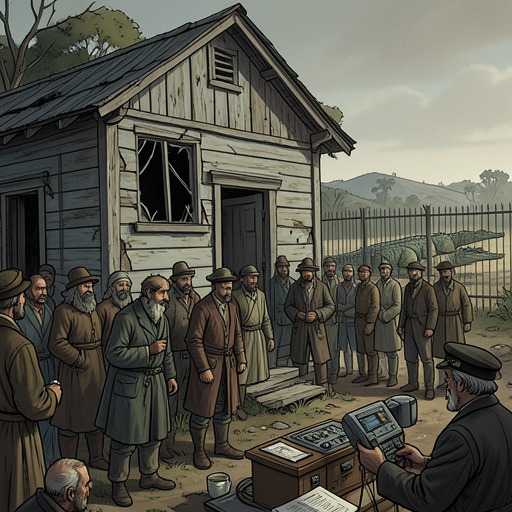
Ted heads north with his possessions and no settled destination beyond the hope of finding somewhere safe. Smaller, more remote towns seem less invested in the affairs of strangers. In Crimson Lake township, he imagines the damp, rain-soaked landscape as a place where histories might be washed away and a person’s past consumed. The house he rents on the lake’s edge is cheap and neglected, with a porch and a wire fence at the bottom of the yard. For a time, remoteness gives him a kind of shelter, but it is a precarious one rather than a restoration of ordinary belonging.
The house also registers how he experiences that shelter. Three bricks have been thrown through its front window since his arrival, and he leaves the latest damage unrepaired. With vigilantes outside and crocodiles beyond the back fence, he compares the position to prison; the sense of security comes partly from feeling unable to run. The scene makes refuge double-edged: distance and barriers protect him, yet the threats around the house reproduce the confinement he has just left.
Recognition travels with his name
The stigma reaches beyond newspaper headlines through small, personal encounters. When Ted takes an injured goose and her chicks to a veterinarian, he pays seven hundred dollars for their care and leaves with the family of domestic geese. The vet notices that his credit card bears the name Conkaffey rather than Collins. The recognition changes the vet’s expression; Ted takes the birds and leaves before he can see the full response. He later reflects that he is tired of being met with that look. A name, rather than any new evidence about the case, is enough to turn a routine act of care into another encounter with his public identity.
A visit from Sean offers a sharp contrast. The solicitor brings food, paperbacks, and a thick envelope of forms, and tells Ted that his assets have been released. The forms include further adjustments to the divorce settlement, with Kelly stalling over details. Ted takes joy in seeing Sean despite the cold coffee and the practical worries. In his estimation, roughly twenty-one million Australians believe him guilty, while Sean remains the solicitor who does not. The contrast does not erase the wider judgment; it clarifies how rare trust has become.
A town’s different thresholds
When Amanda Pharrell urges Ted to take an office, she explains that Crimson Lake residents have become more accustomed to her since her own release and less confronted by what she did. Ted, she warns, will be different: if the crowd learns he is in town, his presence will become a spectacle. Her comparison shows that notoriety does not affect them identically. The community may grow familiar with one stigmatized person while treating another as newly alarming, because Ted’s accusation carries a different public charge.
That warning takes shape when Fabiana Grisham approaches him as a reporter from the Sydney Morning Herald. Ted anticipates the storm of recognition, grips his shirt, and considers retreating to find Amanda. Fabiana asks whether he is staying in Crimson Lake and trying to rebuild his life, then whether local people know he is there. Ted asks how she found him. He gets into his car and drives away; Fabiana turns off her phone recorder. The questions make his attempted restart itself a news story, while his effort to leave becomes a response to exposure rather than a decision freely made.
The town’s response can also arrive without questions. At a bar, Ted asks for a beer, but the elderly bartender and another customer stare without serving him. The stillness draws the attention of other men, and Ted realizes they know who he is. He becomes nauseated, drops his keys while trying to get to his car, and berates himself for having assumed he could enter unnoticed. The scene turns public recognition into a collective act: no one needs to state an accusation for the room’s refusal and silence to communicate exclusion.
The force of the public label
Ted understands that the stereotype of a violent paedophile shapes how people interpret him. He reflects that the public expects such a person to look and behave according to a familiar image, whereas he does not fit it. In his view, that mismatch makes him more frightening to the public, not less: he defeats the stereotype people use to recognize danger. His reflection does not establish guilt or innocence; it shows how a social label can outlast the evidence and make an ordinary appearance seem threatening precisely because it does not match expectation.
The narrative repeatedly places that label beside circumstances that complicate it: the withdrawn charges, the absence of an acquittal, Ted’s flight from press attention, and his ordinary attempts to establish a life in a remote town. His ostracism is not one dramatic banishment but a recurring condition, renewed by a vet’s recognition, a reporter’s questions, or a silent bar. Crimson Lake provides distance without guaranteeing anonymity, and Sean’s loyalty offers an exception without changing the public climate. The result is a life suspended between legal uncertainty and social certainty: the case remains unresolved, while other people behave as if the verdict has already been delivered.