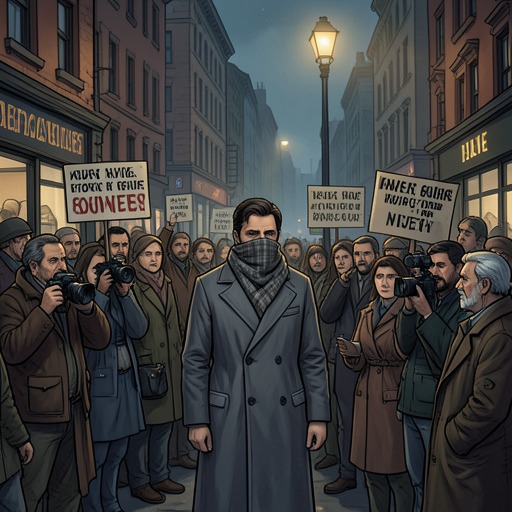
Ted’s Composite Memory of Claire’s Abduction
Crimson LakeTed’s Composite Memory of Claire’s Abduction is Ted Conkaffey’s reconstruction of the roadside encounter preceding Claire Bingley’s disappearance, and a portrait of how that memory was shaped by the case built around it. Ted acknowledges that his account is not a reliable record: it joins uncertain recollection to testimony, news coverage, prison gossip, photographs, and possible nightmare imagery. The scene’s exact details remain contested, while its consequences are unmistakable: a girl disappeared, and Ted became the man the public associated with her abduction.
A Memory Made from Fragments
Ted frames the recollection as both something he believes and something he knows is not wholly true. Some elements, he says, come from direct experience; others entered later through his trial, newspaper accounts, and things whispered to him while he was on remand. Even the weather and the girl’s appearance may have been intensified or supplied by nightmares. He describes the result as a composite that has become difficult to separate into its original strands. The passage therefore does not present vividness as proof. Its force comes from the opposite tension: the memory feels fixed, but Ted knows it has been assembled.
His own account places him at a bus stop on the edge of the highway at Mount Annan. He recalls first noticing the stop and the tracks in the dirt, then pulling over and parking roughly ten to fifteen metres from a pale girl beside the road markers. He says he did not see her until he had stopped and got out. A pink Pokémon backpack lay on the ground beside her. Later, Ted says the few qualities he genuinely remembered were that she was thin, bony, and pale; details such as her teeth and the way her nose crinkled when she smiled came to him from photographs shown at trial. The distinction between remembered observation and later visual evidence is central to the passage’s account of his memory.
The Witness Timeline and Its Unsettled Gestures
The roadside scene is also reconstructed through the times and observations supplied by passing motorists. At 12:47 p.m., Marilyn Hope and her daughter Sally drove south in a blue Hyundai Getz. Sally later gave the time, explaining that she had checked the clock while calculating how long remained before her dance lesson. They described Ted’s car pulling off suddenly and stopping close to the girl. At 12:49 p.m., sisters Jessica and Diana Harper passed in a red Kia and testified that they saw Ted talking with the girl, though they could not agree whether the car’s back-left door was open or shut.
The disagreement became especially consequential when witnesses tried to describe Ted’s gesture beside the rear passenger door nearest the girl. Some accounts suggested a goodbye; others could be read as beckoning her closer. The witnesses agreed that he made a gesture, but not which hand he used or which way his palm faced. Testimony about that distinction occupied three days. Ted’s recollection does not settle the dispute: he presents the gesture as one of the details whose meaning shifts with the testimony surrounding it. He then recalls walking around the front of his car, driving away, and not looking back.
At 12:52 p.m., Claire Bingley’s bus passed the stop. Its GPS recorded the time, and the driver and passengers agreed that the backpack remained on the ground but the girl was gone. The account then sets out what happened beyond Ted’s direct view: Claire was taken to bushland about five minutes away, survived the attack, and eventually reached the highway again. She had been missing for seventeen hours when an older driver found her near Razorback, around ten kilometres south of where she had vanished. These facts establish the gravity of the disappearance without making Ted’s disputed recollection a complete or independent account of it.
Trial Evidence Enters the Recollection
The later trial did not merely test Ted’s memory; its materials became part of what he remembered. He had to watch recordings of Claire’s police interviews in court. Recorded not long after she left hospital, the interviews showed a child still suffering serious effects of the attack: she was bruised, struggled to eat, experienced night terrors, and spoke in fragments. Her speech moved among references to the day, familiar people, and confusing images. A counsellor seized on her mention of a policeman, and the question was repeated in a clip played by the prosecution. The repetition matters because it shows how an interview prompt could become prominent in the public presentation of Claire’s words; it does not, by itself, establish why she used the term.
Ted suggests several possible sources for Claire’s reference. She might have meant the uniformed officers interviewing her, heard someone ask whether her attacker was a policeman, or overheard her parents discussing Ted with investigators. These are possibilities he raises, not explanations demonstrated by the evidence. His account underscores the gap between a child’s trauma-affected interview, the questions posed by adults, and the edited transcripts circulating in the media. The recordings, which Ted says differed from the printed transcripts, were part of the trial record he was required to revisit and of the material from which his later reconstruction took shape.
A separate piece of evidence arrived through Kelly during a prison phone call: Claire had selected Ted’s photograph from a lineup. Kelly gripped the handset and urged him to confront what that meant. Ted responded as though such an identification could happen mistakenly, but Kelly’s horrified reaction exposed the distance between his attempt to minimize the development and the seriousness it held for her. Later, he remembers how the accusations were put to Kelly in detail, including questions about their argument that morning, his fishing habits and equipment, and whether they had had sex that day. He believes she began listening to the investigators after the accusation was fully laid out, and that she trusted Frankie, who could no longer keep believing him. His account makes the prosecution’s case present in family life as well as in court.
Public Images and the Limits of Certainty
The trial’s images followed Ted beyond the courtroom. During the third hour of the interview tapes, he broke down and cried; a photograph of him with his head in his hands appeared the next day beneath the Sydney Morning Herald headline Crocodile Tears. A private reaction became a public image with a ready-made interpretation. In the same way, later photographs filled gaps in his recollection of Claire, while witness testimony gave uncertain gestures a legal and media afterlife. Evidence did not simply sit beside memory: it supplied images and meanings through which the encounter was subsequently recalled.
The novel’s other acts of storytelling sharpen this concern without providing an answer to the bus-stop question. A fan’s letter to Jake Scully describes an intense attachment to his fiction and an attempt to imitate his style; Ormund argues that Jake’s early writing anticipated the apocalyptic themes readers later found in the Last Light Chronicles. Another letter imagines characters as puppets manipulated by their author, and contrasts that control with a character who has begun to act beyond it. These episodes show people using stories to make claims about identity, intention, and control. Ted’s memory belongs to the same broader pattern of narratives being formed from partial material, but it remains specifically grounded in his uncertain recollection and the evidence introduced around Claire’s case.
Ted’s reconstruction matters because it refuses the comfort of a clean boundary between what he saw and what he learned afterward. It preserves concrete timings and objects—the stop, the backpack, the car door—while exposing how uncertain their interpretation became. Claire’s disappearance and survival, her recorded interviews, the disputed gesture, the lineup identification, and the newspaper image each belong to a different evidentiary context. Ted’s account gathers them into one narrative while admitting that the gathered whole cannot be treated as unaltered history.