The Wounded Geese and Recovery Through Care
Crimson LakeThe Wounded Geese and Recovery Through Care follows Ted Conkaffey’s gradual movement out of isolation through his care for a wounded mother goose, whom he calls Woman, and her chicks. Their arrival does not erase his trauma or make recovery effortless. Instead, the daily demands of protecting and tending living creatures give him a reason to act, while the birds’ own fear, vulnerability, and resistance keep the relationship from becoming a simple story of rescue and reward.
Isolation and the Encounter
When Ted finds Woman, he is living alone in a rundown house on the edge of Crimson Lake township, with a gun as his only company. He has withdrawn from ordinary life, drinks heavily, and is preoccupied with the possibility of ending his isolation in the most final way. Outside, the house seems bounded by threats: people harass him from the front, while crocodiles inhabit the wetlands beyond the back fence. He recognizes the fence as resembling the barriers of prison, and its familiarity lends his new home the feel of another enclosure.
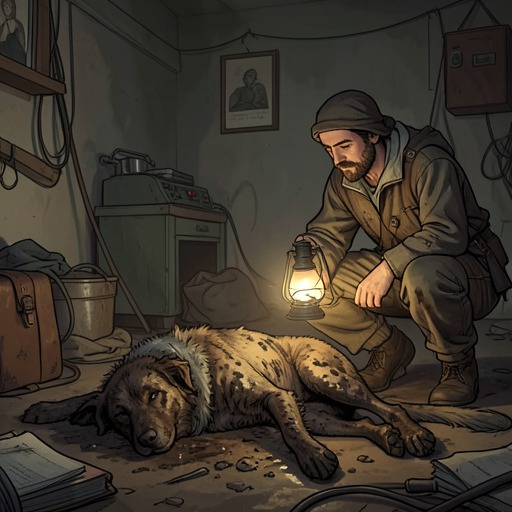
The goose interrupts this closed world by appearing with her scattered grey chicks near the fence. She is injured and struggling to move, but her first approach is not an invitation to easy contact: she retreats, hisses, and flaps at Ted. He must decide whether to stay behind the fence or cross into the dangerous area beyond it. He opens the gate, lunges for the bird, and manages to bring her and the chicks into his yard. Woman snaps at him during the rescue, while the chicks follow her in a line. From the outset, care involves risk and resistance as well as tenderness; the birds are vulnerable, but they are not passive objects.
Ted takes the family to a veterinarian, where treatment costs seven hundred dollars. The expense leaves him with fifty-nine dollars, but the more painful consequence comes when the vet recognizes the name on his credit card. Ted has been in Crimson Lake for only a month, and his case has recently been national news. Seeing the vet’s expression change, Ted leaves before he has to face another person’s judgment. The encounter ties the practical act of rescuing the geese to the public stigma that continues to shape his life: he can pay to help them, but he cannot prevent strangers from recognizing and condemning him.
Care as a Daily Practice
The geese give Ted a set of immediate responsibilities at a point when he has let his own routines collapse. Just over two months after his release, he has been drinking, neglecting meals and washing, and sleeping on a blanket instead of properly settling into the house. He recognizes that his life has become disordered and begins trying to establish rules for himself. The birds become part of this change, not as a cure imposed from outside but as living dependants whose needs call for repeated attention.
Ted begins to make the house more habitable. He orders furniture, boards up the broken front windows, clears away the glass, and obtains food and basic appliances. He also starts an old Victa mower and cuts the overgrown lawn. The work leaves him drenched in sweat and frightens the geese, but the changed yard gives the chicks room to move. He gathers them carefully in his hands, then watches them peck and toddle across the grass. When he tries to pat Woman, she hisses and snaps at him. Ted does not take this as a personal rejection. That response marks an important limit on the rescue fantasy: care does not require the animals to show gratitude, affection, or trust on his timetable.
By nightfall Ted has made a bed, filled the fridge, and arranged a cane lounge on the porch. The geese settle together in their cardboard box, covered by a towel. He takes satisfaction in having completed these ordinary tasks and in the order they bring to the house. His language of rules and handbooks reflects a need for predictability after prison, but the geese make that order concrete through maintenance rather than abstraction: their shelter must be prepared, and their needs recur whether or not Ted feels ready to meet them.
Trust, Fragility, and Memory
The relationship develops through small, provisional moments rather than a sudden transformation. At night, Ted checks the birds beneath the towel. Woman sleeps with her head tucked under her good wing; when he lifts a chick from beside her, she allows him to hold it without protest. The truce belongs to this particular quiet encounter, not to a permanent change in the goose’s nature. During the day she can still resist his touch. Her shifting responses preserve her as an animal with her own boundaries, rather than reducing her to a mirror that simply reflects Ted’s wishes.
Holding the sleeping chick recalls the weight of Ted’s own child in his hands. The recollection connects care for the birds with a personal loss without making them substitutes for his child. The chick is a distinct, fragile creature in his present life, while the memory gives the moment an added emotional depth. The scene is one of the clearest points at which the practical intimacy of tending an animal opens onto grief that has not been resolved by Ted’s new surroundings.
The chicks’ fragility continues to shape his attention. On a rainy night, he keeps them from the weather by bringing them into the house and setting them to swim in a shallow bath. Their little feet carry them back and forth across the water; they dip beneath the surface, ruffle their down, and nuzzle beneath their wings. One turns over, briefly showing its yellow underside before righting itself. Ted smiles and reaches for his phone to take a picture, then stops because he cannot think of anyone to whom he could send it. The impulse to share the sight shows how care creates a moment of pleasure, while the abandoned photograph reveals that his isolation remains.
Recovery Without a Cure
The geese’s place in Ted’s recovery is therefore both practical and emotionally complex. Their arrival gives him immediate work at a time when he has neglected his own basic needs; feeding, sheltering, and protecting them help draw him back into the physical life of the house. The shift is visible in specific acts: he opens a gate he has never used, pays for veterinary care despite his limited money, cleans and repairs his property, and makes room for the chicks to swim. These tasks do not establish that Ted is fully recovered. They show him making choices and sustaining attention where, before, he had been withdrawing.
The story also refuses to make the birds merely instruments of human consolation. Woman approaches, retreats, hisses, accepts a brief nighttime closeness, and watches as the chicks paddle. Her responses do not consistently serve Ted’s emotional needs. The chicks, too, command attention through their own vulnerability and activity: they scatter during the rescue, follow their mother into the yard, and move through the bath in their own small, unpredictable patterns. Their lives matter within the scenes, even as their care allows the narrative to register Ted’s changing capacity for connection.
The resulting theme is recovery through care, but not recovery as a clean cure. The geese do not remove public hostility, restore Ted’s family life, or dissolve his memories. They create a recurring obligation and a fragile form of companionship in a place he had experienced as another prison. Their dependence gives his days structure, while their independence reminds him that care is not possession and does not guarantee intimacy. In this balance between routine and uncertainty, the birds make Ted’s tentative return to life visible without pretending that the wounds behind it have disappeared.