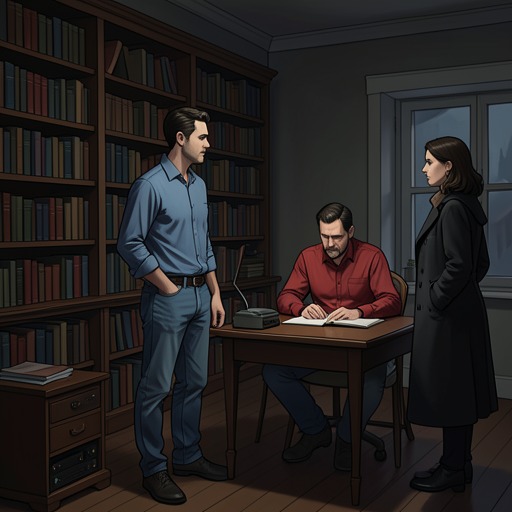
Threatening Emails to Jake
Crimson LakeThreatening Emails to Jake are fabricated messages Harrison Scully used to make his father, Jake Scully, believe that a dangerous admirer was watching the family and might target someone Jake loved. They first appear as a neglected bundle of printed pages, but become evidence of a deliberate frame-up: Harrison wrote the messages, directed suspicion toward Ormund Smitt, and used their final threat to help draw Jake out at night. Their progression from apparent fan mail to a reconstruction of the murder plan makes the papers both a weapon of deception and a clue to its failure.
Discovery and Physical Form
The emails surface in a car, not among the collection of correspondence already found at the house. Amanda Pharrell leans across the passenger seat with a wad of papers that are dry, cracked, crumpled, and folded down beside the driver’s seat. She spreads them on the centre console, where Ted Conkaffey recognizes them as new to him. Their condition suggests they had been stowed out of sight rather than presented as a formal collection; the evidence does not establish who placed them there or when.
The physical pages complicate their identity. They look like letters when handled, and the characters refer to them as letters during the later confrontation, but Ted identifies them as printed emails. That distinction matters to the investigation: they are not merely anonymous notes left inside a house. They preserve electronic messages in a form that can be read and compared, while their paper disguise initially lets them blend into Jake’s fan correspondence. Amanda asks why Cary Minnow did not alert them to these pages, underscoring that their existence had not been incorporated into the material they had already examined.
Escalating Message and False Persona
As Ted reads, the messages grow longer, and the progression changes their character. The early material can pass as intense admiration: the sender presents an imagined kinship with Jake and declares pride in him. Later lines turn toward menace, asking what it would take to command Jake’s attention and threatening people he loves. The shift makes the collection more than ordinary fan mail. Admiration becomes a performance of access and danger, designed to make Jake feel that the sender is close to his family and capable of acting against it.
The later pages extend that false persona into the domestic space. The supposed admirer claims to have watched Jake at home, observed private routines, and sat in his chair behind his desk. These claims are not independently established as real surveillance; in the confrontation, Amanda and Ted identify them as part of Harrison’s fabrication. Their specificity is therefore double-edged: they make the fictional stalker seem more threatening, but they also create details against which the investigators can test the story.
Harrison’s Frame-Up of Ormund
Amanda identifies Harrison as the writer, saying he made up the messages and emailed them to his father. The emails were meant to make Jake paranoid and to cast suspicion on Ormund. Harrison’s scheme depended on a plausible-looking culprit: Ormund was a local obsessive whom Jake might have suspected of luring someone into the waterways. By directing Jake’s attention toward him and letting him know where Jake’s car was, Harrison made Ormund’s connection to the car appear incriminating. Ormund visited it, leaving his prints and fibres there; those traces could then be read as evidence against him, although Harrison had engineered the circumstances that put them there.
The papers also offered Harrison a means of manufacturing urgency. Their invented sender appeared to know the family and to be escalating toward a confrontation. In the final messages, the supposed fan threatened to come for Harrison. Ted reasons that Jake would have been worried about what Ormund might do to his son. The messages thus manipulated Jake’s concern as a father, while the false trail toward Ormund concealed who had created the danger and why.
The Contradiction That Exposes the Deception
The emails’ account of access to Jake’s home contains the flaw that helps undo the frame-up. Ted recalls Jake’s unfinished manuscript, lying on the desk with dust on its first page. If Ormund had truly been entering the house, watching the family, and inhabiting the space described in the messages, leaving a new manuscript untouched would be difficult to reconcile with the supposed admirer’s conduct. The manuscript is not itself one of the emails, but it provides a concrete test of the story the emails tell: their claims of intimate access do not fit the untouched object in the very room they describe.
That contradiction reframes the messages. Their convincing fan voice and escalating threats had made them useful as a disguise, but their performance of obsessive closeness was too elaborate to withstand comparison with the scene. Ted’s conclusion is that Ormund did not write them. The detail that seemed to make the fictional sender credible instead exposes the distance between the invented narrative and the evidence in Jake’s house.
Role in Jake’s Final Journey
The emails also clarify how Jake came to leave the house. Ted reasons that there was no genuine phone call or message from an outside admirer summoning Jake to the river. Instead, the last emails had made Jake fear for Harrison, and Harrison woke his father with a claim that a man online wanted to meet him by the river and had something to say about the family. Jake went in his son’s place, believing he was confronting the person who threatened him. The messages therefore connect Harrison’s long-term deception to the fatal journey: their fabricated threat established the fear, and Harrison’s account of a meeting turned that fear into an immediate reason for Jake to go.
As evidence, Threatening Emails to Jake work through a reversal. At first they suggest a dangerous stranger closing in on a family; later, their wording and their mismatch with the untouched manuscript expose the son who manufactured that stranger. They explain how Ormund was made to look culpable and how Jake’s protective response was exploited, while preserving the distinction between what the emails claim and what the investigation establishes. The printed pages are not a reliable account of a fan’s actions. They are the surviving script of Harrison’s frame-up.