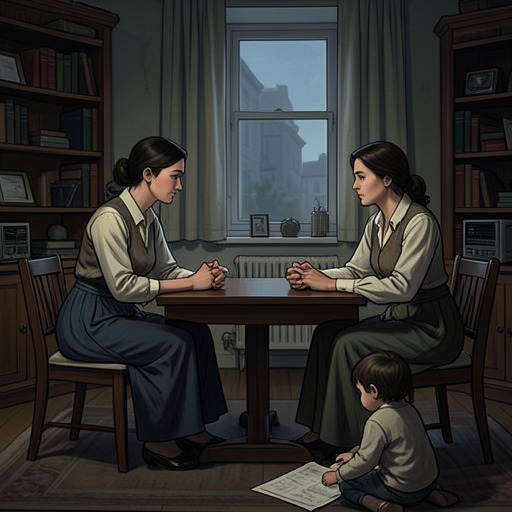
Dissociative identity disorder
Crow GirlDissociative identity disorder is central to Sofia Zetterlund’s explanation of Victoria Bergman’s memory lapses and divided identity: Sofia presents the different versions of Victoria as ways of surviving experiences she could not otherwise bear to remember. The account links this adaptation to both an outwardly functional life and the possibility that an internal pattern of abuse could continue. It remains a clinical interpretation offered by Sofia, not a diagnosis independently established in the material presented here.
Identity and Background
In conversation with Jeanette Kihlberg at the Sunflower Nursing Home, the elderly Sofia identifies Victoria as someone who suffered extreme sexual abuse by her father and probably other men. She then says Victoria also has multiple personality disorder, using dissociative identity disorder as an alternative name for the condition. Jeanette recognizes the general concept, recalling that the younger Sofia had previously explained a similar condition in Samuel Bai.
Sofia frames Victoria’s divided identity as an adaptation to trauma: Victoria was forced to invent different versions of herself to survive and cope with memories of what happened. The explanation treats the identities not as arbitrary disguises but as responses to experiences that could not be held together in one continuous sense of self. It also makes clear that the history of abuse is the background against which Sofia understands the disorder, rather than a separate detail in Victoria’s biography.
Memory Lapses and Crow Girl
Sofia’s written reflections describe Victoria forgetting what she herself said only ten minutes earlier or a week before. They raise, rather than resolve, the question of whether these lapses are ordinary gaps in memory or signs of dissociative identity disorder. The lapses tend to occur when Victoria speaks about subjects she usually cannot discuss, especially her childhood and earliest memories. Her account is associative, with one memory leading to another, leaving Sofia uncertain whether a particular personality is speaking or whether Victoria adopts the more childlike behavior of her twelve- or thirteen-year-old self because it makes those memories easier to approach.
The notes preserve further uncertainty: Sofia asks whether the memories are real or mixed with Victoria’s present thinking about the past, and who the frequently mentioned Crow Girl might be. Victoria’s answer gives that figure a specific place within the divided identity: Crow Girl is a mixture of all the others except the Sleepwalker, who has not realized Crow Girl exists. The Sleepwalker’s lack of awareness marks a limit within the proposed system; even the composite figure does not encompass every part of it. Taken together, the reflections present memory as both a source of information and a field of uncertainty. Sofia observes patterns, but her questions show that she cannot simply treat every recollection as a stable, complete record.
Adaptation and the Risk of Repetition
Sofia explains that, when Victoria was given a new identity, she had documentation that one of her split personalities had really existed. Sofia describes this as the conscientious part: the identity able to receive an education, work, and live what appeared to be a normal life. The documents thus provide an external footing for one part of a divided self. In Sofia’s account, the identity that could function in ordinary society did not erase the fragmentation that had made such functioning possible.
Sofia also introduces Freud’s concept of moral masochism to explain a possible return of abuse through another personality. She says she detected a trace of this pattern in Victoria: a dissociative person might relive their own abuse by allowing an alternative personality to do something similar to others. Sofia does not present this as a certainty about Victoria’s later actions. Her warning is conditional: if Victoria has not received help as an adult, the personality may still be present and may act like her father, tormenting and punishing Victoria herself. The possibility gives the disorder a continuing consequence beyond memory disruption, but the account does not establish what ultimately happens to that personality.
Interpretation and Limits
The explanation brings together outward competence, memory discontinuity, and the possibility of internal repetition without making them interchangeable. The conscientious identity’s education and work show how one part could support an ordinary public life; the childhood lapses and Crow Girl account point to experiences and identities that remain difficult to access or integrate. Sofia’s concern about an abusive personality then turns the same division toward a possible danger, while retaining uncertainty about whether it remains active.
The scene also sets the force of Sofia’s interpretation against the fragility of her present-day condition. Jeanette is astonished by how the elderly woman shifts between intellectual clarity and dementia-like confusion, even as Sofia takes direction of the conversation and explains Victoria’s history with confidence. Their discussion ends when a manager and nurse catch them smoking and reprimand them. The frame does not invalidate Sofia’s account, but it gives readers reason to distinguish her explanation from an uncontested clinical finding. Dissociative identity disorder, as presented here, is both an account of how Victoria may have survived and a warning that survival strategies can carry unresolved consequences.