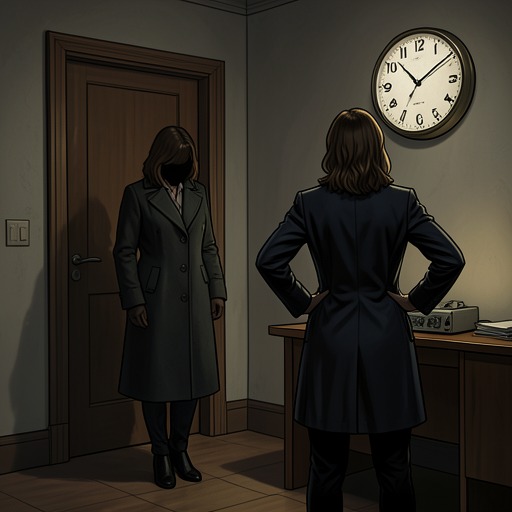
Fredrika Grünewald
Crow GirlFredrika Grünewald’s importance lies in the distance between the authority she wielded at school and the vulnerability of her final years. At Sigtuna College for the Humanities, she helped turn an initiation into a display of control over younger girls; later, impoverished and living on the streets, she was known as the Duchess. Her death in the caverns beneath St Johannes Church reconnects that past to the present investigation, where humiliation, silence, and participation all carry consequences.
Identity and Background
The account of Fredrika’s school years places her among an upper-class circle whose status was made visible through money, expensive clothes, and prestigious names. The girl who remembers her also resents the anonymous girls from Danderyd and Stocksund who, in her view, treated those advantages as proof of their superiority. Fredrika is remembered alongside them as both a particular person and part of a social group whose privileges helped shape the school’s hierarchy.
Fredrika’s later circumstances are sharply different. By the time a woman tracks her down, she has been living on the streets and has become known as the Duchess, a name linked to her supposed noble-family background. The Grünewald family has lost its fortune following Fredrika’s poor judgement and risky investments. The contrast is not presented as a moral settlement for what happened at school: her decline has not erased the memory of her actions, nor does it end the other woman’s plan for revenge.
Power at Sigtuna
During the first week of a new school year, Fredrika and her acolytes selected three girls for a particularly degrading initiation. Wearing dark capes and homemade pig masks, the older girls took them to a tool shed and poured ice-cold water over them. The ceremony made power physical: the younger girls were isolated, exposed to discomfort, and subjected to a ritual determined by their seniors.
The filmed scene continues with a supposed welcome gift from the school’s headmistress. The girls had agreed that the newcomers would be served chocolate pudding, but Fredrika instead served real dog excrement, using the shock to cement her hold over the younger girls. The others’ laughter grows louder, yet the watching Sofia Zetterlund recognizes it as forced, as though the girls laugh from obligation rather than genuine amusement. Fredrika’s control is therefore not simply a matter of initiating the cruelty; it also shapes how others are made to respond to it.
The film’s close view of Jessica Friberg, Hannah Östlund, and Victoria Bergman on the floor preserves the humiliation as a visible record. Sofia, watching silently, feels fury. Yet she also feels pride in her younger self: she had fought back and, by taking responsibility for the final shock, had helped bring the performance to its end. Fredrika’s authority was real, but the memory does not reduce the younger girls to passive figures; resistance, too, became part of what the scene recorded.
Shame, Memory, and Complicity
The initiation leaves more than an isolated recollection. The girls shared the shame for three years, and for three years the idea of revenge held them together. That duration gives their bond a double character: it is a form of solidarity, but one sustained by an injury that remains unresolved. Fredrika’s actions become part of a past the girls carry collectively, even as the passage distinguishes their different roles within it.
Ten years later, at Viggo Dürer’s farm in Struer, Fredrika told the woman who would come after her about Sigtuna. At first, Fredrika did not recognize her; the last time they had met was a decade earlier. The remembered account emphasizes that Fredrika had stood by and enjoyed the spectacle. That recollection complicates the question of responsibility: whether she initiated the cruelty or merely performed her part in it, the woman seeking revenge judges her guilty. In that judgement, choosing not to act does not make a bystander innocent.
The past returns not as a neutral account but as a sequence of bodily impressions: a filthy floor, breathing, and the stench of sweat, damp earth, and machine oil. Those details make the remembered event persist as something sensed as well as understood. They also connect the school’s humiliation to the later decision to pursue Fredrika. When the woman hesitates because Fredrika’s life has already fallen apart, the memory answers with the insistence that the plan must be completed and that sympathy has no place in it.
The Caverns and Fredrika’s Death
After killing Per-Ola Silfverberg, the woman spends almost two weeks tracking Fredrika to the caverns beneath St Johannes Church. The refuge’s public meaning is a pointed counter-image to the school ritual. The Swedish Order of St Johannes has a long association with aid to the poor and sick, and its emblem at the entrance declares that anyone should be able to feel safe there. Yet the account of the caverns also stresses the gap between that promise and what actually happens: a cry for help echoes in a place designated as shelter.
Fredrika is found in a tent made from large plastic bags, with a shabby blue blanket hanging over its entrance. She is identified as the woman known as the Duchess, although the police are still checking the story of her supposed noble background. Witnesses report that a man called Börje came down the previous afternoon with an unknown woman. The information does not itself settle the identity of that woman; instead, it places Fredrika’s death in the rough, exposed world of the cavern and leaves the investigation to establish who came there.
A Polaroid of Fredrika’s body supplies a more explicit record of the killing. Jeanette Kihlberg examines the image: Fredrika’s face is lifeless, her mouth open, her eyes fixed in an anguished expression. Blood runs down her pale blouse, and piano wire has cut deeply into her rigid neck. The photograph is not merely evidence of a death; it is also one of the images left behind in a sequence connected to the murders, forcing the police to confront a case whose acts have been deliberately documented.
Investigation and Narrative Significance
Jeanette Kihlberg recognizes the school network linking Fredrika to Charlotte Silfverberg, Henrietta Dürer, Annette Lundström, Victoria Bergman, Hannah Östlund, and Jessica Friberg. Hannah and Jessica are missing when Jeanette presents her evidence to Prosecutor Kenneth von Kwist. He agrees to issue warrants for their arrests on reasonable suspicion of Fredrika’s murder; the evidence concerning Per-Ola’s murder is less compelling, though it gives grounds for suspicion. These are investigative suspicions, not a final resolution of responsibility.
Fredrika’s role consequently reaches beyond the immediate circumstances of her death. Her school conduct links the humiliation of younger girls to a longer history of shared shame, while her remembered pleasure in the spectacle makes silence and passive participation part of the moral dispute. The refuge where she dies sharpens the contradiction: a place marked as safety has become the setting of a killing, and the school’s past resurfaces through photographs, testimony, and missing former classmates. Fredrika remains central not because the account offers a complete portrait of her inner life, but because her actions and remembered presence expose how a group’s hierarchy can be enforced—and how long its injuries can continue to organize the lives of those who survived it.