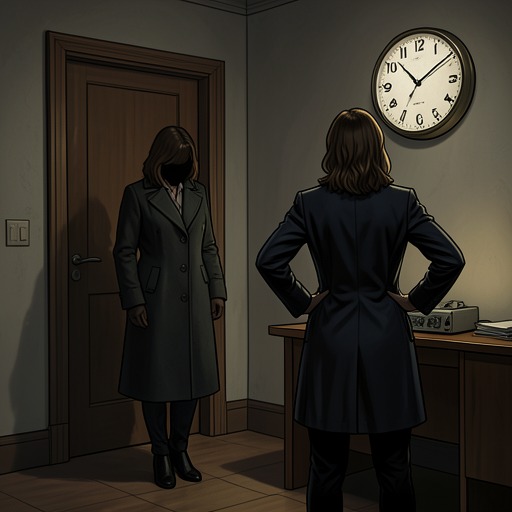
Hannah
Crow GirlHannah is a school friend of Victoria Bergman and one of the three girls whose shared history is replayed through Sofia Zetterlund’s memories, recordings, and photographs. Her significance lies less in independent actions than in the changing meaning Sofia assigns to their friendship: Hannah first appears as someone who failed her, then as someone who had trusted her without knowing the part Sofia herself played in the events that bound them together.
Sigtuna and the school initiation
A recording from four months earlier recounts a ferry journey with Hannah and Jessica, whom the speaker says she had met in Sigtuna. The school years return more fully in footage Sofia watches: a girl announces herself as the representative of the student body and says that new members must eat a welcome gift from the school’s headmistress. The promised chocolate pudding has been replaced with dog excrement. Hannah, Jessica, and Victoria are shown sitting on the floor as the other girls laugh. Sofia can see that the laughter is forced, encouraged by Fredrika Grünewald, and understands the scene as a public exercise in coercion rather than harmless fun.
Hannah is included in the humiliation, but the account does not single her out as its instigator or describe her individual response. That distinction matters to Sofia’s later reckoning. She remembers Hannah and Jessica as caught up in Victoria’s game, while also recognizing that they never knew it had been Sofia’s idea all along. In front of them, Sofia had performed the role of the victim, concealing her own responsibility behind the appearance of being wronged. The initiation therefore leaves Hannah with an incomplete understanding of what happened among the three girls.
The Roskilde Festival assault
A cassette account recalls a later trip to the Roskilde Festival. The speaker travels with Hannah and Jessica, but the two go to the festival stage and leave her alone in a tent. Four German men assault her there, taking turns holding her down. In the recording, the distant sounds of Sonic Youth and Iggy Pop mark the divide between the festival beyond the tent and the violence taking place inside it. The speaker also recalls being knocked out by sweet dessert wine and says that, afterward, she did not want to tell her friends why she was so upset or explain that she wanted to leave.
The account establishes Hannah’s absence and the speaker’s sense of being abandoned; it does not establish that Hannah knew what was happening in the tent. That gap between what the speaker suffered and what she told her friends shapes the later memory of their friendship. The assault could not simply be discussed between them: the speaker withheld its cause, while Hannah and Jessica’s presence at the festival did not make them witnesses to what happened. The recollection is thus both an account of violence and an account of how its secrecy distorted the girls’ understanding of one another.
Friendship, rupture, and retrospective judgment
In the album Sofia studies, an Interrail card and a Roskilde Festival ticket sit beside three blurred photographs of Hannah, Jessica, and the speaker. The objects preserve a period when the three were close enough to be remembered as the Three Musketeers. Sofia recalls that they shared everything and solved problems together at first; toward the end, she felt that Hannah and Jessica had turned away from her. When a situation became serious, she judged them as having cried and run home rather than showing the character she expected of them.
Looking again at their photographs changes that judgment. Sofia now sees Hannah and Jessica not as foolish or false, but as unsullied: they had trusted her and believed the best of people. The shift does not erase her sense that they let her down, nor does it make them responsible for what they did not know. Instead, it exposes how Sofia’s own hidden role and performed victimhood shaped the accusation. Hannah’s place in the story is therefore bound to a painful asymmetry: she had been part of an intimate friendship, but did not know the secret that would later alter Sofia’s account of it.
Narrative significance
Hannah is presented through mediated recollection rather than an independent point of view. The cassette preserves the speaker’s earlier anger and isolation; the television footage makes the school humiliation visible; and the album gives Sofia a later opportunity to revisit the friendship. Each medium offers a different piece of the past, and none turns Hannah into an all-knowing observer of the events. The reader encounters her instead at the intersection of what Sofia remembers, what Sofia concealed, and what she can now recognize in the photographs.
That structure makes Hannah important to the novel’s treatment of blame and trust. Sofia’s first account treats her friends’ distance as proof of their failure, while her later reflection recognizes their innocence and the confidence they had placed in her. Hannah does not deliver this reassessment herself; Sofia arrives at it while facing the evidence of her own deception. Their friendship consequently becomes one measure of how the past can be reinterpreted without changing what happened: the girls shared a history, but they did not share the same knowledge of it.