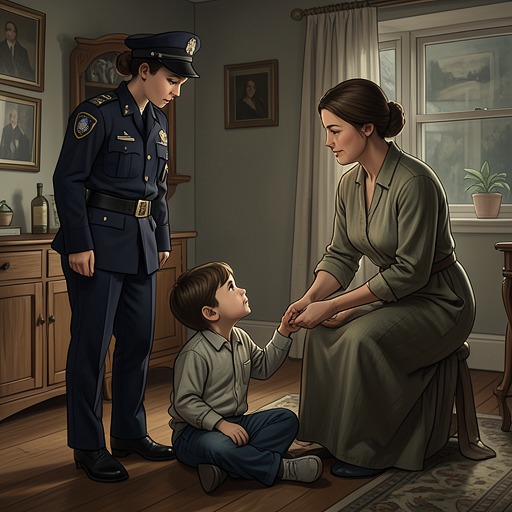
Johan Kihlberg
Crow GirlJohan Kihlberg is Jeanette Kihlberg’s teenage son, and his increasingly unsettled home life forms a personal counterpoint to her work on a case involving the deaths of boys. He is distant at school, difficult to reach at home, and caught between parents whose separation has disrupted his sense of stability. His disappearance at Gröna Lund briefly makes him the focus of a frightening parallel in Sofia Zetterlund’s memories: she fears that what happened to him might resemble an earlier event involving Martin, but Johan is found unharmed.
Identity and Introduction
The story presents Johan chiefly through the changing impressions of his mother and the people around her. He is a teenager, but the evidence of his distress is practical and observable: according to his teacher, he has missed several lessons in one week, and when he does attend, he seems distant, uninterested, gloomy, and introverted. At home, Jeanette sees signs that his mood and her own uncertainty about how to reach him are becoming difficult to separate.
Johan’s interests nevertheless remain present beneath that withdrawal. One night, at four in the morning, Jeanette finds him and Jens Hurtig absorbed in a computer game. A blue insect moves across the screen; when it swallows what appears to be a hairy red spiral, Hurtig urges it on and slaps Johan on the back. Jeanette’s first impulse is to reprimand them for being awake and send them to bed, but she stops herself and lets them play. The scene gives Johan a moment of uncomplicated companionship with Hurtig, while showing Jeanette choosing not to turn every encounter into a correction.
Home Life and Family Strain
Johan’s relationship with Jeanette is shaped by her worry and by the limits of her availability. When she returns home, she finds the kitchen in disarray, a faint haze in the living room, and food left out. Seeing light from Johan’s room, she calls to him and worries again. He tells her from inside that he has already eaten; later, she discovers that he has fallen asleep on his bed. Before that, he has set the table for her. Jeanette is close to tears when she notices the gesture, because his rejection of conversation and his attempt to care for her coexist in the same evening.
That small domestic reversal matters to Jeanette. Her recollections of evenings with Åke, when they watched television, ate chips, and laughed at bad films, lead her to regard their marriage as a long, emotionally diminished wait for something to change. She concludes that life is too precious to spend waiting. The thought does not resolve Johan’s difficulties, but it marks the pressure his situation places on Jeanette as she reassesses her own life and the family arrangements that have left him unsettled.
Jeanette learns from Åke that Johan is having trouble accepting Alexandra Kowalska. Johan has called Alexandra a whore, provoking a serious argument. Hurtig laughs at the account and says the boy has guts; Jeanette, however, sees the episode within a broader pattern of instability. Åke is moving out, and Jeanette worries that Johan is being shuttled between her, where she has little time for him, and Åke and Alexandra, whose plans seem uncertain. Her concern is not simply that Johan has behaved badly, but that the adults around him are failing to provide steadiness while expecting him to accommodate changes in their lives.
Disappearance and Its Echoes
Johan’s disappearance at Gröna Lund gives his family strain an immediate and frightening dimension. Later, as Sofia examines notes from her past, she remembers that he disappeared during the visit. The incident recalls Martin, the boy who vanished during a trip to a fair and was later found drowned in the Fyris River. Sofia’s memories connect her own actions to Martin’s death, which had been treated by police as an accident, and she carries guilt about the consequences.
The resemblance does not make the two events identical. Sofia is convinced that she would not have harmed Johan. She believes he may have gone away by himself or been taken by someone else, then released; in any case, he is found unharmed. The episode therefore joins Johan’s immediate vulnerability to Sofia’s buried history without making him a repetition of Martin. It also reveals how a missing child can reactivate a past that Sofia has spent years suppressing with medication and alcohol. Johan’s safe return distinguishes his experience from Martin’s while exposing the emotional force of that comparison.
Relationships and Continuing Significance
Johan’s relationship with his father also contains an effort at repair. Åke calls Jeanette to ask to take Johan to London for a football match that weekend, framing the trip as a chance to spend time with his son and simply be a father. Johan is eager to go. For Jeanette, the plan is welcome to him but troubling in its context: she sees the visit as part of an uncertain sequence of arrangements, not a guarantee that the instability at home has ended.
Across these episodes, Johan is not defined by a single confrontation or by the disappearance alone. His school absences, withdrawal, conflict over Alexandra, quiet act of setting a table, companionship with Hurtig, and enthusiasm for time with Åke reveal different aspects of a teenager responding to a family in transition. His presence also makes the novel’s investigation of endangered boys intimate for Jeanette and unsettling for Sofia. The case brings fear and old guilt close to the family, while the ordinary exchanges around meals, games, and a football trip show the ongoing work of caring for Johan without pretending that the adults have made his circumstances secure.