Kihlberg family home
Crow GirlThe Kihlberg family home in Gamla Enskede is a domestic counterpoint to Jeanette Kihlberg’s police work: a place glimpsed through ordinary routines, but also where the consequences of a case begin to enter family life. Its few described spaces—the garage, bedroom, attic studio, and living room—give the household a practical outline, while the events associated with it connect private habits to changes Jeanette does not yet foresee.
Setting and household spaces
The home is identified with Gamla Enskede and the Kihlberg household. The account offers no complete floor plan; instead, it makes the house legible through movement between particular parts of it. Jeanette backs her car out of the garage, sees Åke at a window, and later shares the living room with him. A bedroom contains two beds, one of which provides a thin mattress, while an attic studio holds Åke’s unfinished oil paintings. These glimpses establish a lived-in family house without turning it into a detailed architectural portrait.
The spaces are associated with distinct activities. The garage and car mark Jeanette’s departures; the bedroom is a place from which a mattress can be moved; the living room is where the couple sit together with tea and watch television. The attic studio belongs to Åke’s painting, a recurring project he has not yet brought to completion. The home is therefore described less by furnishings or appearance than by what its occupants do there.
Family routines and domestic character
A scene at the window captures a small separation within the household’s daily rhythm. Jeanette waves to Åke as she leaves, but he is on the phone and does not see her. His day is expected to include washing the week’s accumulation of sweaty tops, muddy socks, and dirty underwear. With Jeanette and their son devoted to football, laundry has become a repeated chore: the old washing machine is pushed close to breaking point at least five times a week. The detail makes domestic life specific and habitual, rather than an abstract backdrop to Jeanette’s work.
Once the washing is finished, Åke is expected to go up to the attic studio and continue one of his many unfinished paintings. Jeanette regards him as romantic and dreamy, but also as someone who has difficulty completing what he begins. She has urged him to contact a gallery owner who showed interest in his work; Åke’s response is that the pictures are not ready yet. His repeated postponement gives the studio a double meaning: it is a space for creative ambition, but also the setting for work indefinitely left unfinished. That pattern belongs to Åke’s characterization, not to an asserted explanation of the house itself.
The living room offers a different picture of shared routine. After their son Johan has gone to bed, Jeanette and Åke sit with cups of tea while a pre-game television programme considers Sweden’s chances in the European Football Championships. The discussion of possible progress to the quarter-finals or semi-finals, and hopes of winning gold, places the couple within the ordinary anticipation of a major sporting event. The scene is domestic and conversational, yet Jeanette’s thoughts about work and money sit alongside it, bringing her professional and financial concerns into the same evening as the family’s television ritual.
Police work enters the household
The home remains connected to Jeanette’s police work even when the scenes take place outside it. On the evening after the body is found at Thorildsplan, she leaves police headquarters shortly after eight. Jens Hurtig offers her a lift home, but she declines, saying she wants to walk to Central Station before taking the train to Enskede. The journey makes the family home a destination at the end of a workday shaped by the case, while also showing Jeanette choosing how to make that transition rather than accepting a colleague’s ride.
The case is introduced as the beginning of events that will change Jeanette’s life, though she is unaware of that significance as she backs out of the garage. This contrast connects the house to the story’s larger structure: the reader can understand the departure as a threshold between family routine and a consequential investigation, while Jeanette herself does not yet know what it will set in motion. The home is not described as a refuge from the case so much as the ordinary point from which its effects will be measured.
A new arrival
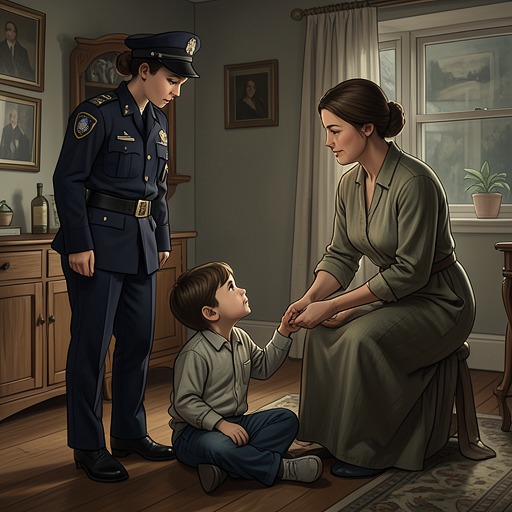
One evening, a sleeping boy is carried into his new home. Beforehand, someone puts the books back and fetches a thin mattress from one of the two beds in the bedroom. The account links this concrete preparation to the Kihlberg home but does not, in this passage, identify the boy or explain the longer-term arrangement. What it does establish is an immediate adjustment to the household’s physical space: a mattress is taken from an existing bed, and the sleeping child is brought inside.
That arrival alters the meaning of the rooms already associated with everyday family life. The bedroom is no longer only part of the household’s established routine; its furniture can be rearranged to accommodate a boy who needs a place to sleep. The passage does not claim that the house’s ordinary tensions disappear or that a permanent solution has been reached. Instead, it presents care through practical action—returning the books, finding a mattress, and carrying the sleeping boy home. Set against the earlier images of football laundry, television, and Åke’s unfinished paintings, this moment shows the Kihlberg family home as a place where routine can be interrupted by another person’s immediate needs.