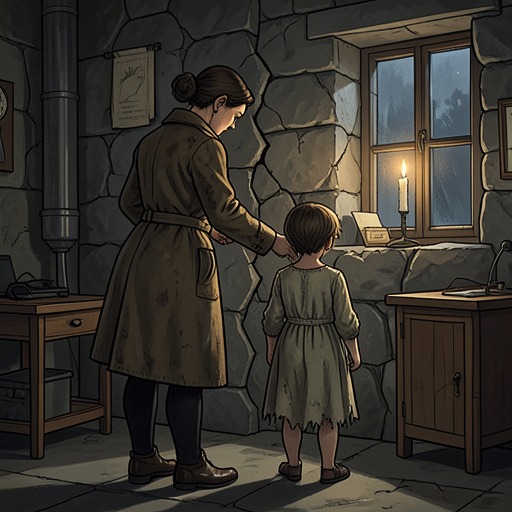
Klippgatan Stairs
Crow GirlKlippgatan Stairs turn a familiar climb through Södermalm into a meeting place for mistaken recognition, memory, and an act of mercy. Their successive flights draw Sofia Zetterlund toward an elderly stranger she associates with Birgitta Bergman, then provide the setting where Madeleine Silfverberg confronts Victoria Bergman and abandons her chance to kill her. The stairs matter not as a source of revelation about the old woman, who is not Birgitta, but as the ground on which the characters’ recognition and refusal take physical form.
Setting and Approach
The route to the stairs unfolds through a sequence of sudden sounds and ordinary street details. Sofia parks by London Viaduct and walks up Folkungagatan; near Erstagatan, a man’s loud slamming of a car boot startles her. As she approaches Klippgatan, the bell of a corner shop sounds unnaturally loud to her. Its owner comes out with a small, bent woman, and warns her, “Take care now, Birgitta. Those steps up to the church can be slippery.” The brief exchange makes the climb a recognizable part of neighborhood life before Sofia’s response gives it a more charged meaning.
The woman has grey hair tied in a bun and carries weekly magazines. As she starts up, she stops by a rubbish bin, searches through it, and puts a beer can in her bag to reclaim its deposit. Her brown wool suit is dirty and worn, and her shoes are scuffed. These details establish a particular stranger rather than confirming the name Sofia has just heard. The stairs lead upward toward a church, but their narrative pull comes from what Sofia brings to the sight of the woman.
First Flight: A Mistaken Recognition
Watching the woman climb, Victoria remembers the stairs at home and the repeated labor of cleaning them without making any difference. The recollection makes this public staircase overlap with a remembered domestic space: a handrail and ascending steps prompt a return to a past that is not safely past. When she follows the woman and grips the cold rail, the narrative calls her Victoria and gives her words to the stranger: “We have to talk,” she says. “You can’t just go without explaining what’s going on. You’re dead. Don’t you get it?” The woman turns, and recognition fails: it is not Birgitta.
That correction is essential to the scene. The shopkeeper’s address has supplied a name, but the woman’s appearance and movement have not made her the dead person Victoria expects. The stairs carry the encounter forward without resolving the past through a literal return. Their handrail instead marks the bodily route into recollection, while the old woman continues climbing as an independent stranger. The scene’s tension lies between Victoria’s certainty that she must speak to someone dead and the plain evidence that the woman before her is someone else.
Second Flight: Madeleine’s Decision
The stairs later become the point of convergence for Madeleine, who has followed a little blue car farther into Södermalm. She has found Victoria before, at Gröna Lund, but acted too hastily because she believed the boy holding Victoria’s hand was her half-brother. At Klippgatan she sees her mother across the street. The narrative then separates the woman on the stairs from the person Madeleine has come to face: the elderly stranger climbs the second flight and disappears into the darkness, while Victoria remains at the railing beneath the silhouette of Sofia Church.
Madeleine approaches the bottom of the steps and looks at Victoria’s bowed back. As Victoria straightens and grips the rail, Madeleine loosens her hold on the revolver. In her thoughts she feels sorry for her mother and decides that letting her live is punishment enough; she understands them both as having no past and no future. Victoria then climbs, slowly at first and with increasing determination, reaches the top of each flight, and disappears. Madeleine realizes she has done the right thing. The stairs thus frame not a reunion or reconciliation, but a choice with an immediate consequence: Victoria leaves alive, and Madeleine does not carry out the killing.
Narrative Significance
The two encounters make the flights and handrail recurrent points of passage, but not toward a simple resolution. In the first, climbing calls up the repetitive labor of cleaning the stairs at home and briefly directs Victoria’s grief toward a stranger. In the later encounter, the old woman’s disappearance clears the scene for Madeleine’s recognition of Victoria and her decision to spare her. Ordinary features—the slippery steps mentioned by the shopkeeper, the rubbish bin, the rail, and the darkness above—anchor moments in which memory and present action threaten to blur.
The location also gives the scene its structure. A person climbs away from the street; another follows or waits below; the successive flights divide approach from arrival. At the end, Victoria continues upward and vanishes, while Madeleine remains with the consequence of having lowered the revolver. Klippgatan Stairs therefore connect mistaken recognition to deliberate recognition: the first cannot bring Birgitta back, but the second allows Madeleine to see her mother and choose not to kill her.