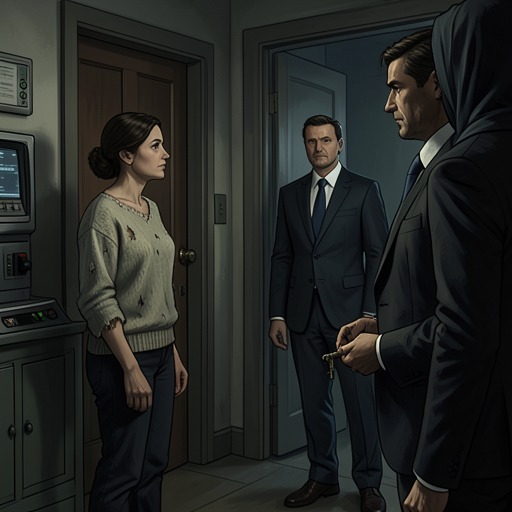
Madeleine spares Victoria
Crow GirlMadeleine Silfverberg spares Victoria Bergman at Skanstull Bridge after approaching her with a six-shot revolver and the intention of killing her. Their encounter turns on a brief exchange of looks: Madeleine sees the mother she has lost and recognizes in her own suffering a likeness that makes revenge seem like another turn of the family’s violence. She loosens her grip, lets Victoria climb away, and experiences relief at having chosen not to kill her.
The Family’s Cycle and the Earlier Encounter
The scene is framed by the idea that the Bergman family is a snake swallowing its own tail. Murder, betrayal, and revenge are not isolated events here but parts of a vicious circle Madeleine no longer wants to join. Her decision at the bridge therefore concerns more than whether Victoria will live: it is also a decision about whether Madeleine will continue the family’s inherited pattern of violence.
At Gröna Lund, Madeleine had encountered Victoria by chance. She believed that the boy holding Victoria’s hand was her half-brother, and acted on impulse, too hastily. The earlier meeting supplies a contrast for the bridge: then, belief and haste drove her action; now, she approaches Victoria deliberately, carrying a weapon and confronting the consequences of what she might do. The text also recalls that Viggo Dürer had seen Victoria at this location before. This time Madeleine finds her by the Skanstull Bridge, where the earlier sighting had occurred, and comes close enough to approach her.
The Approach with the Revolver
Victoria is huddled and appears to be freezing. Madeleine gets out of the car, crosses the road, and follows until she is only ten metres behind Victoria as she reaches the pavement. Inside her jacket pocket, Madeleine feels the revolver: cold metal, loaded with six bullets. The narration presents her purpose as clear and implacable, and calls the weapon the key to her freedom. In that moment, killing Victoria appears to Madeleine not simply as an act of revenge but as the means by which she might escape the burden binding her to the past.
The approach slows at the steps. An old woman walks up the second flight and disappears into the darkness, while Victoria remains by the railing. Behind her, the silhouette of Sofia Church rises against the sky. Madeleine stops at the bottom of the steps and looks at Victoria’s bowed back from behind. As Victoria straightens and grips the handrail, Madeleine puts her hand in her pocket and holds the revolver. The scene keeps the possibility of violence physically present: Madeleine has not arrived unarmed or uncertain of what the weapon can do, but she has not yet acted.
Recognition and the Choice to Spare
Victoria turns, and for a brief moment the two look at each other. The look brings Madeleine memories she has never possessed, arriving like a wave about to break against a stony shore. She feels a tear for a stolen past and recognizes how far down she has fallen; what remains, as she understands it, is the journey back. She wants to get away from the cold and thaw out. These images place the encounter between recovered connection and exhaustion: the face before her does not restore what was taken, but it makes the relationship and its losses newly present.
Madeleine interprets Victoria’s distant gaze, veiled by madness, as an inability to see her. She feels invisible and loosens her grip on the revolver. Instead of treating that apparent failure of recognition as permission to kill, she thinks of Victoria as her mother and feels sorry for her. Letting Victoria live becomes, in Madeleine’s judgment, enough of a punishment; she sees them as alike, without a past or a future, like the first blank page of an unwritten book. The decision is neither reconciliation nor a claim that the past has been repaired. It is a refusal to make killing the next act in the cycle.
Departure and Aftermath
Victoria begins climbing, slowly at first and then with more determined steps. She reaches the top of the first flight and then the second, and disappears. Madeleine realizes she has done the right thing. Her body slumps in a fraction of a second of relief, registering a physical release after the tension of following Victoria with the revolver in her pocket.
Madeleine’s final resolve is to consider them all dead to her and to put down her burden, too tired to carry it any longer. The phrasing marks a separation, not a reunion: Victoria lives, but Madeleine does not ask to resume a relationship or settle the past between them. The decisive change is that she leaves the burden of vengeance behind rather than passing it on through another killing. The encounter thus reverses the expectation established by the loaded weapon and its stated purpose. Madeleine does not gain freedom by destroying her mother; she recognizes that sparing Victoria is the right thing to do, and allows the other woman to leave.