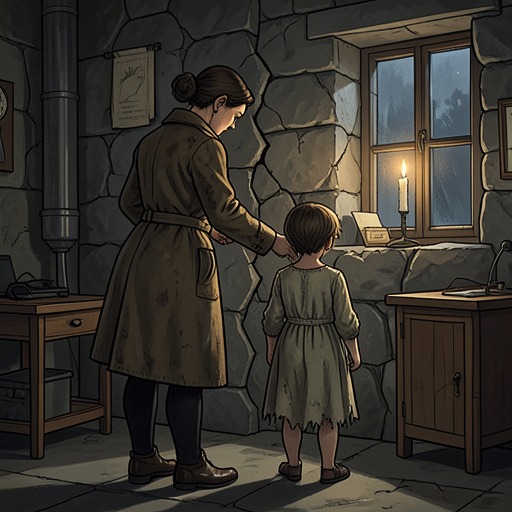
Madeleine’s Copenhagen medical and psychiatric records
Crow GirlMadeleine’s Copenhagen medical and psychiatric records are a compact documentary history of her birth and childhood, but they also expose how institutions recorded her distress while treating her testimony as suspect. Carried in a suitcase and known to her by heart, the papers contain concrete medical details, reports of her accusations against her father, and judgments shaped by her mother’s account. Presented alongside Polaroid photographs concerning her foster parents, they become part of Madeleine’s effort to make her history legible to another person without allowing the records’ dismissive conclusions to stand unquestioned.
Contents and Provenance
Madeleine plans to tell her story for as long as necessary and to use Polaroid pictures to show what her foster parents had done. The medical and psychiatric papers form a different kind of evidence: institutional documents rather than images. The surviving passage does not describe the photographs’ contents in detail, but it establishes that Madeleine presents them together with the records as part of her account. The distinction matters: the documents preserve what hospitals and social services entered into their files, while the photographs are offered as visual evidence of her experience in foster care.
Among the papers are records from Copenhagen University Hospital. They state that Madeleine was born breech and taken from her biological mother along with the placenta. The file gives her birth length as thirty-nine centimetres and her weight as almost two kilos, and records that she was placed in an incubator because jaundice was suspected. A postnatal clinic later assessed her as a month younger than the age stated in the documents. These precise details make the file more than a general account of a troubled childhood: it preserves a sequence of birth and early-care information, while also recording a discrepancy in how her age was assessed.
The suitcase also contains material from a Childhood and Adolescent Psychiatry unit. Madeleine knows the papers so well that she can identify particular entries and a faded handwritten note in the margin. Her familiarity gives the archive a double character: it is an official record of decisions made about her, but it is also information she has repeatedly studied and retained. The documents’ physical survival and her command of their contents allow her to reconstruct a childhood whose own descriptions were filtered through other people’s judgments.
Psychiatric Assessments and Disputed Testimony
The psychiatric record describes Madeleine as showing signs of depression and having a persistent pattern of self-harm; it also characterizes her as capable of violence. It further records that she repeatedly accused her father of sexual abuse, but that her accusations were not considered credible. The file therefore preserves the fact that she made the allegations while simultaneously preserving the institutional decision to disbelieve them. Its evidentiary value is not that it independently establishes every event she describes, but that it documents both her repeated disclosures and the response they received.
A pencilled marginal note offers the reasoning used to discount her account. It relies largely on her mother’s assertion that Madeleine had always possessed a vivid imagination, and cites her frequent, incoherent references to a farm in Jutland as evidence of recurrent delusions. The note is now almost illegible, but Madeleine knows what it says. Its placement in the margin distinguishes it from the formal entries, yet its judgment bears directly on how the rest of the file frames her. A report of what the child said becomes an argument against her credibility, linked to a family member’s explanation and a psychiatric interpretation rather than treated as testimony requiring belief or investigation.
Placement and the Records’ Limits
Another document bears a social-services stamp and officially authorizes Madeleine’s placement in a family home. The record establishes that her placement was formally authorized; it does not, in the available account, explain the full reasoning behind the decision or document what happened afterward. Read alongside the psychiatric assessments, however, it shows how several institutions contributed to the written account of her childhood: hospitals recorded her birth and early care, psychiatric services categorized her distress and speech, and social services issued the authorization for her placement.
The papers are not a neutral, complete narration of Madeleine’s life. Their concrete measurements and dates sit beside descriptions and conclusions whose basis includes her mother’s claims and the clinic’s interpretation of Madeleine’s speech. Nor does their existence, by itself, settle the truth of every remembered event. Their force comes from this tension: the file confirms that Madeleine repeatedly made accusations, yet also records the judgment that she was not credible. In showing and reciting the documents, she can expose that contradiction without mistaking an official file for an unfiltered account of what happened.
Role in Madeleine’s Account
Madeleine’s knowledge of the records contrasts with the uncertainty that surrounds memory elsewhere in the therapeutic material. Sofia Zetterlund wonders whether Victoria’s lapses reflect ordinary gaps, dissociation, or the difficulty of discussing childhood; she also questions how memories may be mixed with later thoughts about the past. Those questions make it important to distinguish remembered experience from documentary corroboration. The Copenhagen papers offer specific external entries, but they also demonstrate that records themselves contain interpretation, omission, and the influence of other people’s testimony.
The archive consequently serves as both evidence and an account of failed recognition. It preserves the measurements of a premature-looking, medically observed newborn, the later descriptions of a distressed child, her repeated allegations, the rejection of those allegations, and the authorization of a family placement. At the same time, it shows how a child’s words could be absorbed into a file that characterized her as unreliable. Madeleine’s act of bringing the documents forward reverses their original direction: instead of allowing institutional language to define her privately, she makes its judgments available for scrutiny as part of the history she is trying to tell.