Martin
Crow GirlMartin is a boy from Victoria Bergman’s childhood whose disappearance and death at the Fyris River return throughout the story as both a tender memory and a source of enduring guilt. The recovered accounts do not settle into a simple explanation: a newspaper calls his death an accident, Victoria remembers striking him and letting his body sink, and a child’s perspective shows older boys assaulting him while she is away. That tension makes Martin more than a lost friend; his fate marks the point where Victoria’s capacity to care for someone and her capacity for violence become inseparable.
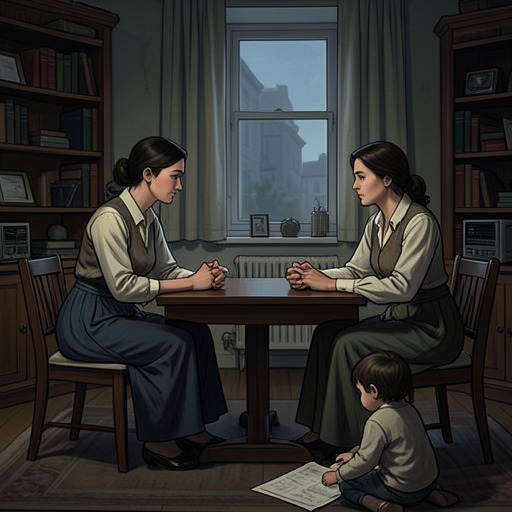
Identity and Early Bond
Victoria’s memories place their first meeting during a summer by the water. She was ten and Martin was three when they got to know each other at a cottage; elsewhere, the recollection describes him as a little boy for whom she became a kind of self-reliant, protective older child. Martin’s parents had found a house to rent in Dala-Floda, and the counterfactual chain surrounding that move gives their meeting the weight of an accident that altered both their lives. Victoria remembers swimming between the jetty and a diving rock, then lying on the beach. In that landscape she first met Martin, and learned, in her words as the memory is presented, to take care of someone else.
A letter and photograph preserve Martin beyond Victoria’s fragmentary recollections. The letter, dated 9 July 1982, appears to have been written with help, though Martin wrote his own name. He reports sunny, hot weather and swimming almost every day, then draws a flower and something like a small dog. Beneath the drawing are the words “SEA STACK AND SPIDER FLOWER.” The photograph was taken at Ekeviken, on Fårö, in the summer of 1982: Martin, five years old, stands beneath an apple tree, holding a white rabbit that seems to be trying to escape. He is smiling and squinting in the sun. The small, ordinary details of the letter and photograph contrast with the later records that reduce him to a missing child and a body recovered from a river.
The Disappearance and the River
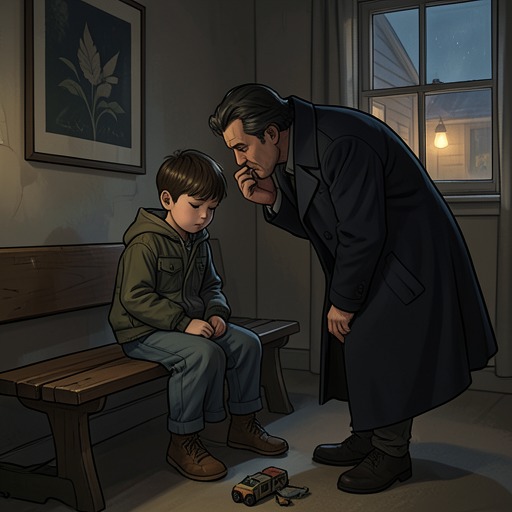
Martin’s association with a fair and a Ferris wheel is woven into Victoria’s memories of the day he went missing. He had wanted to ride the Ferris wheel; the recollection ties that wish to the jetty at the Fyris River and to Victoria’s shame at having lost him. In a later account, she remembers leaving him alone by the river for five minutes. She cannot establish exactly what happened during that interval, and the remembered possibility of an accident remains alongside the possibility that it was not one. The brevity of the absence does not lessen its consequence: in her retrospective understanding, five minutes were enough for everything to fall apart.
A child’s-eye account shows Martin alone at the jetty, watching boats and waiting for Victoria. Three boys from school approach. They are larger and stronger than he is, and he is frightened of them. One taunts him about a river monster. Martin’s fear makes his body go stiff, as if stillness might protect him. The boys hold him between them and swing him back and forth like a hammock; as they let go, he looks up and sees a star. This account gives the bullying its own physical sequence, rather than treating Martin’s death as an abstract accident. It also keeps the narrative close to his vulnerability: the person who should be returning to protect him is absent, and he has to face the boys alone.
Victoria’s recovered memory supplies a more disturbing account of her own actions. She sees the newspaper clipping that had reported a nine-year-old boy found dead in the Fyris River, a story she had reread for years and knew by heart. This time, the clipping provokes unease rather than the sadness she expects. In the recollection that follows, the laughing face before her becomes associated with her father’s eyes; overwhelmed, she attacks, fetches a large stone from the riverbank, and says, “It isn’t me” before letting the body sink into the water. Later, Sofia Zetterlund’s notes make the connection explicit: Victoria struck Martin on the head with a stone and put him in the water, while the police recorded his death as accidental. The narrative places this memory beside the boys’ assault without offering a tidy reconciliation of the accounts.
Memory, Guilt, and Return
Martin survives in Victoria’s memory less as a continuous biography than as a series of vivid objects and scenes. Alongside the letter and photograph, her recollections include him on the Ferris wheel, the jetty, and the shame that follows losing him. When she searches through her stored papers, the names carved into her desk mean nothing to her; Martin’s is the one name that still does. She remembers meeting him when he was three, and remembers that the first time he took her hand he did so without wanting anything more. That gesture gives their bond a rare tenderness, sharply unlike the violence and exploitation that shape other parts of her past.
The consequences of Martin’s disappearance recur years later. Victoria realizes she has not gone to a fair for three years, not since the day Martin went missing. She still thinks he may have fallen into the water, but does not know precisely what happened. Later, while looking through notes about her own life, Sofia reads that Martin vanished during a fair trip, was found drowned in the Fyris River, and that Victoria had struck him and left him in the water. The contrast between the official account and the recovered memory turns a familiar newspaper item into personal evidence. The repeated return to the clipping does not itself restore a complete past; it shows how a fact can be known and yet remain emotionally and psychologically inaccessible.
Martin also returns in a final, intimate childhood image: the water laps beneath the jetty as he curls close to Victoria, and she calls him her little boy. The scene recalls the care she once learned to give him without pretending that care cancels what followed. By the novel’s later recollection, Victoria understands that she left Martin alone and that Crow Girl received her name down by the river. She is also sure that Crow Girl is not one of her personalities, though the flickering and blind spots she recalls suggest something else. Martin’s death is therefore bound not only to grief, but to the story’s unresolved account of how Victoria’s divided experience took shape.
Narrative Significance
Martin’s place in the story is defined by the gap between the child Victoria remembers and the dead boy described in public records. A photograph catches him smiling with a rabbit; a newspaper headline turns him into a nine-year-old found in a river; Victoria’s notes and memories attach to that record an act she had not been able to face clearly. These forms of evidence accumulate without making the past wholly transparent. Their differences preserve the uncertainty around the circumstances while establishing the central fact of Victoria’s responsibility and guilt.
His story also gives concrete form to Victoria’s contradictory relation to protection. She had learned to look after Martin, and he trusted her enough to take her hand and wait for her return. Yet the five-minute absence at the river becomes the measure of a failure she cannot put aside, and her recovered memory goes further than loss alone: she remembers striking him and letting him sink. Martin’s significance lies in that irreversible break between care and harm. The river holds both the remembered refuge of Victoria’s childhood swimming and the place where Martin disappeared, so that the setting of their first bond becomes the setting of its ruin.