Per-Ola Silfverberg
Crow GirlPer-Ola Silfverberg is a wealthy foster father whose claim to have cared for the children in his household sits uneasily beside the accusations against him and Madeleine’s recollection of his abuse. His history reaches beyond his family: he appears in a Danish investigation, in the work of the Sihtunum i Diasporan foundation, and in a circle of men who helped organize projects involving adopted children. His murder by Hannah Östlund and Jessica Friberg makes him both a victim in the present investigation and a figure whose earlier conduct demands scrutiny.
Identity and Public Position
Per-Ola is married to Charlotte Silfverberg and was Madeleine’s foster father. He is presented as a man with money, a place in an influential social network, and enough standing to have a lawyer present when he was interviewed in Denmark. That position gives him access to institutions and resources that the children connected to him do not appear to possess. The narrative gradually sets his public authority against the private experiences and allegations that the adults around him dismiss or obscure.
He is also one of the men associated with the Sihtunum i Diasporan foundation. In Annette Lundström’s account, Per-Ola and Viggo Dürer handled practical matters while Karl Lundström and Viggo led the group. Annette describes the children as happy and well provided for, and recalls that the children, including Madeleine and the adopted children, were among those initiated. Her account offers a benevolent description of the organization, but the surrounding evidence makes that description difficult to accept at face value. The gap between the foundation’s charitable image and the children’s experiences is central to how Per-Ola’s role is reassessed.
The Danish Investigation
An earlier allegation against Per-Ola had been pursued in Denmark. In the follow-up interview, he denied the accusations and described his foster-daughter as having a vivid imagination. He also said that Madeleine had been abandoned by her biological mother shortly after birth and then placed with the Silfverberg family. The account was delivered in a formal setting: former police commissioner Gert Berglind conducted the interview, Kenneth von Kwist attended as prosecutor, and Viggo Dürer was there as Per-Ola’s lawyer. The Copenhagen police had requested von Kwist’s presence.
The interview’s details return when Jeanette Kihlberg questions von Kwist years later. He recounts the meeting smoothly and without checking notes, including Per-Ola’s denial and his claim that his foster-daughter’s accusations were imaginative. Jeanette notices that the prosecutor seems to be repeating a prepared story and asks whether there had been good reason to believe Per-Ola. Von Kwist says he remembers the interview exceptionally well; his confidence does not resolve Jeanette’s concern about the outcome.
Per-Ola and Charlotte left Denmark after he was released. Jeanette considers their departure suspicious, though that circumstance by itself does not establish guilt. His account of Madeleine’s childhood also acquires a different weight as Jeanette encounters documents describing her placement in a family home and a note that characterizes her accounts of a farm in Jutland as recurrent delusions. What had been recorded as a reason to doubt the child now reads as part of the history through which adults’ claims could displace hers.
Family Life and the Foundation
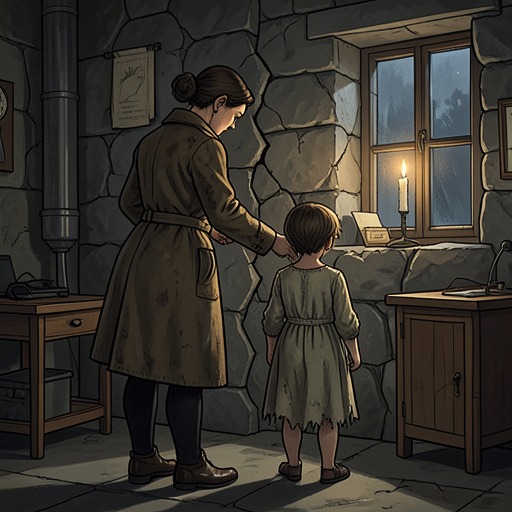
Per-Ola’s conduct as a foster father is marked by a conflict between care and control. In Madeleine’s memory of a beach outing, he sits close to her, runs a hand down her back, and applies sunscreen. He asks her to turn over; she pretends to be asleep and does not respond. The scene does not present care as uncomplicated kindness. His ordinary gestures take on a troubling meaning because Madeleine is trying to avoid his request while remaining in his presence.
A film watched by Jeanette shows Per-Ola seated with Charlotte, who holds a small child Jeanette takes to be their foster-daughter Madeleine. Hannah Östlund, Jessica Friberg, and Fredrika Grünewald are also present, along with a man whose profile appears at the edge of the image. The footage gathers several people later connected to the cases in one frame. It gives the investigation a material record of their association, while leaving the meaning of the gathering to be reconstructed from other testimony and evidence.
Annette’s recollection further places Per-Ola among the adults who arranged the practical side of the foundation’s activities. She says that he and Viggo made sure the children were happy and had what they wanted, while describing the women as less important and the children as participants in the initiation. Her understanding is compromised by her later-described psychosis, so her statements are not a straightforward account. Even so, Jeanette and Jens Hurtig recognize patterns in what she says, and her list of people expected at Polcirkeln brings Per-Ola into a wider network that includes Charlotte, Madeleine, Karl, Linnea, Gert, Fredrika, and Viggo.
Madeleine’s Account and the Offer of Money
When Madeleine reveals who her father was, Per-Ola responds in a way that suggests he understands what she is confronting him with. He begs her forgiveness and offers money. To Madeleine, the offer is inadequate: his fortune cannot compensate for what he did. The contrast is stark. Money is the resource Per-Ola can readily put forward, but Madeleine does not accept it as a meaningful substitute for accountability or repair.
That encounter changes the significance of his earlier claims about a vivid imagination. In the interview, those claims helped cast doubt on the foster-daughter; in Madeleine’s recollection, his plea for forgiveness and offer of compensation acknowledge a history for which money cannot make amends. The narrative does not treat his remorse as erasing the harm. It places the apology beside the abuse and the earlier failure to credit the child, leaving the attempted reconciliation unresolved.
Murder and the Investigation
Per-Ola is killed after a woman has spent nearly two weeks tracking Fredrika Grünewald to a shelter in the crypt beneath a church. The narrative first recounts Per-Ola’s death from the attacker’s perspective: he has let her into his home and is described as trusting her too readily. She photographs him with a Polaroid camera. The account’s focus on his invitation and her camera makes the scene part of a larger pattern of killings, rather than an isolated crime; Jeanette has already noticed yellow tulips and an attached card in Fredrika’s tent, details that draw her attention back toward the Silfverberg family.
The police investigation eventually identifies Hannah Östlund and Jessica Friberg as the people who killed Per-Ola and Karl Lundström. Jeanette tells Sofia Zetterlund that the two women also killed the homeless woman in the cavern and have since died by suicide. Before that identification, Sofia wonders whether Madeleine may have been involved, connecting the deaths to her own history and fearing that she might be next. Jeanette’s account corrects that suspicion, although Sofia cannot immediately reconcile the news with her memories of Hannah and Jessica.
The investigation also links Per-Ola to information about a half-million kronor deposited in Annette’s bank account, which Jeanette suspects may have been a bribe, though its source has not been traced. Sofia had told her that Ulrika Wendin had substantial cash and suggested that Dürer might be behind it. Separately, a letter from Karl to Linnea and Linnea’s childhood drawings raise the possibility that Dürer was a paedophile. These clues do not establish Per-Ola’s responsibility for the money or for Dürer’s conduct, but they place his name within an investigation of relationships, payments, and allegations that extend beyond the household.
Narrative Significance
Per-Ola’s character is built through competing records: his denial in an official interview, Annette’s account of a benevolent foundation, Madeleine’s memories, a film that places him among the other adults, and the police reconstruction of his murder. None of these sources has identical authority. Annette’s statements are affected by psychosis; Per-Ola’s interview is self-exculpatory; Madeleine’s recollections reveal what the official account excluded. The reader must therefore follow the shifts in who is speaking and whose version of childhood the institutions accept.
His story also exposes the limits of apparent protection. Per-Ola and the other adults could describe the children as cared for, included, or imaginative, while the investigation later uncovers abuse and a network in which powerful men had practical and organizational roles. His murder does not settle the history or restore what Madeleine lost. Instead, his death forces the investigation to connect the visible crime to the older failures that allowed children’s accounts to be discounted, and leaves Madeleine’s rejection of money as compensation as the clearest measure of what his power could not repair.